


Central vacuum system cost usually falls between $800 and $3,500 for a professionally installed setup, with most homeowners spending $1,094 to $2,194 and an average around $1,583. If you're tired of dragging a heavy vacuum up stairs or around a North Atlanta house with multiple levels, those numbers give you a realistic starting point before you call anyone for a quote.
A lot of homeowners start with the same frustration. The vacuum works, but the cord is never long enough, the canister is awkward, and the dust seems to settle right back into the rooms you just cleaned. That's why central vacs stay popular in bigger homes and in renovation plans, especially when people want a cleaner routine without hauling equipment from room to room. For a general sense of how housekeeping budgets compare, you can also look at this average cleaning service cost guide, since many homeowners compare whole-home cleaning costs before adding another home-care expense.
The useful part of learning the price early is simple. It helps you separate the cost of the system itself from the cost of the labor, and that's where most confusion starts. A basic install in a new build can look very different from a retrofit in an older Cobb, Cherokee, Fulton, or DeKalb home, and the final bill usually tracks the layout more than the brand name. Once you understand the moving parts, you can budget with confidence instead of guessing.
Introduction to Central Vacuum Costs
A central vacuum system sounds like a luxury until you watch someone clean a long hallway with a heavy upright and a tangled cord. In a North Atlanta home, that daily hassle is often what pushes people to look at built-in systems, especially when stairs, pets, and larger square footage make portable vacuums feel more like a chore than a tool. The surprise for many homeowners is that the price is less mysterious than it first seems.
The core numbers are straightforward. Professionally installed systems usually run from $800 to $3,500, with most homeowners landing between $1,094 and $2,194 and an average around $1,583 according to major U.S. guides (Angi). That range gives you the broad market, but the primary question is where your home fits inside it.
A small, simple setup can stay near the low end. A finished home with long pipe runs, more inlets, or hidden-hose hardware tends to move upward fast, because labor and routing complexity matter more than the vacuum motor alone.
Practical rule: if a quote only talks about the machine and ignores the wall work, it's not a real budget yet.
The rest of this guide walks through the pieces one by one, so you can see what's worth paying for, where the hidden premiums live, and how to compare bids from North Atlanta installers without getting lost in jargon. If you've been putting this off because the pricing feels fuzzy, the sections below break it into plain home-owner language.
Understanding Central Vacuum Components and Pricing
A central vacuum system is built from a few main parts, and each one affects the final price in a different way. The power unit is the motor that creates suction. The hidden piping network carries debris through the house. The inlet valves are the wall openings you connect to, and the hose kit is the part you move from room to room. Once those pieces are separated, the quote becomes easier to read because you can see where the money is going.
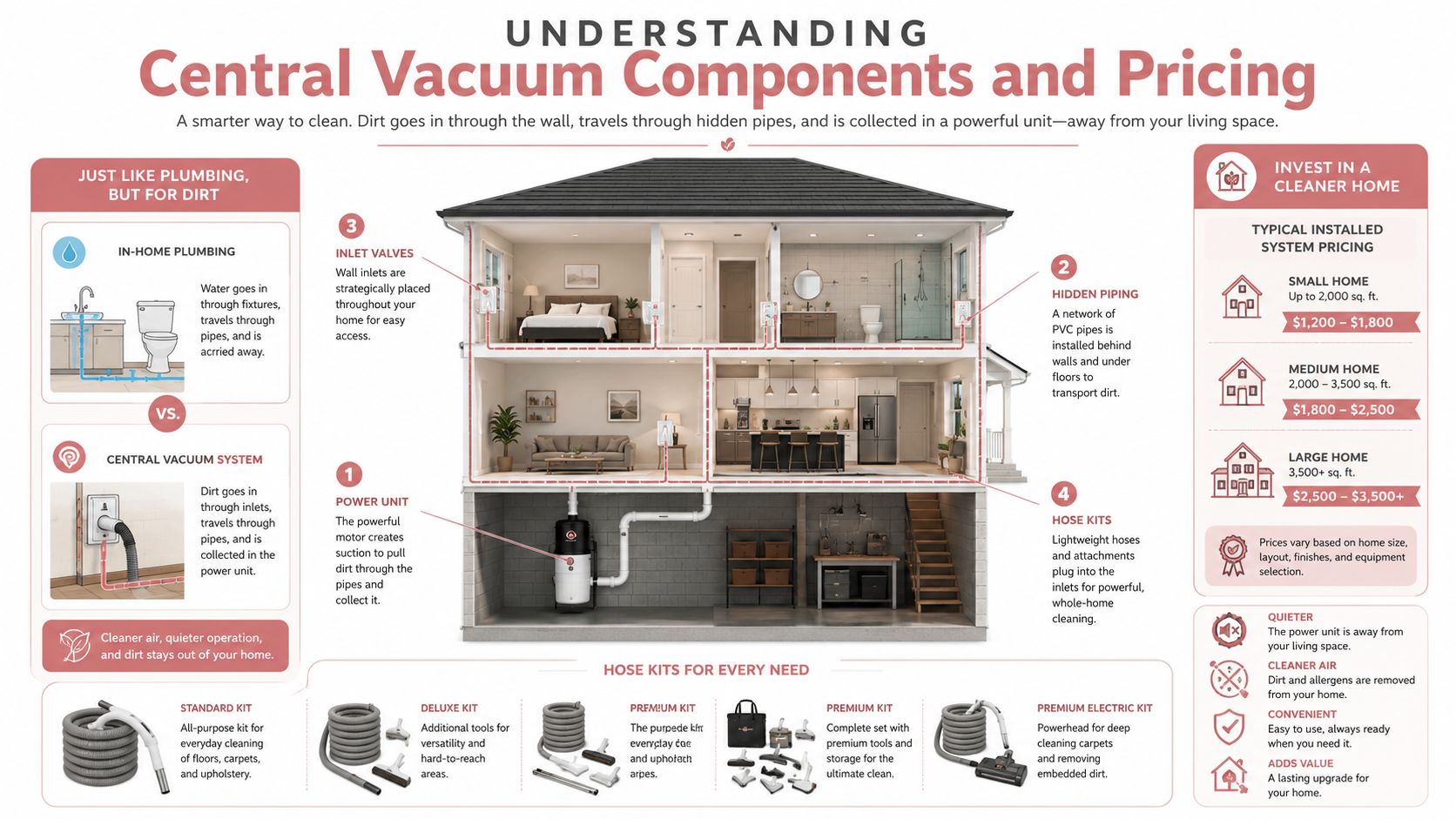
The hidden parts usually create the biggest price changes. Two homes can look similar from the outside and still land at very different totals if one needs more wall access, longer pipe runs, or extra inlet points. In North Atlanta, that difference can grow during retrofit work, since finished basements, tight attic routes, and older framing often add labor that national cost articles tend to gloss over. The machine itself may be straightforward, but the path it has to travel through the house is what often moves the bill.
What Each Component Really Does
The power unit is the engine of the system. Component-level market data places that piece around $500 to $1,500, while piping and fittings usually run $300 to $800 and attachment kits about $150 to $550 before labor is added (CentralVac). That breakdown makes the quote easier to interpret. You are not buying one appliance, you are paying for a set of parts that have to fit together inside the home.
The most useful budgeting approach is to separate equipment from installation. Major U.S. guides place professionally installed systems at $800 to $3,500, with about $400 to $2,000 for equipment and $400 to $1,500 for installation (HomeGuide). That split matters because a homeowner can choose a midrange unit and still end up with a higher bill if the home layout is harder to work through. A clean, open route is one thing. A retrofit that has to avoid finished walls is another.
A quote should tell you what is being supplied, what is being installed, and how much wall access the job needs.
For a quick local comparison, it helps to treat the system like a built-in appliance with hidden carpentry work behind it. Homeowners comparing convenience features in other cleaning products often approach the decision the same way, which is why the AquaBot product page can be a useful reference point for how people weigh ease of use against upfront cost.
Breaking Down Equipment and Installation Expenses
A quote for central vacuum system cost makes more sense once you separate the parts from the labor. The equipment is the hardware you can point to, while installation covers the work hidden inside the home, such as routing, wall access, and cleanup. For homeowners, that split is like seeing both the price of cabinets and the carpentry needed to fit them into a kitchen. The sticker price is only part of the bill.
| Component Cost Breakdown | Cost Range |
|---|---|
| Power unit | $500 to $1,500 |
| Piping and fittings | $300 to $800 |
| Inlet kits | $150 to $550 |
| Contractor labor | $400 to $1,500 |
These ranges reflect component-level pricing and help explain why two homes with similar square footage can still produce very different bids (CentralVac). One house may need a straightforward run with short pipe distances. Another may need extra inlets, longer routing, or more careful work around framing and finished surfaces.
A practical way to read the numbers is to start with the machine, then add the hidden work. If you choose a basic power unit and a standard hose setup, the equipment side stays easier to control. If the installer has to hide more of the system inside finished walls or add access points in awkward places, the labor rises even when the vacuum itself stays the same.
Why Labor Can Cost More Than People Expect
The equipment is the easy part to compare, because it is visible on the estimate. Labor is where the installer spends time cutting access points, running piping through framing, and closing everything so the home still looks finished. That is why the labor line can vary more than the equipment line.
For North Atlanta homeowners, retrofit work often carries a hidden premium because finished walls, trim, and attic or crawlspace layouts can make the job slower. A house with open framing gives the installer a clear path, while an older finished home may require more careful routing and patching. If you are comparing bids, a lower total is only useful if it includes the same inlets, attachments, and routing choices as the higher one.
The same kind of access-driven pricing shows up in other home services too. A useful comparison is this AC duct cleaning cost guide, where the final price also depends on how easy the system is to reach, not just on the equipment involved.
Factors That Influence Central Vacuum System Cost
Two houses can look similar on paper and still produce very different estimates. The biggest split usually comes from whether the installer is working in new construction or fitting the system into a finished home. In a new build, the piping and inlet locations can be planned before the walls are closed, so the work stays cleaner and often costs less.
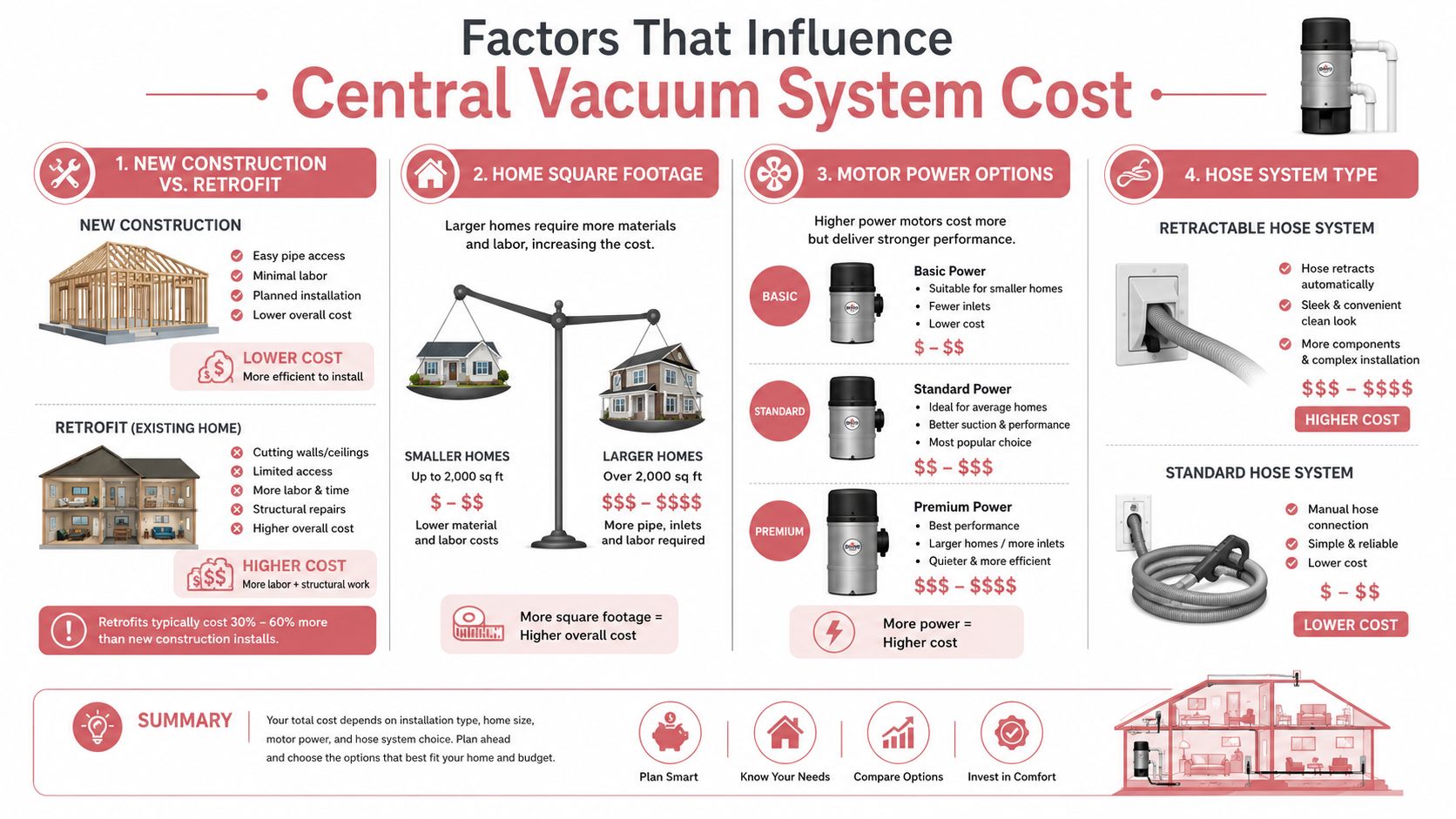
A retrofit is more like adding plumbing to a house after the drywall is painted. The installer has to work around trim, finished walls, attic access, and crawlspaces already in place. That extra effort is why the house itself often matters more than the vacuum unit on the quote.
New Build or Retrofit
New construction installs usually fall on the lower end because the home is still open and easier to route through. Retrofit jobs are often higher because existing walls may need to be opened, routes may have to bend around obstacles, and cleanup takes longer. For North Atlanta homeowners, that gap is one of the clearest reasons estimates can spread apart so much, even before equipment choices enter the picture.
A simple way to picture it is this. If the installer is working while the framing is still visible, the tubing can usually be placed with less interruption. If the home is already finished, every hidden path becomes a small puzzle, and each puzzle adds labor.
Home Size and System Style
Larger homes usually need more inlets and longer pipe runs, so the project naturally moves toward the higher end of the range. The layout matters too, since a home with several floors or a harder-to-reach basement may need more planning than a compact floor plan.
System style changes the total as well. A standard hose setup is usually easier to price because the parts and routing are straightforward. A retractable Hide-A-Hose system adds convenience, but it also adds materials and installation complexity, which can raise the installed total into a higher bracket (CentralVac). That is similar to choosing a built-in storage solution instead of a simple shelf, the extra convenience comes with extra work behind the scenes.
What Else Pushes the Price Around
Small choices can move a quote more than homeowners expect. The number of inlets, the type of hose package, the path the piping has to follow, and whether the installer has easy access from an attic or crawlspace all affect the final bill. A system that looks simple from the room level may still require careful routing behind walls.
Material and service preferences matter too. Some homeowners want a setup that supports a quieter routine or a more eco-friendly approach to cleaning, which can influence which equipment package feels worth paying for. The main point is that cost is not just about buying a vacuum, it is about how the whole system fits the house and the way the home is built.
For a broader look at the household side of that choice, the eco-friendly cleaning option page offers a useful comparison point.
Maintenance Costs and Return on Investment
A central vacuum system makes the cost conversation easier once you look past the installation day. The upfront price is higher than a portable vacuum, but the value is tied to how the system works inside the house, where it stays put instead of being dragged from room to room, tipped over, or replaced as often. For many homeowners, that makes it feel less like a single appliance purchase and more like a comfort upgrade built into the home.
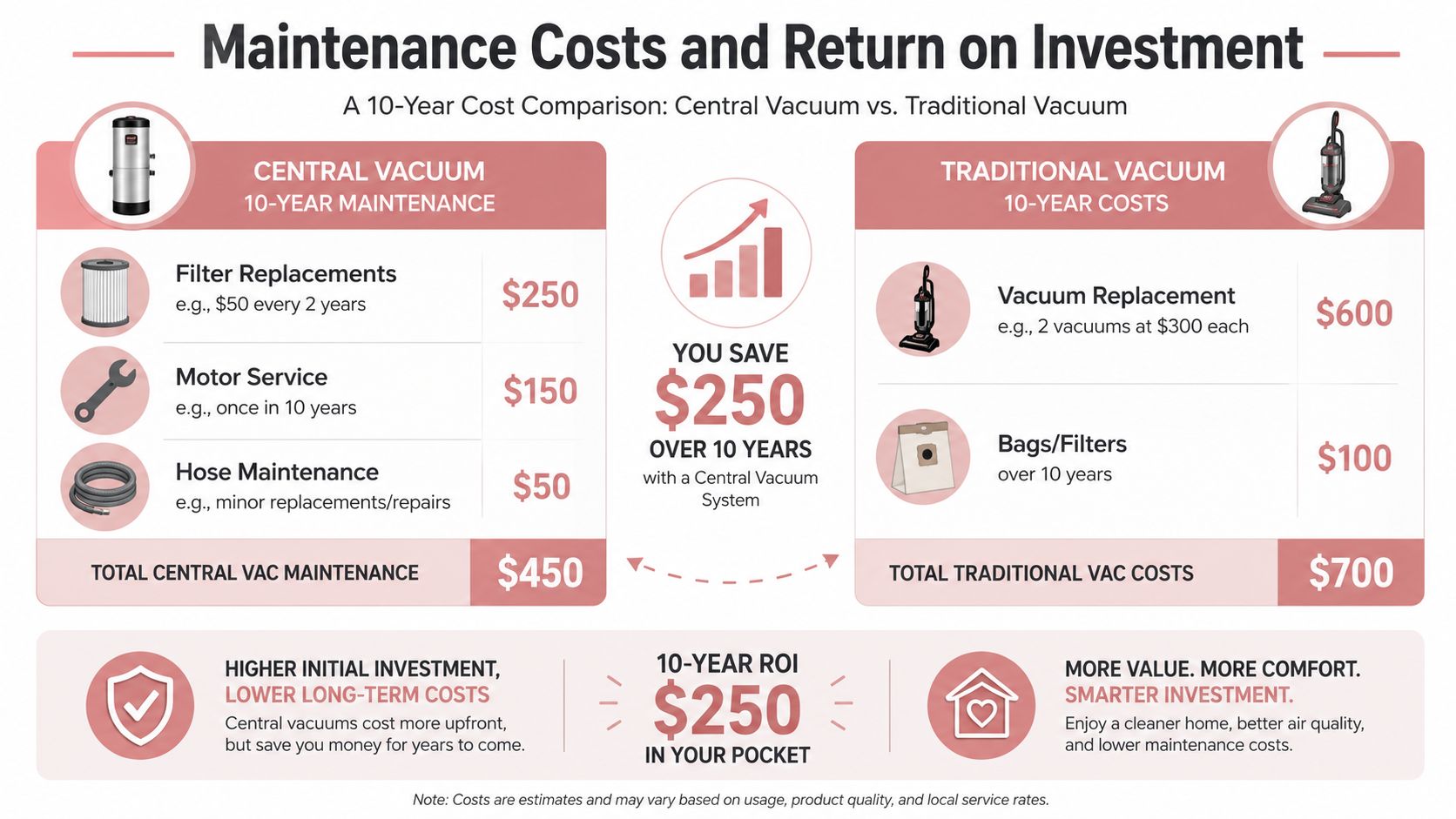
The starting price still shapes the return. A typical installed system often includes equipment and installation costs that can vary widely, and retrofit work in an existing home usually lands higher than a new-construction install because the piping has to be fitted around finished walls, flooring, and access points. That matters in North Atlanta, where older homes, attic layouts, and crawlspace access can change the labor needed from one house to the next.
What Owners Usually Keep Paying For
Ongoing upkeep is usually manageable, but it is not zero. Filters, bags, hose wear, and occasional motor service are the main items homeowners should expect over time. A bagged system can feel closer to replacing small household supplies than maintaining a major machine, while a bagless setup may shift more of the work to filter care and emptying the canister.
The time savings matter too. Portable vacuums need to be moved, plugged in, and emptied every time you clean. A built-in system removes some of that friction, which is why the value shows up in daily use, not only in resale talk.
Practical rule: the cheapest system on day one is not always the cheapest system to live with.
Indoor air can also be part of the return. If you want fewer dust clouds and less material recirculating while you clean, a guide to reducing allergens at home gives helpful background for households that are comparing cleaning methods.
Why ROI Feels Different in Real Homes
ROI here is not just a resale number. It also shows up as less effort in your weekly routine, fewer bulky machines to store, and a cleaning setup that works better in a larger or busier home. Families with pets, kids, or multiple floors usually notice that convenience first.
A good way to judge the return is simple. Will the system make cleaning easy enough that you use it more often? For many North Atlanta households, the answer is yes, and that steady day-to-day use is where much of the return comes from.
Choosing Installers in North Atlanta
A good installer is the difference between a neat, quiet system and a job that feels patched together. In Cobb, Cherokee, Fulton, and DeKalb counties, you want someone who can explain the route, the inlet placement, and the finish work without making the process feel vague. The quote should read like a plan, not a guess.
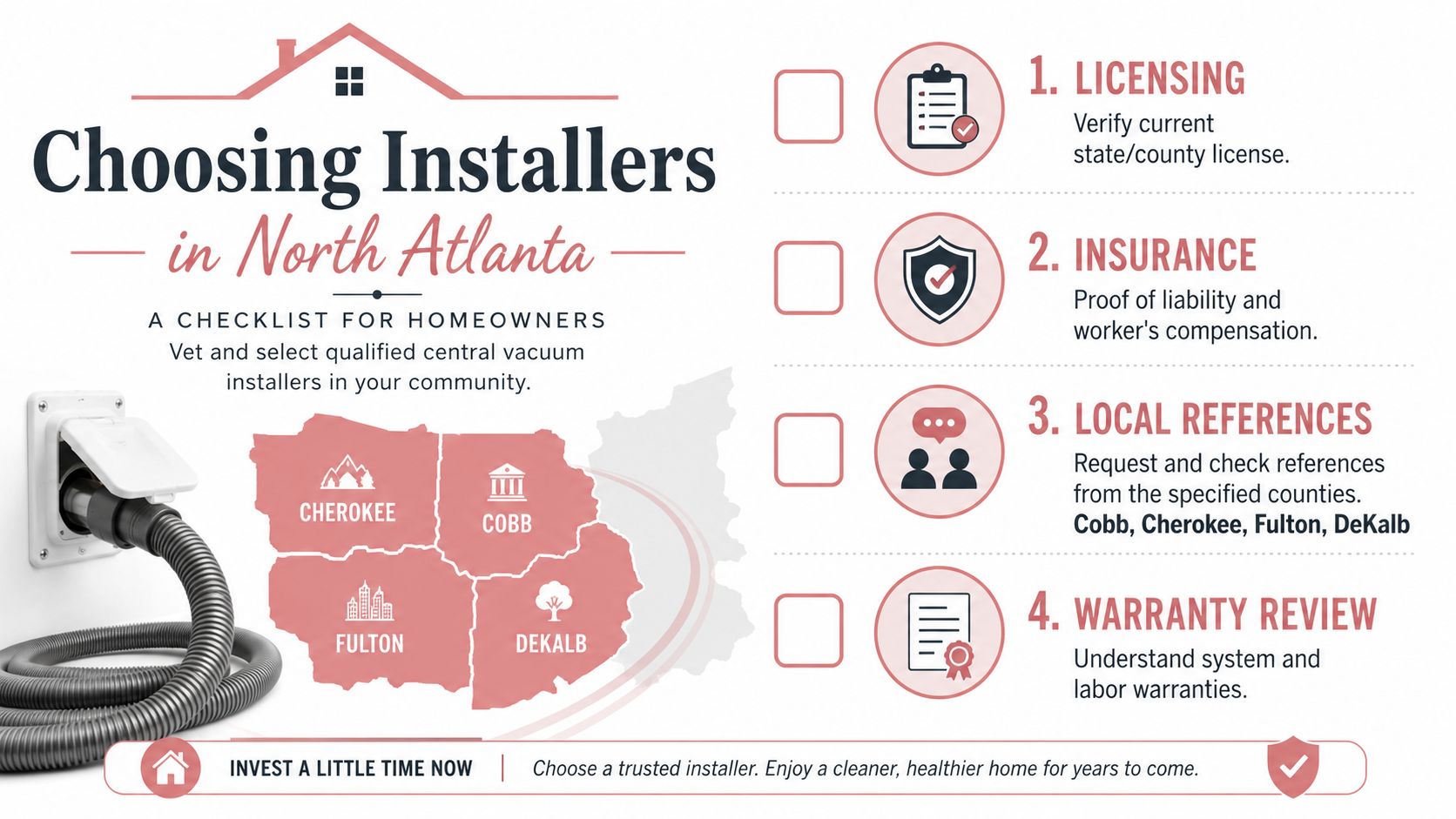
Local references matter more than most homeowners realize. A crew that has worked in nearby homes already understands attic access, crawlspaces, older trim, and the small finish details that turn into big problems if they're ignored.
What to Verify Before You Sign
- Licensing: Verify current state or county licensing, and ask who will do the work.
- Insurance: Request proof of liability coverage and worker's compensation, so you're not exposed if something goes wrong.
- Local references: Ask for recent references from Cobb, Cherokee, Fulton, or DeKalb homes, not just generic testimonials.
- Warranty review: Read both the system warranty and the labor warranty, because they can cover different things.
Multiple quotes help you identify the actual market price. If one bid is far below the others, ask what was left out. Low pricing can hide weaker piping, fewer inlets, poor trim restoration, or a hose setup that won't fit the way you planned.
A clear installer explains where the pipes go, how the walls will be closed, and what the final finish will look like.
If you're comparing eco-conscious options, ask whether the installer offers products that fit your household priorities. Families in North Atlanta often want a solution that's convenient, but also aligned with cleaner indoor living and low-maintenance upkeep. The best contractors answer those questions plainly, without pushing you into a more expensive setup you don't need.
Real World Cost Examples
A North Atlanta couple with a 1,800-square-foot new build planned for three inlets and a standard hose system. Because the house was still open for work, the installer could route piping before the walls were fully finished, which kept the job closer to the lower end of the market. The couple chose a straightforward layout and avoided retractable hardware, which helped keep the invoice controlled.
A different homeowner in a 2,200-square-foot vintage house faced a much messier retrofit. Hidden studs, trim removal, and routing around finished spaces all added labor, and the choice of retractable hoses raised the complexity further. That kind of job can move into the higher retrofit bands, and professional retrofits often range from $2,000 to $4,000, with complex jobs hitting $3,500 to $6,500 when inlet count, wall access, and hose-hide systems pile on (MyCentralVacuum).
The contrast is the lesson. The first home was priced mostly by planning. The second was priced by problem-solving inside an existing structure. In both cases, homeowners controlled costs by choosing the right hardware for the house rather than chasing the fanciest option.
A helpful way to think about it is this. New construction rewards clean planning, while older homes reward careful compromises. If you're renovating anyway, that's often the moment to ask an installer to quote the system alongside the rest of the project so the labor overlaps instead of repeating later.
Key Takeaways and Next Steps
The smartest budget starts with the right frame. Central vacuum system cost is usually driven more by installation complexity than by the vacuum unit alone, so a quote should always separate equipment, labor, and the house layout. That's especially true in North Atlanta, where older homes, finished interiors, and retrofit work can change the price quickly.
Use this checklist before you compare bids.
- Set a realistic budget: Start with the installed market range and then adjust for your home's layout.
- Prioritize core components: Decide whether a standard hose system is enough or whether hidden-hose convenience is worth the premium.
- Account for retrofit work: Finished walls, trim, and added inlet points can raise labor more than most homeowners expect.
- Plan for maintenance: Build in the small ongoing costs so the system stays easy to live with.
- Vet installers carefully: Licensing, insurance, references, and warranty terms all matter.
If you're already planning a remodel, that's the best time to ask for a central vacuum quote. The installer can often work alongside other trades, which may reduce disruption and give you a cleaner final result. For older homes, that timing can make the difference between a straightforward install and a much more expensive retrofit.
A CTA for Aquastar Cleaning Services, LLC.