


You're standing in a bathroom with a chalky faucet ring, cloudy shower glass, and a kettle that leaves your tea tasting flat. That's exactly where citric acid cleaning earns its place, because it tackles the mineral mess hard water leaves behind without the sharp smell that pushes a lot of people away from vinegar. Used well, it's a practical powder for limescale, soap scum, stainless shine, and deodorizing jobs that need an acid, not a harsh scrub.
The key is knowing what it does well and what it doesn't. Citric acid is excellent on mineral buildup, but it isn't a magic sanitizing shortcut, and it shouldn't be treated like one. If you want a cleaner that feels simple, works fast on scale, and stores easily in a dry jar, this one belongs in the caddy, especially if you already prefer eco-friendly routines like those described in this low-tox cleaning overview.
Why Citric Acid Belongs in Your Cleaning Caddy
A bathroom tells on hard water fast. You wipe the faucet, and the white crust comes right back. You scrub the shower door, and the film still catches the light. Then the kettle hisses, and the inside looks like someone dusted it with chalk. That's the kind of week-in, week-out mess where citric acid earns its keep.
Mineral problems need an acid
Citric acid is a weak organic acid, but that's exactly why it works so well on scale. It doesn't just smear grime around, it helps break down mineral deposits so they can rinse away, and its chelating behavior is what makes it effective on calcium and magnesium buildup. The history matters here too. Citric acid was first isolated from lemon juice in 1784 by Carl Wilhelm Scheele, and industrial fermentation was later developed through the work of C. Wehmer in 1893 and James Currie in 1917, which is why the powder is now widely manufactured and consistent enough for everyday use (source).
That shift from fruit-only extraction to industrial production is what made modern citric acid cleaning practical for homes. It's no longer a specialty ingredient you save for one odd job. It's a shelf-stable powder you can use on sinks, kettles, faucets, and shower parts when scale is the problem, not grease.
Scale and soap scum are mineral problems, not grease problems.
You'll still need a different product for some tasks, especially anything that needs actual disinfection or heavy degreasing. But for the everyday hard-water film fought in kitchens and bathrooms, citric acid is one of the simplest tools around.
How Citric Acid Actually Works on Dirt and Scale
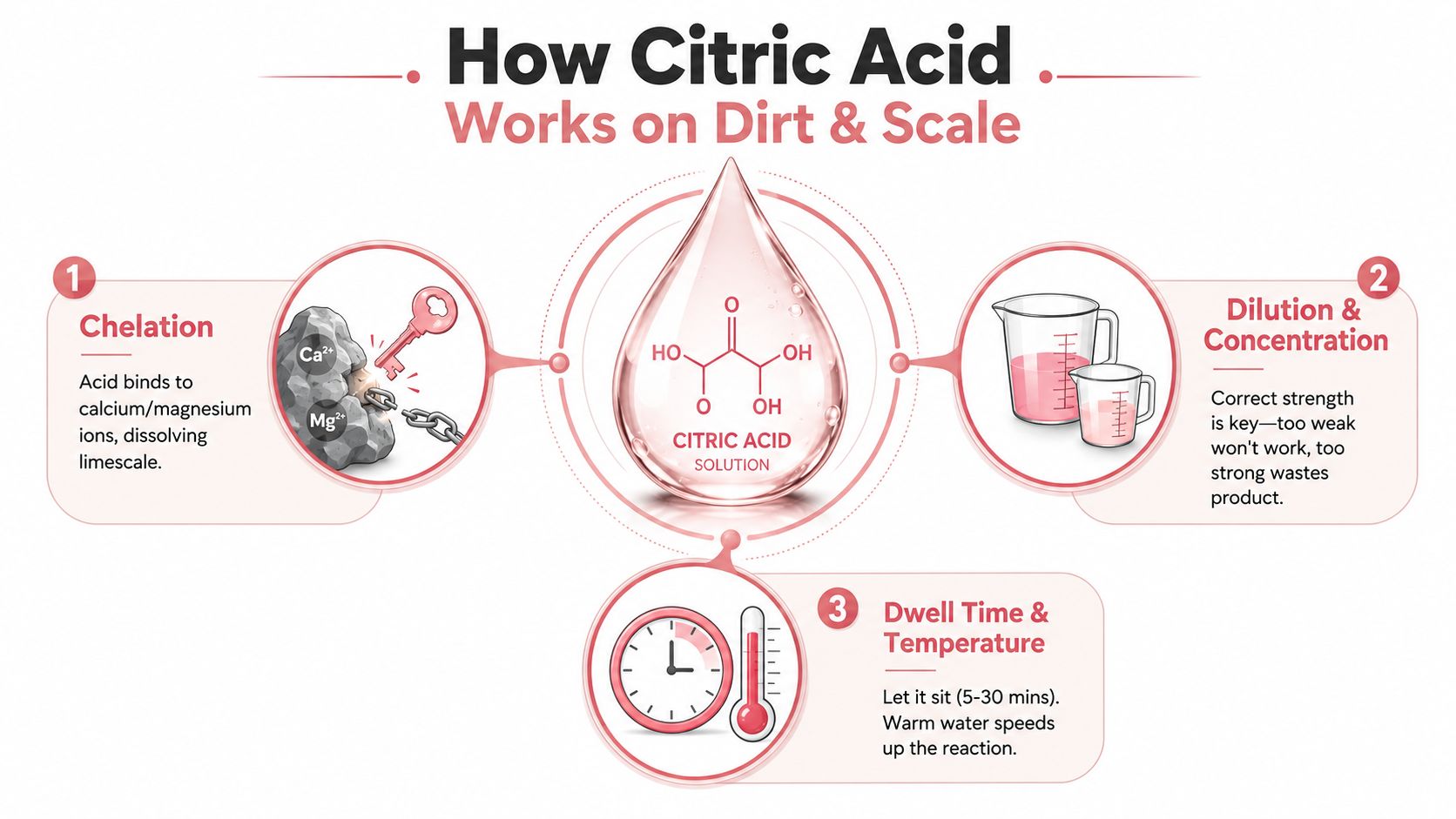
Citric acid works because it grabs the minerals that make scale stick. Calcium, magnesium, and rust ions get pulled into solution instead of clinging to the surface, so the deposit loosens and rinses off. Warm water speeds that process up, and the right dilution matters more than people expect.
The chemistry in plain English
Think of limescale like glue made from minerals. Citric acid doesn't “scrub” that glue off, it binds to the ions that hold it together and helps the deposit leave the surface. That's why a kettle or showerhead often looks dramatically better after soaking, even when the cleaner itself never touched a brush.
The ingredient's modern rise also explains why it's easy to use at home. Once industrial fermentation made it cheap and scalable, citric acid moved from fruit-based novelty to a common raw material. One cited source says the price fell from $1.25 to $0.40 per pound in about five years, and that by 1930 roughly 90% of citric acid was reportedly produced by fermentation rather than direct fruit extraction (source). That cost collapse is part of why it ended up in everyday cleaning routines.
If the stain feels gritty and chalky, you're usually dealing with minerals, not dirt.
That distinction changes the product choice. A greasy backsplash needs soap or a degreaser. A cloudy kettle or crusted faucet usually needs acid, contact time, and a thorough rinse. The better you understand that, the less you'll over-scrub and the fewer products you'll need to keep around.
Compare mineral removal and deeper scale cleaning
The Core Dilution Chart Every Recipe Builds On
The safest habit is simple. Always add citric acid to water, never the reverse, and use warm water so the powder dissolves faster. For wiping and spray jobs, I keep one mental model. For soaking and descaling, I move up in strength and let the surface sit long enough to do the work.
Citric acid dilution guide
| Strength | Mix Ratio | Best For | Dwell Time |
|---|---|---|---|
| Light | 1 tablespoon per 1 cup of hot water | General wipe-downs, light shine work | Brief wipe or short contact |
| Routine | 1% to 2% | Everyday detergent-type cleaning | About 15 to 30 minutes if needed |
| Kettle scale | 3% to 5% w/v | Kettle scale and similar mineral buildup | Soak, then rinse well |
| Heavy deposits | 5% to 10% w/v | Stubborn mineral crust and heavy buildup | 15 to 30 minutes or longer if needed |
That chart is the backbone of almost every citric acid job. A spray bottle works well for sinks and fixtures, while a bowl, basin, or kettle soak makes sense when you need full contact. For critical surfaces, the final rinse matters just as much as the cleaner itself, and distilled or deionized water is the safer follow-up where residue would be a problem.
Match the strength to the mess
A weak mix is fine for fresh residue and light maintenance. Push the concentration only when you're dealing with deposits that have clearly built up over time. If you jump straight to the strongest mix for every job, you waste product and still won't fix the core issue, which is usually contact time.
See how citric acid compares with other acid cleaners
Room by Room Recipes That Actually Work
Kitchen sinks get a dull film on the basin and a chalk ring around the tap base. A 1 tablespoon per 1 cup of hot water spray handles the stainless well, as long as you wipe, then rinse, instead of letting it dry on the surface. For the ugly little crust at the faucet base, I like a thicker paste on a cloth, rubbed around the seam, then wiped clean with fresh water.
Bathroom glass and tile respond best when the buildup is still mineral, not mold. A showerhead can sit in a bag filled with citric solution and tied around the fixture with a rubber band, and that's often enough to clear the spray holes without heavy scrubbing. For soap scum on tile and grout, a stronger solution works better, but you still need a rinse, because leftover acid just invites streaking.
Practical rule: If you can feel residue after the clean, you didn't finish the job.
For toilets, citric acid is useful for the waterline ring and light limescale. Pour it in last thing at night, let it sit undisturbed, then brush and flush in the morning. Laundry is simpler, add 1 to 2 tablespoons to a wash cycle when detergent residue or hard-water dullness is the issue, and let the rinse cycle carry the loosened film away.
Always keep the chemistry honest. Never mix citric acid with bleach or ammonia. That warning matters more than the recipe itself, especially in homes where people reach for whatever bottle is closest.
See related bathroom cleaning guidance
Descaling Appliances With the Right Dose
Appliances are where dose and contact time matter most. A kettle with visible scale needs a different approach than a coffee maker with stale mineral buildup, and both need more patience than a quick countertop wipe. The simplest way to avoid mistakes is to match the appliance to the exact method and rinse steps.
Appliance descaling quick reference
| Appliance | Citric Acid Dose | Water Volume | Contact / Cycle |
|---|---|---|---|
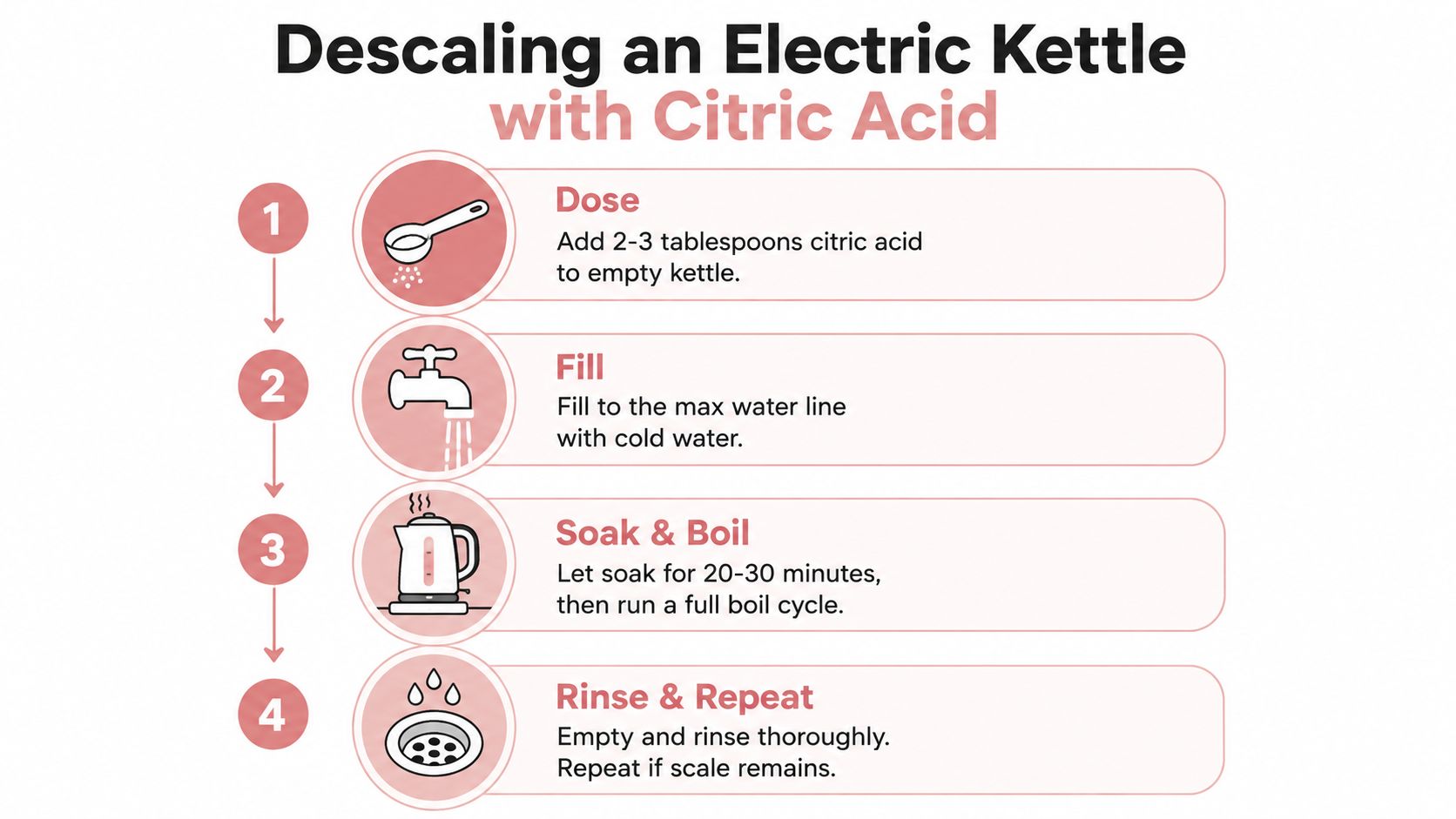
| Kettle | 2 to 3 tablespoons | Fill to the max line | 20 to 30 minute soak, then boil and rinse |
| Coffee maker | 2 teaspoons | 1 quart of cold water | Full cycle, then two plain-water cycles |
| Washing machine | 1/2 cup | Empty drum, hot cycle | One full hot cycle, then wipe the drawer |
| Dishwasher | 3 to 4 tablespoons | Empty machine | Hot empty cycle |
For kettles, I use the dose, fill to the max line, let it sit, then run one boil cycle and rinse the inside thoroughly. If scale is still visible, repeat rather than forcing it with a harsher mix. For coffee makers, the two plain-water cycles matter because they purge the acid and any loosened mineral film from the lines.
Washing machines and dishwashers are maintenance jobs, not miracle fixes. A hot empty cycle helps strip residue and scale, but you still need to wipe the dispenser drawer and check spray arms or seals if buildup keeps coming back. Persistent return usually points to water hardness or a neglected rinse path, not a bad cleaner.
See appliance-scale cleaning examples
Citric Acid vs Vinegar and Commercial Descalers
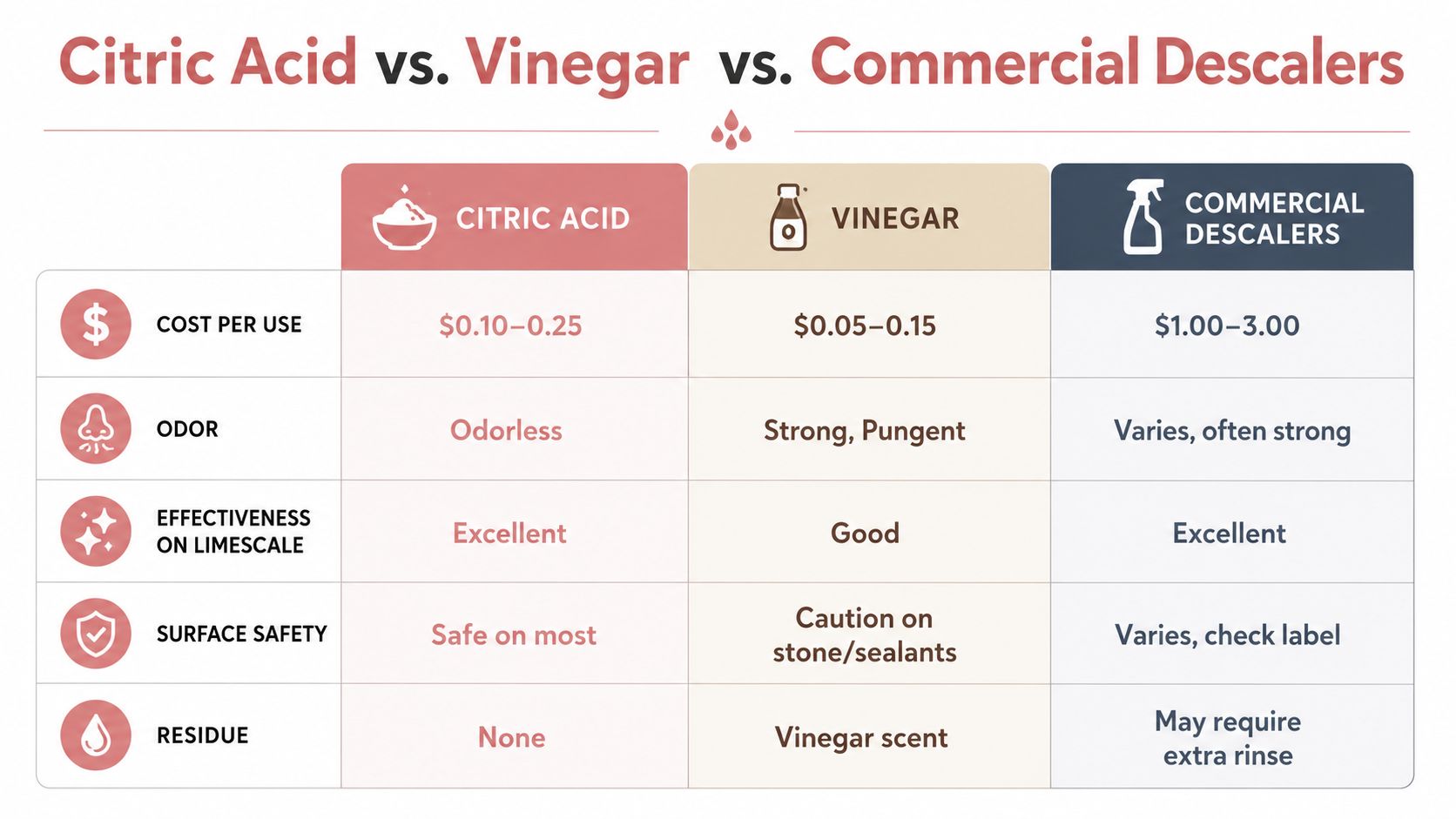
Citric acid is not automatically the cheapest option, and that's fine. Vinegar is often easier to buy and usually costs less per use, while commercial descalers can work quickly and sometimes include added surfactants. The better question is which trade-off matters in your home, smell, residue, speed, or surface comfort.
The real-world trade-offs
Citric acid wins on odor because it doesn't leave that sharp sour smell behind, and it stores as a dry powder instead of a liquid bottle with vinegar fumes. It also performs well on thick scale when you use a stronger mix, which is why it often feels more comfortable for bathrooms and kettles. Commercial descalers can be excellent when you need speed, but stronger fragrance and extra packaging are common trade-offs.
The biggest mistake is treating citric acid like a disinfectant just because it's plant-derived or food-adjacent. A technical source notes that citric acid has no EPA-registered disinfectant claims (source). That means you should not call a toilet rim, cutting board, or pet-area surface sanitized just because you washed it with citric acid.
It still does real cleaning work. In one cited demonstration, a 5% citric acid solution reduced bacterial counts by over 99.9% within 60 seconds (source). That tells you why it's useful for cleaning, but not why it can replace a registered disinfectant.
For hygiene-critical spots, use a two-step method. First remove the biofilm, grime, or mineral film with citric acid. Then follow with an EPA-registered disinfectant chosen for that room or surface. Kitchens, pet areas, and sick rooms deserve that extra step, because cleaning and disinfection are not the same job.
More on eco cleaning options and vinegar alternatives
Surface Compatibility and Damage You Should Avoid
Citric acid is friendly to many sealed surfaces, but that doesn't make it universal. Sealed glass, ceramic tile, porcelain, stainless steel, and enameled finishes usually tolerate short contact at standard dilutions. The trouble starts when people assume every countertop or fixture belongs in that same group.
Where to skip it or test first
Natural stone needs the most caution. Granite, marble, and quartz can etch over time when acid sits on them, so these surfaces should be avoided or spot-tested in a hidden corner for about 5 minutes before any broader use (source). Unsealed grout, aluminum cookware, and finished wood can also dull or pit, which is why a quick wipe is safer than a long soak.
A simple spot test keeps you out of trouble. Put a little diluted solution on a hidden area, wait a few minutes, wipe it off, and check for dullness, color change, or softening. If the surface looks fine, you can move forward with confidence. If it looks cloudy or rough, stop there.
Anything that needs more than a quick wipe should get a full clean-water rinse.
That rinse rule matters on metals and finishes just as much as on stone. Citric acid is useful because it cleans without heavy fumes, but it still needs to be treated like an acid. Store the powder in a sealed container, keep spray bottles labeled, and keep everything out of reach of children and pets because the dry powder can irritate if inhaled.
For jobs that keep returning, or for surfaces you can't risk learning on, it's smarter to hand the task off. Persistent pink staining in grout, water-heater scale, sewage odors, and post-renovation dust are all examples where a deep-clean crew can solve the problem faster than another round of DIY. For homeowners in Kennesaw and the greater North Atlanta area who want dependable, eco-conscious help, Aquastar Cleaning Services, LLC offers customizable house cleaning, deep cleans, and move-in or move-out service with careful attention to the details that DIY often misses.