


Saturday morning, the driveway is usually the first thing that tells you winter and spring have overstayed their welcome. A two-car concrete slab may be mottled with mildew, leaf tannins, and a faint oil slick near the garage, while dark tire marks run toward the curb. You want better curb appeal and safer footing, but you don't want to scar the concrete or send dirty water into a storm drain.
Learning how to pressure wash a driveway doesn't require professional experience. It does require the right balance of pressure, water volume, nozzle choice, detergent, and runoff control. For most residential concrete, the practical range is 1,500 to 3,000 PSI, with 2,500 to 3,000 PSI often providing a useful balance of speed and cleaning power on standard slabs. Concrete driveway pressure-washing guidance also warns that new concrete under 12 months old should stay below 2,000 PSI with a 40-degree nozzle.
The project becomes manageable when you divide it into equipment selection, preparation, washing, troubleshooting, and maintenance. You'll also see why biodegradable detergent and water containment deserve equal attention, especially because municipal guidance in places such as San Francisco and San Diego warns against sending wash water into storm drains. Stormwater protection guidance from San Francisco Public Utilities Commission is a useful reminder that driveway cleaning is both a surface-care job and a runoff-management job.
Picture a Cleaner Driveway by Sunday
A driveway can look dramatically better by the end of a weekend, but the result depends more on control than brute force. Start with a small test area, work in sections, and treat stains before you reach for a narrow nozzle. That approach protects the slab while giving detergent time to loosen the grime that water alone won't remove.
For a typical two-car concrete driveway, plan to use a machine suited to residential concrete, a surface cleaner if available, a concrete-safe biodegradable detergent, and a way to direct or capture wastewater. Keep vehicles off the slab until the surface is finished and dry enough for normal use. If the driveway slopes toward a street drain, preparation should include a berm, wet vacuum, or other containment method.
Practical rule: More pressure isn't automatically better. The safest setting is the lowest one that cleans the surface without forcing you to linger over a single spot.
Before Sunday dinner, you can work through this sequence:
- Choose the machine: Match PSI and GPM to the concrete's age, finish, and condition.
- Prepare the area: Remove vehicles and loose grit, protect plants, and plan the runoff route.
- Treat the stains: Use biodegradable degreaser for oil and dense grime before washing.
- Wash evenly: Keep the wand moving and overlap each pass.
- Inspect and adjust: Increase cleaning strength only after a test area shows that the surface can tolerate it.
- Control the discharge: Keep wash water away from storm drains and gutters.
- Maintain the result: Sweep, spot-treat, and rinse before dirt becomes embedded.
This pacing also makes renting or borrowing equipment practical. You won't need to rush through the job, and you won't burn the lawn, leave zebra-like stripes, or strip the surface trying to finish quickly.
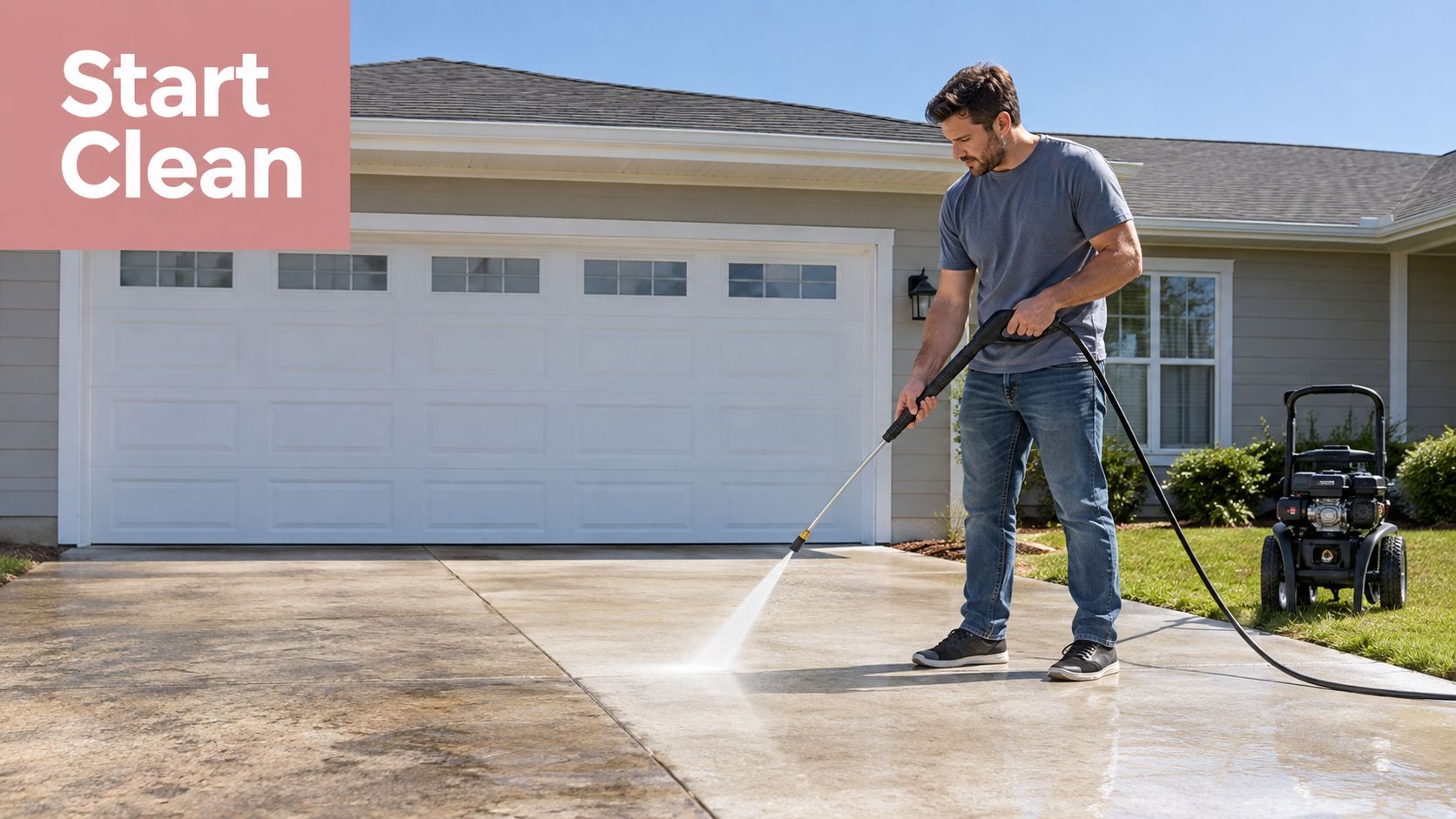
Picking the Right Pressure Washer and Nozzle
Choose the machine by matching PSI and GPM to the driveway's material and condition. PSI supplies the force that breaks grime loose. GPM supplies the water that carries it away. A washer with high pressure but weak flow can leave residue behind and make a large slab frustratingly slow to clean.
For standard poured concrete, a practical operating range is roughly 2,500 to 3,500 PSI with 3 to 5 GPM, preferably with a surface cleaner. Pressure-washing PSI and GPM guidance explains how stronger flow moves loosened grit away and helps limit striping. Other concrete guidance places many jobs around 2,900 to 3,300 PSI with at least 2.0 GPM. Pavers, stamped concrete, and colored concrete usually need about 1,500 to 2,200 PSI, since excessive force can remove joint sand or damage the colored surface. Concrete pressure and flow guidance treats PSI, GPM, and nozzle choice as one setup rather than separate specifications.
A compact electric washer around 1,800 PSI can handle light dirt on a sound broom-finished slab, although the work may take longer. For a large or heavily soiled driveway, renting a machine with better flow and a surface-cleaner attachment often makes more sense than buying equipment for one project.
Match the nozzle to the work
Nozzle angle controls how concentrated the spray is. Wide fans give you more forgiveness, while narrow fans clean aggressively but punish poor distance and slow wand movement.
| Task | Nozzle | PSI Range | Notes |
|---|---|---|---|
| General concrete washing | 25-degree green | 2,500 to 3,000 PSI | Use on older, intact concrete with the wand moving |
| Tire marks and concentrated grime | 15-degree yellow | Up to about 3,500 PSI | Test first and avoid lingering |
| Rinse passes | 40-degree white | Below 2,000 PSI for new concrete | Provides a wider, gentler fan |
| Soap application | 65-degree black | Low pressure | Applies detergent without forcing it into the slab |
| Very stubborn spot | 0-degree red | Carefully controlled upper range | Reserve for sound concrete after testing |
The Consumer Reports surface-safety overview notes that concrete can be cleaned with at least 1,500 PSI, while routine residential work is often kept near lower or middle settings. A setting around 3,500 to 4,000 PSI can damage concrete when used carelessly, especially with a narrow tip held too close.
A rotary surface cleaner keeps the spray at a consistent distance, helping prevent tiger stripes. Apply a biodegradable detergent through a downstream injector or siphon tube at low pressure, then change back to high pressure for rinsing. Gas-powered machines also require stable footing, ear protection, and careful handling of backpressure, particularly on sloped driveways. Choose the least aggressive setup that cleans effectively, because controlling spray and wastewater matters as much as raw pressure.
Getting the Driveway and Gear Ready
Preparation determines whether the wash water stays under control. Move both cars onto the street, sweep loose grit from the slab, and remove planters, furniture, trash bins, and toys. A clean surface lets detergent dwell evenly instead of becoming trapped in piles of sand and leaves.
For a two-car driveway, soak nearby shrubs and grass with fresh water before applying cleaner. Wet vegetation is less likely to absorb concentrated detergent. Cover delicate plants if the low edge of the slab drains toward them, but don't use a tarp as a substitute for runoff planning.
Lay a weighted tarp, absorbent socks, or a containment berm at the low edge. Direct clean rinse water toward a suitable grassy strip where local rules allow it, not toward a curb or storm drain. Some municipalities require capture and proper disposal, so check local requirements before you start. The house-cleaning supplies checklist can help you assemble basic protective and cleaning supplies before the machine comes out.
Set up the machine safely
Place the washer within 50 feet of a spigot, using a suitable garden hose, an in-line filter, and a GFCI outlet for electric equipment. Keep electrical connections away from standing water, and route the hose so you won't trip while backing down the driveway.
Choose a biodegradable, phosphate-free concrete cleaner and follow the product label for dilution. A common label direction may be 10:1, but the product's instructions control. Don't combine cleaners, and don't assume a household product is safe for concrete, plants, or stormwater.

Put on safety glasses, closed-toe shoes with grip, and hearing protection when using a gas-powered unit. Before cleaning the visible surface, perform a 30-second test spray on a hidden corner. Check for etching, loosened aggregate, color loss, and splash reaching plants or drains.
Washing the Driveway Step by Step
Take a realistic driveway with a three-week-old oil spot beside the garage and dark tire marks leading toward the curb. The mistake would be to point a narrow nozzle at both problems immediately. Oil is difficult because water doesn't dissolve it, and aggressive pressure can roughen aged concrete before it removes the stain.
Begin with the oil area. Apply a biodegradable degreaser, allow it to dwell for 5 to 10 minutes, and keep it from drying. Work it with a stiff concrete-safe brush if the label allows. The purpose is to loosen and emulsify surface grease before the pressure washer carries it away.
Work from the garage toward the curb
Rinse the entire surface with water first, using a broad spray. Then apply detergent with the 65-degree black soap nozzle at low pressure, covering manageable sections rather than flooding the whole driveway. Keep the runoff moving toward your planned grass swale or containment area, never toward a storm drain.
Switch to a 25-degree green nozzle for the cleaning passes. Hold the wand about 10 to 12 inches from older, intact concrete, keep it moving, and use slow overlapping strokes that follow the driveway's slope. Starting too close creates visible cuts. Moving too quickly leaves alternating bands of clean and dirty concrete.
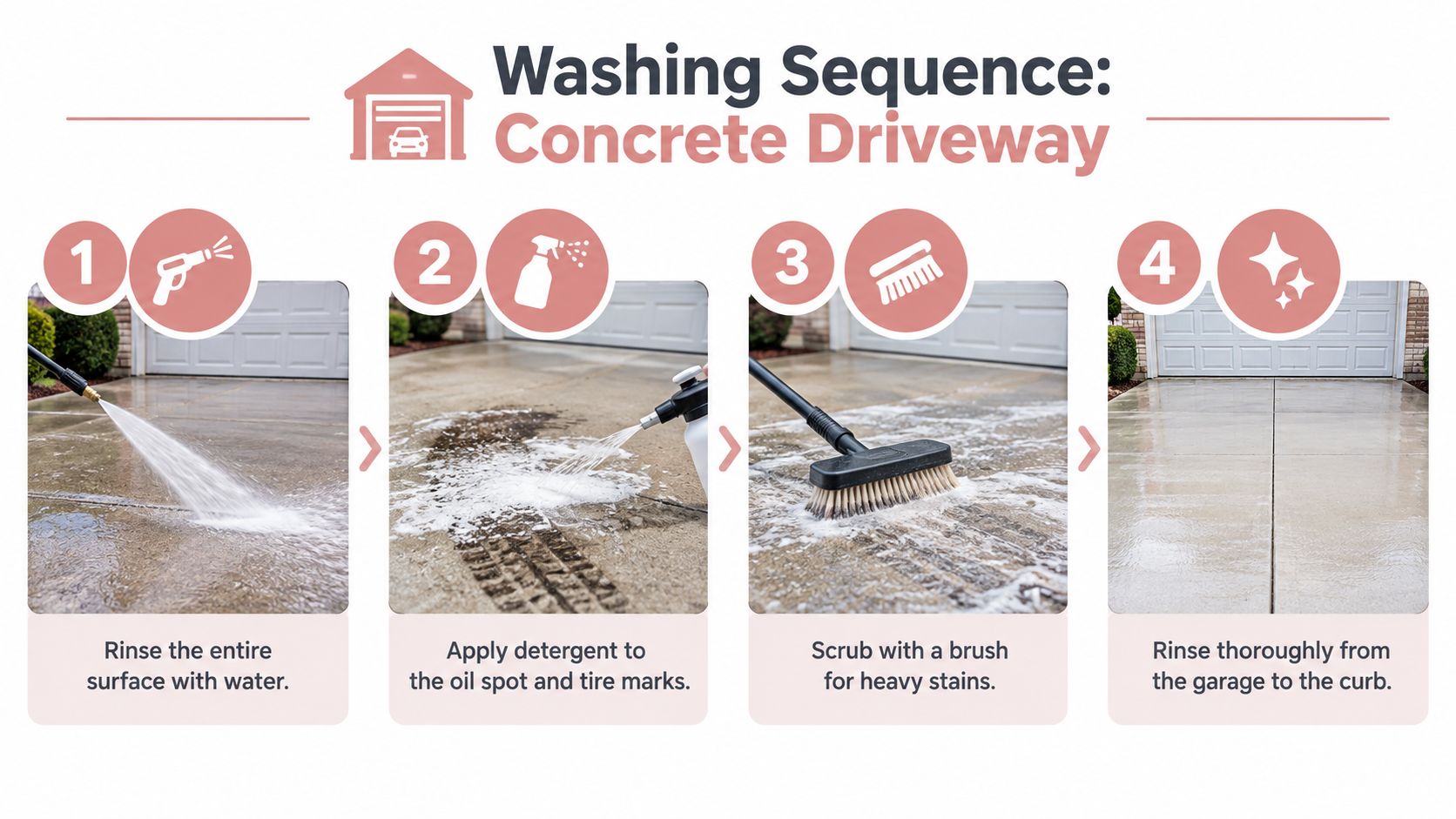
For tire marks that remain after treatment, test a small section of sound concrete with a 0-degree red tip only if necessary. Keep the tip moving, use it briefly, and stop if the surface begins to change texture. Guidance on pressure washing a driveway is useful for comparing nozzle technique and cleaning sequence, but your driveway's finish and condition should determine the final setting.
A surface cleaner is the better choice for broad areas because it maintains a consistent distance and reduces striping. After the last pass, rinse from the garage toward the curb or controlled collection point. If you also work on a basement slab, keep the same care around detergents and drainage, as discussed in this guide to cleaning a basement concrete floor.
When the driveway is finished, flush the detergent line and pump with fresh water. Residue left inside the system can dry and crystallize, particularly when the machine is stored through winter. Follow the equipment manufacturer's shutdown instructions rather than leaving chemical solution in the hose.
Troubleshooting Streaks, Stains, and Runoff
The driveway can look clean while wet and reveal problems as it dries. Most issues come from uneven technique, a stain that needs chemistry rather than force, or water that traveled somewhere it shouldn't have.
Diagnose the visible result
Tiger stripes usually mean the wand height, travel speed, or overlap changed between passes. A surface cleaner reduces that risk, but it won't compensate for stopping in place or working at different distances. If you used a wand, repeat the affected area with a consistent 10-inch standoff and a steady walking pace.
An oil shadow that returns after drying usually needs another detergent treatment, not a more aggressive blast. Deep stains need a poultice-style or capillary-action treatment that draws oil from the pores. More pressure on aged concrete can etch the surface while leaving the underlying stain.
| Problem | Likely Cause | Recommended Fix |
|---|---|---|
| Tiger stripes | Uneven wand height or speed | Rewash with consistent distance and overlapping passes |
| Oil shadow remains | Oil has penetrated the concrete | Repeat with a suitable degreaser or poultice-style treatment |
| Rust stain persists | Stain chemistry needs targeted treatment | Use a concrete-safe rust treatment, then rinse carefully |
| Suds reach the gutter | Detergent and runoff lack containment | Block the flow, capture the water, and use phosphate-free cleaner |
| Grass shows stress | Concentrated runoff reached vegetation | Flush plants with fresh water and improve diversion |
Treat runoff as part of the job
If the final rinse is flowing toward a curb, stop and redirect it toward permeable soil where permitted. Use a wet vacuum, absorbent socks, or berms to block the path. Municipal requirements differ, and some locations demand capture and disposal rather than allowing wash water to flow or evaporate.
For leaves and organic debris, remove the material before washing. Homeowners deciding between mulching leaves and raking can use either approach in the yard, but driveway debris should be swept away so it doesn't become dirty runoff. Eco-conscious households can also review eco-friendly cleaning options before selecting a detergent.
Flow rate matters as much as force. A machine producing at least 2.0 GPM can handle many driveway benchmarks, while roughly 3 to 5 GPM moves loosened grit more effectively on standard poured concrete. If a stain remains, first ask whether the problem is insufficient water volume, the wrong nozzle, or the wrong chemical treatment.
When It Makes Sense to Call a Pro
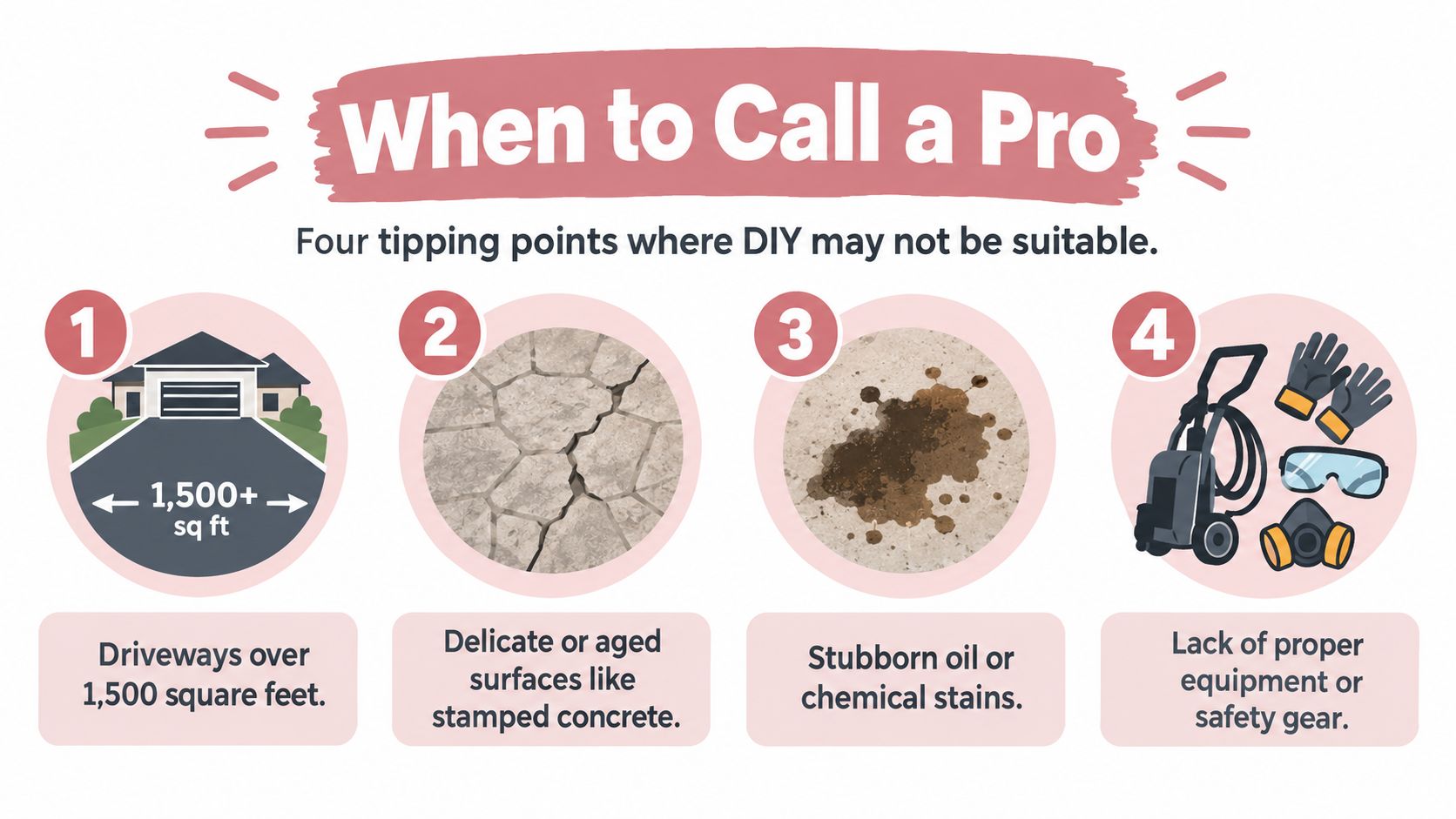
DIY pressure washing stops being a bargain when the driveway's size, surface condition, access, or drainage requirements exceed your equipment and confidence. A driveway over 1,500 square feet can take much of a Saturday, especially with a small electric unit. Spalling, exposed rebar, loose aggregate, and decorative coloring also call for inspection before spraying.
Ladder work changes the risk. Do not combine an unstable ladder, a reactive wand, and a wet surface. Multi-story homes, steep slopes, and tight access points are better handled by a crew with suitable equipment and safety procedures.
Stormwater rules may decide the issue. Some municipalities require commercial recovery equipment, while a professional may bring containment, vacuum recovery, and disposal procedures that a homeowner lacks. A residential electric washer at 1.4 GPM will not move water like a truck-mounted system producing 4 to 8 GPM, so a project that seems manageable can take far longer. The earlier PSI and GPM guidance covers these equipment differences.
Aquastar Cleaning Services, LLC lists driveway pressure washing alongside residential cleaning. Its service options may suit homeowners who want exterior surface maintenance handled with other home-cleaning needs. Compare providers by their process, not promises.
Ask these questions before booking:
- Insurance: Can the company provide proof of current insurance?
- Recovery: How will the crew contain, recover, and dispose of wastewater?
- Chemicals: Can they provide detergent SDS sheets and explain plant-safety measures?
A professional is especially useful when wastewater cannot be safely diverted, the slab may be damaged, or the work requires ladders and specialized recovery equipment.
Keeping Your Driveway Cleaner for Longer
A clean driveway stays presentable when you prevent grit, leaves, oil, and standing moisture from building into a larger problem. The maintenance routine doesn't need to be complicated. It needs to happen before stains become embedded.
Sweep weekly to remove grit that can grind into the finish under tires. After pollen or sap falls, rinse with a garden hose and move the water toward a permitted permeable area. If soap is involved, use catchment rather than allowing suds to reach the gutter.
Use a simple maintenance rhythm
Spot-treat oil drips within 48 hours with a biodegradable degreaser. Fresh contamination is easier to address than a dark shadow that has settled into the concrete. Rotate where you park when practical, which spreads tire wear and reduces repeated loading in one location.
A full pressure wash every 12 to 18 months can suit many driveways, depending on shade, traffic, mildew, and the amount of organic debris. A shaded slab may need attention sooner, while a sunny, lightly used driveway may stay presentable longer. Use the mildest effective method and repeat the small test area when conditions change.
Resealing can help limit moisture and oil penetration, with many maintenance recommendations placing resealing around every 2 to 3 years. Choose a sealer compatible with the concrete finish, and don't apply it until the surface is clean, dry, and free of residue.
For broader home-care routines, the house-cleaning tips collection offers a useful place to organize recurring tasks. Tape this checklist inside the garage door:
- Weekly: Sweep grit, leaves, and loose debris.
- After spills: Blot and spot-treat oil promptly.
- After seasonal buildup: Rinse pollen, sap, and organic residue toward an approved area.
- Before deep cleaning: Inspect cracks, spalling, plants, drains, and runoff routes.
- During washing: Use biodegradable detergent and contain soapy water.
- After washing: Flush the machine and check the dry surface for stripes or stains.
- Every few years: Evaluate the sealer and surface condition before recoating.
Aquastar Cleaning Services, LLC offers driveway pressure washing for exterior surface maintenance, along with residential cleaning and eco-friendly product options when requested. If you'd rather have the concrete, runoff planning, and surrounding home-care tasks handled by an insured local team, visit Aquastar Cleaning Services, LLC to request a quote.