


You're standing in a Kennesaw living room with dark traffic lanes, a pet spot near the sofa, and a family schedule that can't spare a damp floor for long. You call for steam cleaning, but the cleaner offers hot-water extraction instead. That sounds like a bait-and-switch until you understand the terminology.
The decision isn't just carpet cleaning vs steam cleaning. Choose based on what's in the carpet, how well your home can dry it, and who uses the floor. A toddler crawling on damp carpet, a senior with respiratory sensitivity, and a lightly soiled apartment don't need the same process.
| Situation | Best starting point | Why |
|---|---|---|
| Embedded soil and traffic lanes | Hot-water extraction | Flushes soil out and recovers the dirty water |
| Fast refresh between deeper cleans | Dry or low-moisture cleaning | Uses less moisture and returns the room to service sooner |
| Pet urine | Cool-water extraction with enzyme treatment | Avoids heat that can set the stain and odor |
| Dust and some allergens | Thorough extraction with strong recovery | Removes contaminated material rather than only warming it |
| Humid home with limited airflow | Low-moisture cleaning or carefully managed extraction | Reduces the risk of prolonged dampness |
What Homeowners Actually Mean When They Say Carpet Cleaning vs Steam Cleaning
A homeowner in Kennesaw may ask for “steam cleaning” because that's the phrase used in advertising. The technician may describe the service as hot-water extraction, and both people may be talking about the same professional carpet process. Carpet cleaning is the umbrella term. “Steam cleaning” usually means hot-water extraction, not literal dry vapor.
Hot-water extraction sprays heated water and detergent into the carpet pile, then immediately vacuums the liquid back out with suspended soil. Technical descriptions place the water temperature at roughly 150°F to 230°F during injection and extraction, depending on the equipment and carpet being treated (technical overview of hot-water extraction). The process became the dominant professional approach as wall-to-wall carpeting expanded, which helps explain why the old “steam cleaning” label remains common (history and terminology of carpet cleaning).
True dry steam is different. It produces vapor with very little liquid water, so it can heat and refresh a surface, but it doesn't provide the same rinse-and-recovery action needed to remove detergent, oily soil, and material buried near the backing. That's why a handheld steamer may be useful on hard surfaces but is usually the wrong tool for wall-to-wall residential carpet.
The names you'll hear on a quote
Ask the cleaner to name the actual method, not just repeat the marketing label.
- Hot-water extraction: Heated water and cleaning solution enter the pile, then a vacuum removes the liquid, soil, and loosened residue.
- Dry compound cleaning: Absorbent material is worked into the carpet and vacuumed away with collected soil.
- Bonnet cleaning: A damp spinning pad absorbs soil from the upper surface. It's mainly a maintenance method.
- Shampoo cleaning: A foamy solution is agitated through the fibers and then removed, often with more residue risk if rinsing is weak.
- Encapsulation: A polymer surrounds loosened soil and dries into crystals that regular vacuuming removes.
For a practical example, a hallway with flattened gray lanes needs more than a surface polish. A lightly dusty guest room that must be used shortly after cleaning may be a sensible low-moisture candidate. The right question is not “Which label sounds cleaner?” It's “What does this carpet need removed?”
How Each Method Works Behind the Scenes
The machine determines only part of the result. Water temperature, agitation, chemical action, contact time, and recovery strength decide whether soil leaves the carpet or merely changes position.
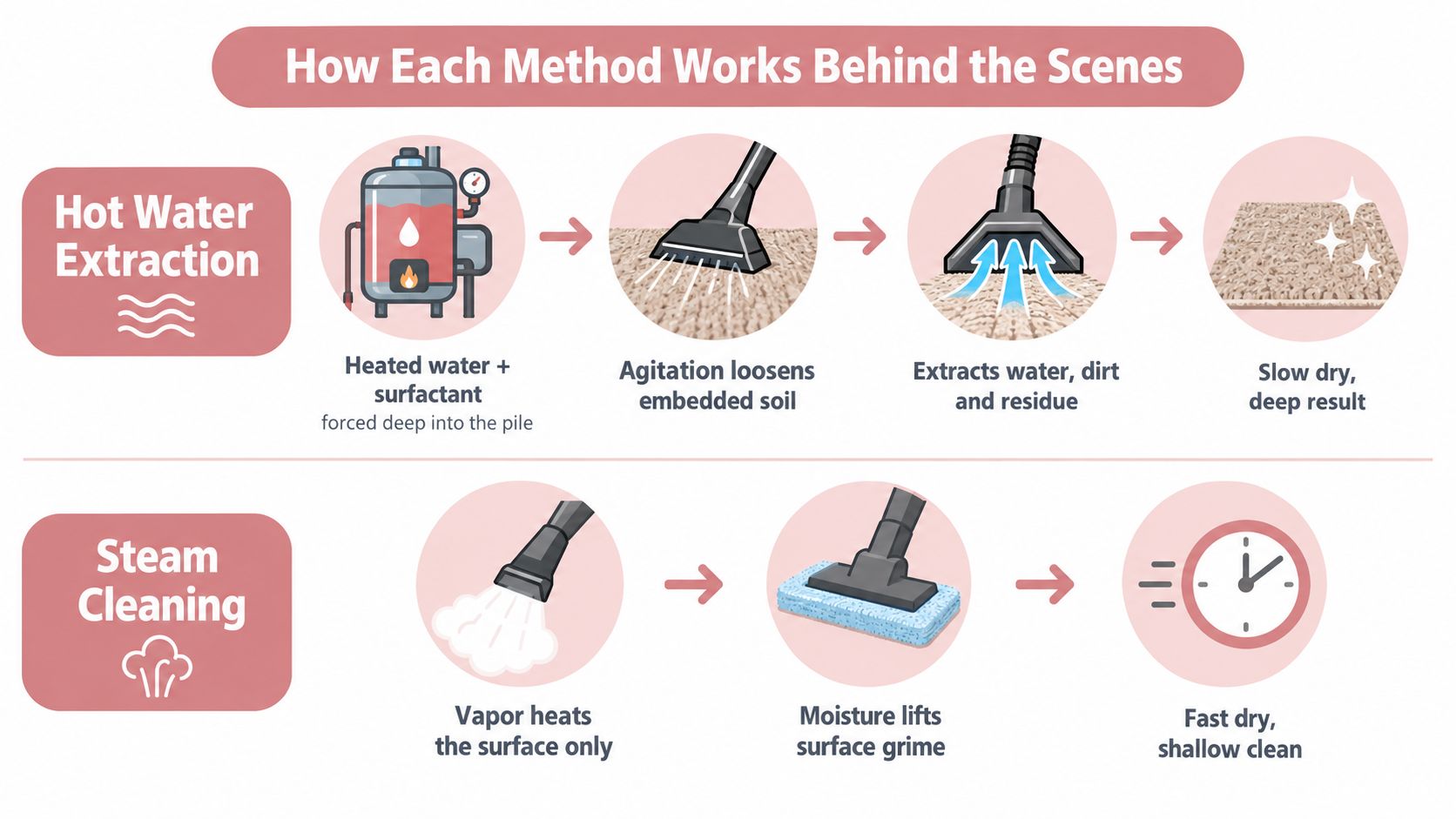
Hot-water extraction
A professional wand or powerhead injects heated water mixed with surfactant into the pile. Agitation separates oily soil from the fibers, and the vacuum slot pulls the liquid back through the carpet. The important action is not the heat alone. It's the rinse and recovery.
Professional truck-mounted systems are described as removing about 85% to 95% of embedded soil and up to 95% of applied moisture in technical industry summaries (hot-water extraction equipment and recovery details). Those figures describe the capability of the system, not a guarantee for every room. A clogged wand, excessive solution, slow drying conditions, or poor technique can produce a very different result.
A practical example is a family-room traffic lane. The operator vacuums grit first, applies a suitable pre-spray, agitates the lane, and makes slow overlapping extraction passes. The machine isn't just making the fibers look brighter. It's carrying suspended soil into the recovery tank.
Dry compound, bonnet, shampoo, and encapsulation
Dry compound cleaning spreads absorbent polymers or sponge-like material over the carpet. A counter-rotating brush works the compound between the fibers, giving it time to collect soil before a vacuum removes the dried material. Moisture is minimal, which makes this useful where the floor must return to service quickly.
Bonnet cleaning uses a spinning pad dampened with solution. The pad absorbs surface soil, but it doesn't provide the same deep flush as extraction. It can improve the appearance of an entryway, though a heavily compacted lane may still hold soil below the cleaned surface.
Shampoo cleaning depends heavily on rinsing and recovery. Encapsulation takes a different chemical route. Its polymer surrounds loosened dirt, dries, and leaves material that later vacuuming can collect. That can work well for maintenance, but it isn't a substitute for extraction when the backing or padding contains substantial contamination.
Practical rule: If the equipment has a recovery tank and removes dirty water, you're looking at extraction. If it only emits vapor, it isn't rinsing the carpet.
Comparing the Two Methods Across What Matters Most
The usual comparison gets distracted by labels. Homeowners need a decision based on depth, drying, fiber risk, allergens, residue, and cost. The table below compares hot-water extraction with the dry and low-moisture methods commonly offered for residential work.
| Criterion | Hot Water Extraction | Dry / Low-Moisture Methods |
|---|---|---|
| Cleaning depth | Deep rinse and recovery of suspended soil | Mainly surface or maintenance cleaning, depending on the system |
| Traffic-lane recovery | Strong choice for embedded soil and compression | Useful for appearance maintenance, less suitable for deeply loaded lanes |
| Drying | Often 6 to 12 hours with suitable airflow, and may take up to 24 hours in less favorable conditions (drying comparison) | Commonly about 30 to 60 minutes for dry cleaning systems (dry-cleaning timing) |
| Allergen handling | Strong choice when contaminated dust is physically extracted | Can reduce surface material, but performance depends on agitation and vacuum recovery |
| Fiber and backing safety | Suitable for many carpets when correctly adjusted, but heat and moisture require care | Lower moisture helps older or moisture-sensitive installations |
| DIY cost | A rented machine may cost $30 to $60 per room, depending on the rental and package | Dry compound may involve no machine rental, though product and equipment costs vary |
| Professional cost | A quoted professional room may fall around $80 to $200, depending on the job and service scope | Pricing varies by method and provider |
| Chemical residue | Rinsing can reduce residue when the operator uses the right solution and recovery pattern | Powder, shampoo, or polymer residue can remain if removal is incomplete |
The verdict by criterion
Cleaning depth: Choose hot-water extraction when soil has moved below the visible surface. Dry methods win only when fast, light maintenance matters more than a restorative rinse.
Drying: Choose low-moisture cleaning when the room must be used soon. Extraction is still reasonable when fans, ventilation, and realistic occupancy planning are available.
Traffic lanes: Extraction gets the nod for flattened, oily paths through a family room. A bonnet or encapsulation pass is better suited to keeping a lightly soiled commercial-style route presentable.
Allergens: Extraction is the stronger physical-removal option, but no method should be judged by the word “steam” alone. A U.S. EPA-hosted study found that hot-water extraction and steam cleaning removed only about 20% of total PFCAs per cleaning round on average, while a separate dry-steam protocol combined with HEPA vacuuming reduced dust loading by 64.4%, PAHs by 69.1%, and dust-mite allergens by 85.5% (EPA-hosted carpet contaminant study). The lesson is simple. Results depend on the contaminant.
Cost: DIY extraction can suit a small, straightforward room and a homeowner willing to handle heavy equipment. Professional service makes more sense when stain treatment, drying control, or delicate fibers raise the consequences of a mistake.
A Practical Cleaning Sequence You Can Follow at Home
A machine won't rescue a rushed process. Start dry, control the chemical, recover slowly, and create airflow immediately.
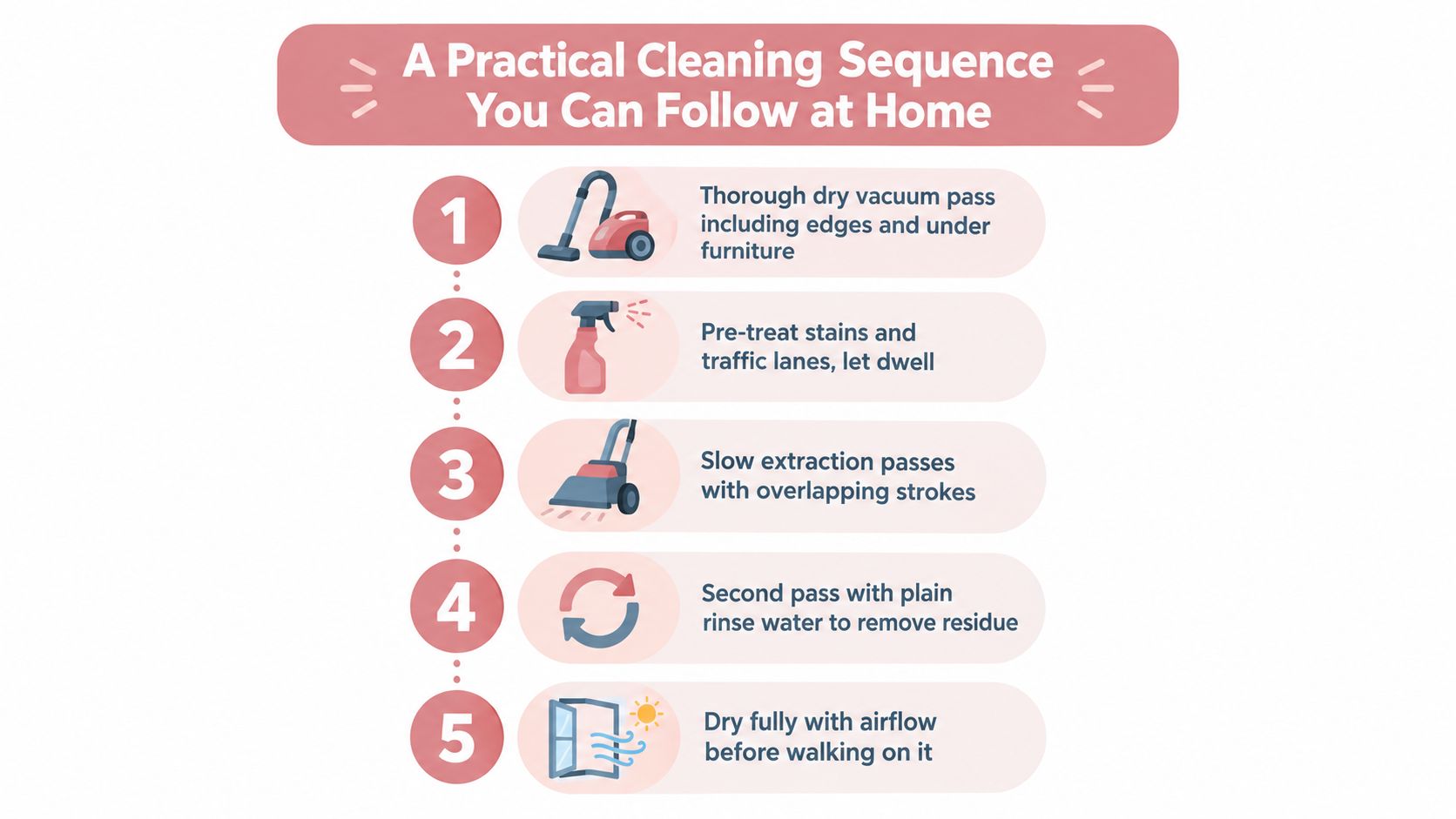
Vacuum thoroughly. Make a dry pass over the open floor, edges, corners, and accessible space beneath furniture. Dry grit turns into muddy residue when water hits it, so removing it first improves both cleaning and recovery.
Pre-treat visible soil. Apply a compatible carpet detergent to traffic lanes and spots. Give it dwell time according to the product directions, but don't allow the area to dry before extraction.
Extract slowly. Use overlapping forward and backward strokes without flooding the pile. Apply solution on the controlled pass, then release the trigger and make a slower suction pass.
Recover excess moisture. Make a second pass without pressing the solution trigger. Multiple carpet-care guides recommend this pattern because extra vacuum recovery leaves less water and residue behind (carpet cleaning sequence guidance).
Force the dry. Place fans so air crosses the carpet, use air conditioning when appropriate, and open windows only when outdoor conditions won't add humidity. Keep normal foot traffic off until the carpet is dry enough for the household.
For a room-by-room example, clean the living room first, move the machine toward the exit, and leave the most difficult traffic lane for deliberate pre-treatment rather than repeatedly soaking it. This guide to how to clean a dirty carpet is useful when you need a more detailed checklist before starting.
Pet-owning households should also remove dander and loose debris before wet work. Aquastar's guidance on reducing pet dander in the home can help you build that dry-maintenance routine.
Here's a visual demonstration of the extraction pattern:
Pet Stains, Allergens, and Odor Control
Don't steam-clean a urine spot. The Carpet and Rug Institute warns that heat can set urine stains and odors, and it recommends wet vacuuming followed by a cool-water rinse instead (Carpet and Rug Institute cleaning guidance).
The common failure pattern is easy to recognize. A pet accident dries in the pile, someone runs a hot machine over it, and the room smells stronger once the carpet warms. Heat isn't neutral in this situation. It can make the protein and odor problem harder to correct.
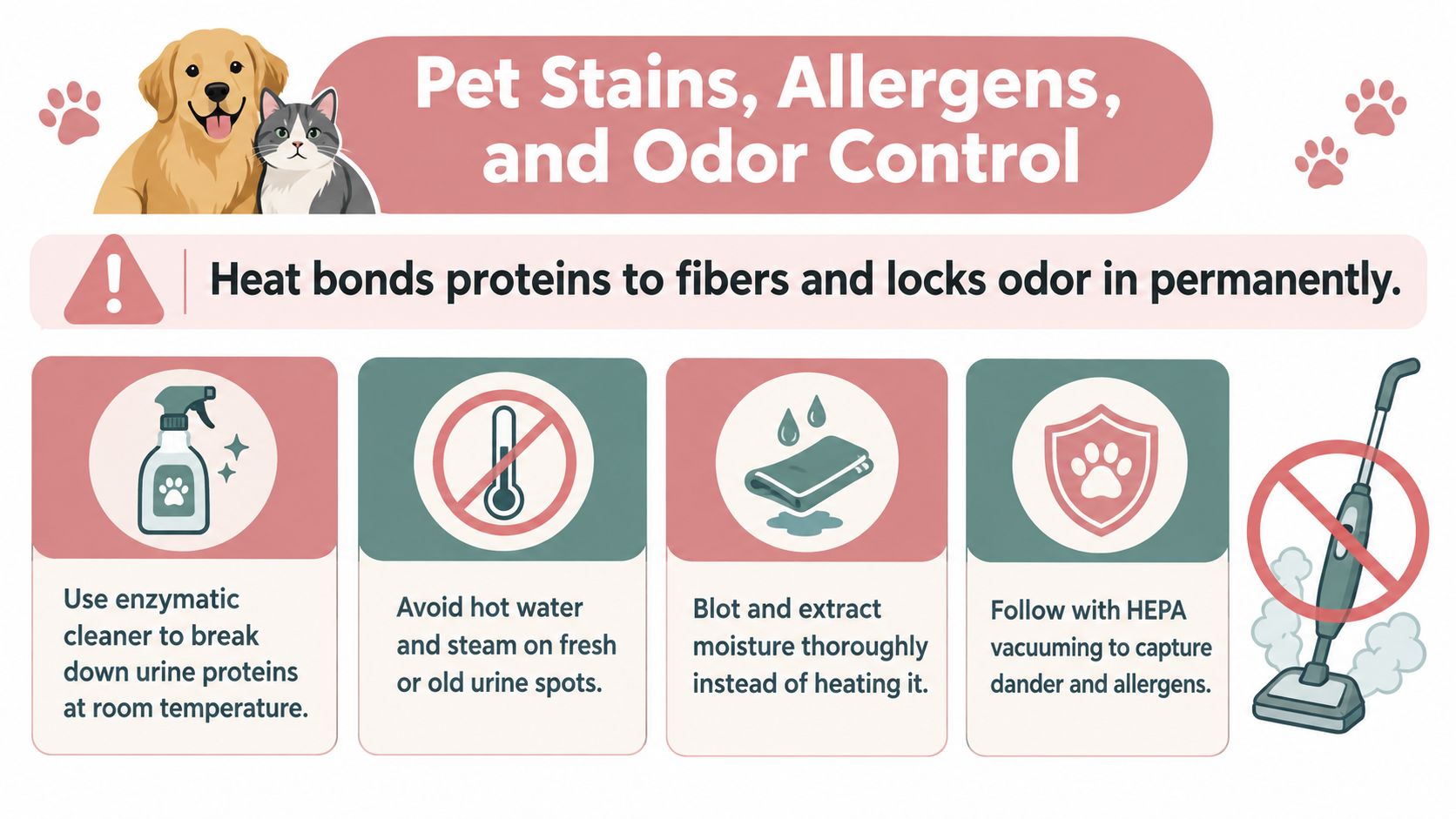
The pet-accident protocol
- Blot fresh liquid: Press absorbent towels into the spot instead of scrubbing it outward.
- Use an enzyme treatment: Apply an enzymatic cleaner at room temperature so it can break down urine-related residue before extraction.
- Flush with cool or lukewarm water: Extract the treated area, then repeat controlled cool-water passes for an older spot.
- Recover thoroughly: Use suction-only passes to remove as much moisture and dissolved residue as possible.
- Dry completely: Move air across the area and keep pets away until the carpet and surrounding backing feel dry.
For a practical example, a fresh accident beside the sofa gets blotted first, treated with enzyme solution, and extracted with cool water. A recurring odor that returns after cleaning may have reached the pad or subfloor, which is no longer a simple surface-stain job. These DIY tips for stubborn cat urine smells provide useful guidance for evaluating that problem before you keep adding cleaning solution.
Allergens require separate reasoning. Dust-mite waste and pollen may respond well to properly managed hot extraction, while HEPA vacuuming helps capture loosened particles after the carpet dries. The priority is not “maximum heat.” It's matching the temperature and removal method to the contaminant. Aquastar's resource on reducing allergens in the home is a practical companion for the rest of the room.
Choosing the Right Method for Your Household
Two homes can have identical carpet and need different cleaning decisions.
A busy family home with toddlers has a demanding floor. Children crawl through the pile, nap on it, and put toys in their mouths. A large wet clean may provide useful soil removal, but it creates a drying and residue-control problem if the family can't keep the room empty. In that home, I'd choose low-moisture encapsulation for routine maintenance or a carefully executed extraction clean when the carpet has embedded soil. I'd treat pet accidents separately and never send hot steam over urine.
An older resident in a small apartment faces a different set of constraints. Limited mobility may make furniture movement and machine handling unsafe, while respiratory sensitivity makes loose dust and lingering fragrance more important than aggressive DIY work. Professional low-moisture cleaning may be the sensible choice for light soil because it limits disturbance and gets the room usable sooner. If allergens are the main concern, the provider should explain how vacuuming, agitation, and particle recovery will be handled.
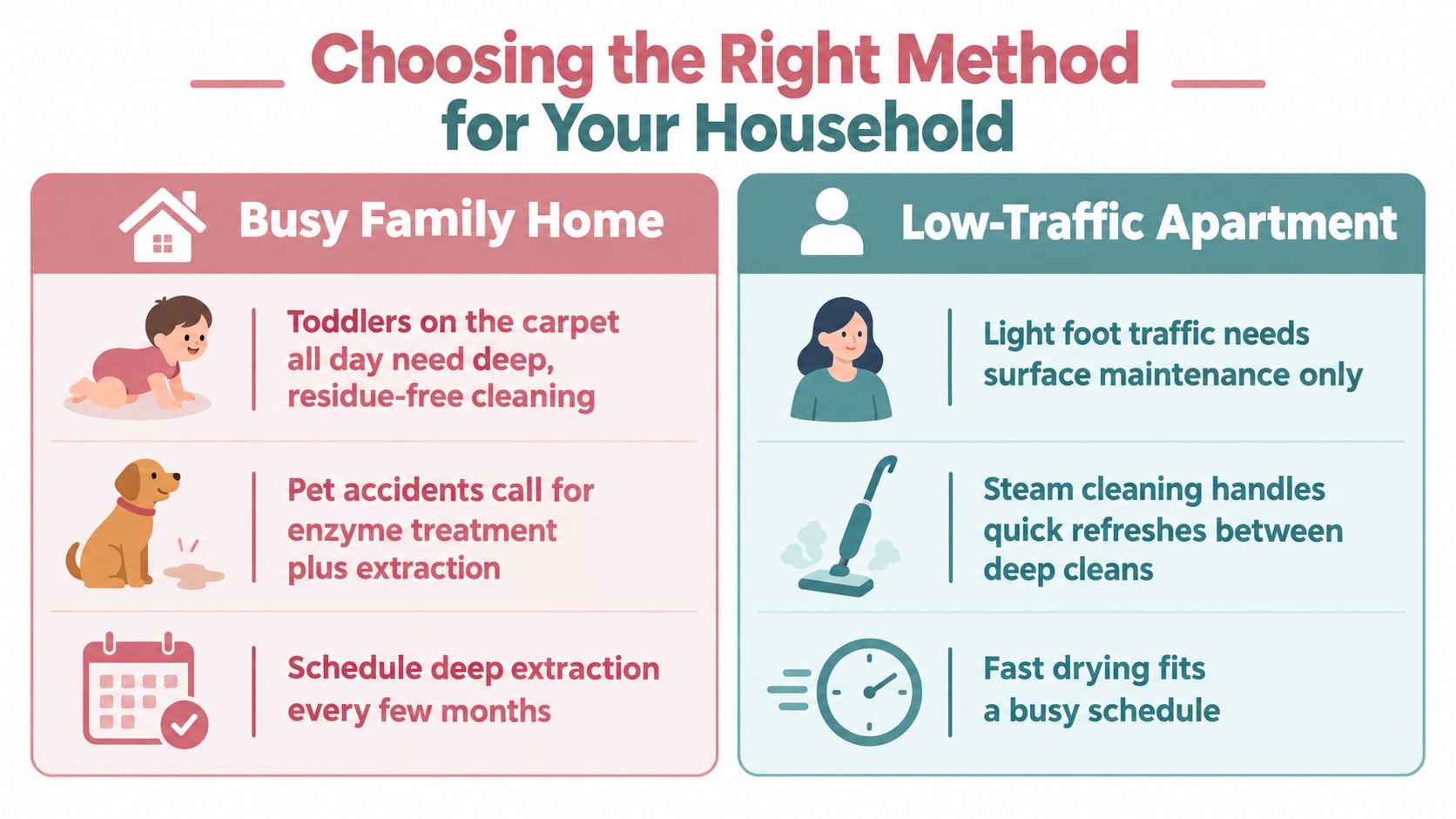
Match the floor to the household
- Toddlers and frequent floor play: Favor residue control and fast, complete drying. Don't assume the hottest process is automatically safer.
- Pets with accidents: Use enzyme treatment and cool-water extraction first. Heat is the wrong default.
- Respiratory sensitivity: Reduce loose dust, avoid unnecessary fragrance, and choose a process the household can tolerate during and after service.
- Lightly used guest rooms: Dry compound or encapsulation can maintain appearance without introducing much moisture.
- Old carpet or uncertain backing: Get the fiber and installation assessed before applying heat, water, or aggressive agitation.
Eco-conscious households can also ask about product selection and ventilation. Aquastar describes eco-friendly cleaning options for residents who want gentler, biodegradable solutions when available. The practical test is still the same: identify the contaminant, check the fiber, and plan the dry.
Drying Time, Humidity, and Reentry Risk
The bigger risk isn't the word “steam.” It's carpet that stays wet too long.
Professionally cleaned carpet may be dry within 6 to 12 hours when airflow, humidity, and applied moisture are favorable, while some steam-cleaned carpet can take up to 24 hours (carpet drying comparison). Dry compound cleaning generally returns a room to service faster, and bonnet cleaning falls between surface maintenance and wetter extraction in its moisture demand.
A Kennesaw home at 70% indoor humidity won't dry like the same room in Phoenix. Air conditioning, ceiling fans, open interior doors, and a dehumidifier can all help move moisture away from the carpet. Opening windows only helps when outdoor air is drier, so don't open them automatically during a humid Georgia summer.
Use a simple reentry decision
- Low humidity plus active airflow: A lightly damp carpet may be acceptable for careful access, but keep toddlers and pets away from wet areas.
- High humidity or weak airflow: Keep everyone off until the carpet is fully dry to the touch.
- Damp padding, tack strips, or backing: Treat the situation as a drying problem, not a scheduling inconvenience.
- Persistent wetness or odor: Contact the cleaner rather than covering the smell with fragrance.
Public-health-oriented guidance notes that wet carpet remaining beyond about 8 hours can affect indoor air quality, and mold may begin growing on wet porous materials within 24 to 48 hours (moisture and carpet drying guidance). Those thresholds aren't permission to wait. They're a reason to plan airflow before the machine starts.
For households that struggle with summer humidity, this resource on using a humidifier in summer is also a reminder to manage indoor moisture deliberately. Choose the method your home can dry, not the method with the most impressive name.
When to DIY and When to Call a Carpet Specialist
DIY makes sense for light soil, regular upkeep, and a single uncomplicated room. Rent a machine when you're on a tight budget and comfortable handling heavy equipment for a long cleaning session. Vacuum first, pre-treat carefully, avoid over-wetting, and accept that a rental machine won't solve every stain or backing problem.
Call a specialist when the consequences of a mistake outweigh the service charge. That includes pet urine saturated into the pad, set stains older than 24 hours, large area rugs, wool or sisal, respiratory-allergy concerns, post-renovation dust, and rental turnovers where the carpet warranty requires documented hot-water extraction.
A dedicated carpet specialist has tools and judgment that a general house cleaner may not. Truck-mounted extraction can provide stronger recovery, trained spot treatment can prevent a stain from being spread, and commercial air movers can improve drying control. For a rental turnover, documentation and careful handling may matter as much as the visible result.
Facility Management Insights explains why carpet care in managed properties requires more than a quick cosmetic pass. The same principle applies at home: the method should match the condition, the occupant, and the available drying window.
Check these four details before booking
- Traffic level: Is the carpet lightly dusty, or are the lanes visibly dark and compacted?
- Stain history: Are you dealing with food, grease, urine, paint, or an unknown old mark?
- Fiber type: Is it synthetic, wool, sisal, antique, or backed with an unfamiliar adhesive?
- Time available: Can the room remain undisturbed while it dries?
Aquastar Cleaning Services, LLC offers dedicated carpet cleaning alongside residential deep cleaning, move-in and move-out cleaning, and post-construction cleanup for homes in Kennesaw and North Atlanta. Its carpet cleaning specialist service is the appropriate type of service to consider when extraction, stain treatment, and drying control need to be handled together.
If your carpet has embedded traffic soil, pet staining, or a drying window you can't manage alone, contact Aquastar Cleaning Services, LLC for a method matched to your fibers, household, and schedule. Visit Aquastar Cleaning Services, LLC to request a quote and explain exactly what's on the carpet before the cleaning begins.