


After dinner, you wipe the kitchen counter, see no crumbs, and assume the surface is sanitized. Then someone grabs the faucet, opens the refrigerator, touches the cabinet pulls, and the same high-touch points are handled again before bedtime.
That's where sanizing house cleaning needs a more practical definition. You don't need to spray every surface in the home or repeat a full clean after every meal. You need to remove soil first, then apply a suitable product only where the household's actual risk calls for it.
What Sanitizing Really Means in Your Home
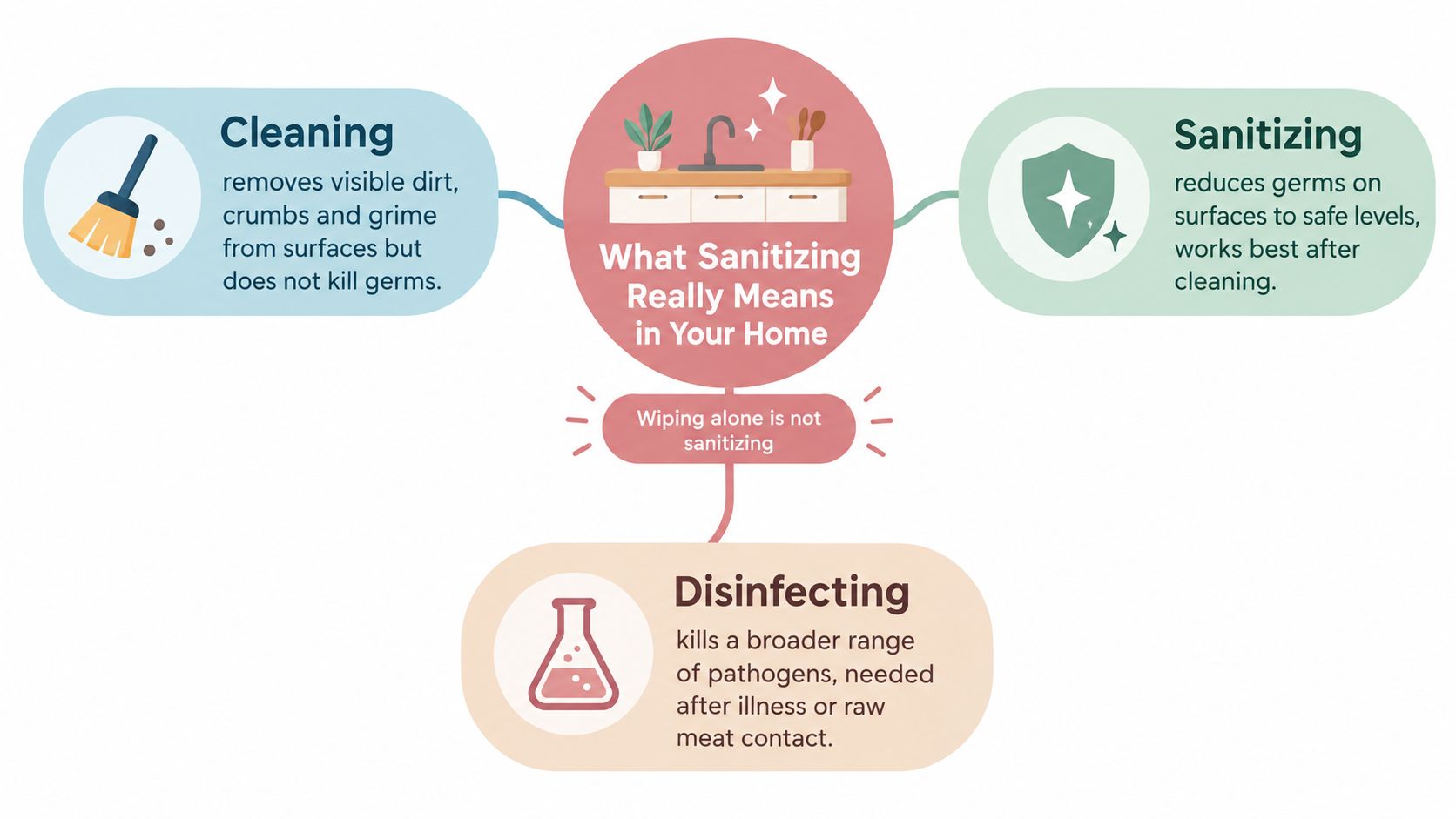
Cleaning, sanitizing, and disinfecting aren't interchangeable words. Cleaning removes visible dirt, crumbs, grease, and other soil with soap or detergent. It's the physical reset that makes a surface look and feel clean, but cleaning alone isn't the same as sanitizing or disinfecting. The CDC's explanation of cleaning, sanitizing, and disinfecting draws that distinction clearly.
Sanitizing lowers germs on a surface to a level considered safe. Disinfecting uses a stronger chemical approach to destroy a broader range of pathogens, which makes it more appropriate after illness or a contamination event such as raw meat contacting a counter. In a generally healthy home, routine cleaning is often enough, while the CDC says home sanitizing or disinfecting is usually unnecessary unless someone is sick or a sick person has recently visited.
Why the order matters
Spraying sanitizer over a greasy kitchen counter is a poor shortcut. Dirt, food residue, and grease can interfere with chemical action, and a sanitizer can only work where it directly contacts the surface. Wipe the counter with soap or detergent first, rinse or wipe away the residue when appropriate, and then apply the sanitizer to the cleaned area.
For example, after preparing raw chicken, remove food scraps and grease from the counter before applying an appropriate disinfectant. On an ordinary evening, cleaning the counter may be all you need, with targeted sanitizing reserved for high-touch areas such as the faucet handle, cabinet pull, or appliance buttons.
Practical rule: A sanitizer isn't a substitute for cleaning. It's a finishing layer applied to a surface that's already free of visible soil.
Look for an EPA registration on the product label. The EPA's explanation of sanitizer and disinfectant products makes an important point: a general-purpose spray doesn't automatically sanitize or disinfect just because its marketing uses words such as “antibacterial” or “germ-fighting.” Registration and label directions tell you what the product is approved to do.
That includes contact time. The surface generally has to stay visibly wet for the full time shown on the label. If it dries immediately, the product may not have had enough time to work. In practice, targeted sanitizing house cleaning is a short addition to normal cleaning, not a second full-house scrub.
Room by Room Sanitizing Routine
Start in the kitchen with a pre-cleaning pass. Remove crumbs, wipe away food residue, and degrease the stovetop and counters with soap or detergent. If you spray sanitizer before lifting grease, you're spending product on a surface where it can't work properly.
Once the counter and stovetop are clean, focus on the places hands use repeatedly. Apply the suitable product to faucet handles, appliance buttons, cabinet pulls, and the sink basin. Give the sink attention after washing raw food or handling dirty dishes. The sponge and sink are easy to overlook because they're associated with cleaning, but they regularly contact food residue, damp materials, and dirty hands. Replace or wash reusable tools according to their material and care directions instead of assuming a quick rinse is enough.
Keep the product away from food, and follow the label for food-contact surfaces. If a label requires rinsing after sanitizing, don't skip that step.
Move through the bathroom
In the bathroom, remove soap scum, toothpaste residue, hair, and visible soil from the sink and counter first. A damp microfiber cloth with a suitable cleaner can handle a light daily buildup, while heavier residue needs more direct scrubbing before any sanitizing spray touches the surface.
Then target the flush handle, toilet handle, seat lid, faucet, light switch, and the counter around the sink. Don't flood the toilet seat or spray directly toward electrical switches. Put the product on a cloth when the label and surface allow it, or apply carefully so the area receives enough product without creating a puddle.
The Aquastar bathroom cleaning service is one example of a room-specific approach that treats bathroom surfaces as separate cleaning tasks rather than one quick wipe across the room.
Finish with shared living surfaces
Dust and tidy the living areas before sanitizing. Remove grit from coffee tables, clear toys from the floor, and wipe visible soil from door areas. Then work across the surfaces that hands touch throughout the day, including remotes, game controllers, door knobs, stair rails, and switch plates.
Check manufacturer guidance before using liquid on electronics. A lightly dampened compatible wipe is safer than spraying a remote or controller directly. For doorknobs and rails, keep the surface wet for the product's stated contact time, then allow it to dry as directed. This room-by-room flow is more efficient than spraying every shelf, cushion, and decorative object.
Choosing the Right Sanitizing Products
Product choice should follow the surface and the situation, not the loudest claim on the front label. Conventional chemical products, plant-based formulas, and carefully prepared household solutions each have a place, but they don't offer identical coverage or handling requirements.
| Product Type | Best For | Strengths | Drawbacks |
|---|---|---|---|
| Conventional chemical sanitizers, including registered quats, bleach products, and hydrogen peroxide formulas | High-touch areas and situations that require a labeled sanitizing or disinfecting use | Clear label directions, defined surface applications, and contact times | Fumes, residue, discoloration, and material compatibility concerns vary by formula |
| Plant-based or eco-friendly products, including citric acid, thymol, and EPA Safer Choice registered sprays | Routine maintenance on generally clean surfaces in a healthy household | Often gentler-smelling and useful for households reducing harsh chemicals | May have narrower approved uses or different contact-time requirements |
| DIY solutions, such as properly diluted bleach or alcohol-based mixtures | Limited, clearly understood applications when official directions are available | Familiar ingredients and direct control over preparation | Mixing mistakes, short storage life, surface damage, and unsafe fumes |
Match the formula to the risk
For everyday maintenance on a clean counter or frequently touched bathroom surface, an eco-friendly registered spray can be a sensible choice. “Natural” alone doesn't prove that a product sanitizes, though. Check the EPA registration or the approved use on the label, and confirm that the formula is compatible with the material.
After stomach-flu exposure, raw poultry contamination, or a mold-prone bathroom, a registered disinfectant may be more appropriate than a mild maintenance spray. The right choice depends on what happened, what surface is involved, and what the label supports. For homes with smoke concerns, cleaning surfaces addresses residue, while a separate resource on air filters for cigarette smoke can help you think about airborne particles and ventilation as a different problem.
Bleach requires discipline
The CDC says most household bleach contains 5% to 9% sodium hypochlorite. When label directions aren't available, its household disinfection guidance gives a typical dilution of 5 tablespoons per gallon of room-temperature water, or 4 teaspoons per quart, with at least 1 minute of contact time on the surface. See the CDC guidance for cleaning and disinfecting with bleach before preparing or using it.
Never mix bleach with vinegar, ammonia, or other cleaners. Ventilate the room, protect your skin as appropriate, and don't use bleach on a surface that the label says it can damage. The difference between sanitizers and disinfectants is also useful when a product's marketing language makes the choice unclear.
Building a Sanitizing Schedule That Sticks
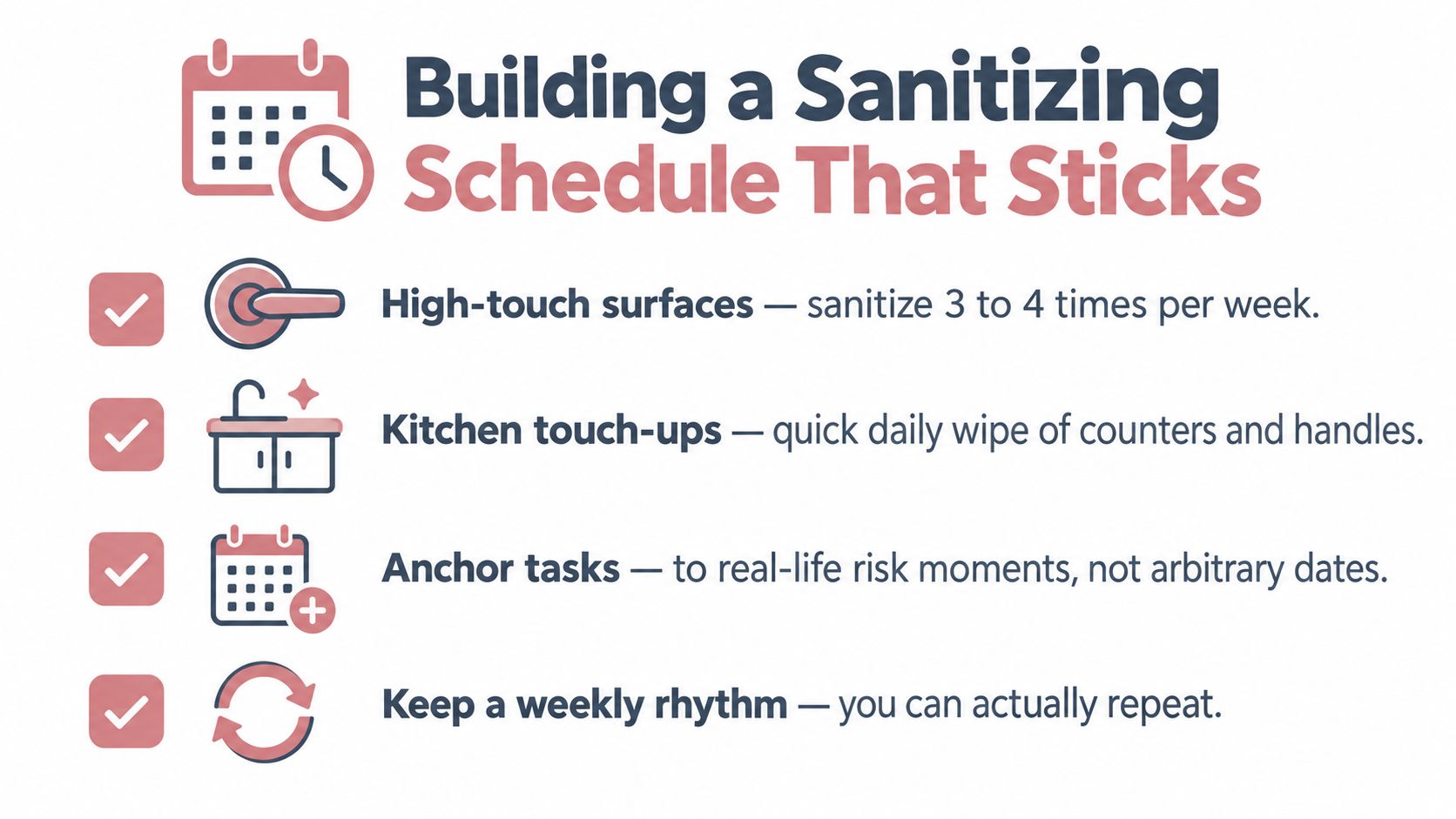
A schedule works better when it follows risk moments rather than arbitrary dates. A kitchen used for every meal needs more attention than a guest bedroom that rarely receives visitors. An entryway deserves extra care during muddy weather, allergy-heavy periods, or a stretch of frequent visitors.
Keep the weekly rhythm simple. Give doorknobs, light switches, faucet handles, toilet handles, counters, remotes, and stair rails recurring attention. Add quick kitchen and bathroom touch-ups to the days when those rooms already receive normal cleaning, so sanitizing doesn't become a separate project that gets postponed.
Use monthly tasks as reset points
Monthly maintenance can cover jobs that don't belong in a daily routine. Wash or launder doormats according to their care instructions, clean the inside of trash cans, and run the dishwasher empty on a sanitize cycle if the appliance has that setting and the manufacturer permits it.
Don't turn those tasks into a reason to ignore high-touch surfaces. A clean trash can interior won't compensate for a sticky refrigerator handle or a bathroom faucet that gets handled constantly.
Let household events change the plan
Back-to-school periods, flu season, a new pet, spring pollen, summer moisture, and an illness in the household are useful calendar anchors. The CDC advises disinfecting when someone is sick or when a person positive for COVID-19 has been in the home within the previous 24 hours, and it recommends cleaning visibly dirty surfaces first when the disinfectant doesn't also contain a cleaning agent. The CDC household cleaning guidance after illness gives that situation-specific approach.
Tape a printable checklist inside the utility closet, where everyone can see it. Add recurring reminders to a phone calendar, and assign rooms rather than expecting one person to remember every surface. A practical house cleaning schedule for a busy family should be repeatable on a tiring week, not perfect only on an unusually productive weekend.
Keeping Kids and Pets Safe During Sanitizing
A product can be effective and still be a poor choice for a surface a child crawls across or a pet licks. In homes with crawling infants or floor-playing toddlers, avoid spraying a wet sanitizer across reachable areas. Use a compatible wipe or apply a solution to a microfiber cloth so you can control the amount of liquid, limit overspray, and see exactly where the product goes.
Cats and dogs deserve the same practical caution. Don't use quaternary ammonium compounds or phenols on surfaces that pets may lick, and check the product's safety information before buying. Keep animals away until treated surfaces are fully dry, even when the product has a mild scent.
| Household Situation | Recommended Sanitizer Type | Avoid | Extra Precaution |
|---|---|---|---|
| Crawling infant or floor-playing toddler | A compatible wipe or controlled cloth application | Open spraying on reachable floors and low surfaces | Keep the child away until the surface is fully dry |
| Cat or dog that licks floors or furniture | A product confirmed suitable for the specific surface and exposure | Quaternary ammonium compounds and phenols on lickable areas | Rinse when the label requires it and restrict access during drying |
| Asthma or chemical sensitivity in the home | Fragrance-free, lower-fume options with clear label directions | Strongly scented products and uncontrolled aerosol spray | Open windows or run an exhaust fan during use |
| Household recovering from illness | An EPA-registered product approved for the relevant use | Unverified “natural” or “antibacterial” claims | Follow cleaning, application, and contact-time directions exactly |
Make ventilation non-negotiable
Open windows when practical, and run the bathroom fan during chemical sanitizing and for 15 minutes afterward. That ventilation step reduces lingering fumes and helps protect people who react to fragrances or cleaning chemicals. Don't combine products to “boost” performance. The CDC specifically flags mixing bleach with ammonia or other cleaners as unsafe.
Store concentrates in a locked cabinet or a high cabinet that children and pets can't reach. Keep each product in its original labeled container, never pour a cleaner into a drink bottle, and wipe the outside of containers before returning them to storage. A short labeling routine prevents a tired household member from confusing a diluted solution with a concentrate.
For households seeking gentler bathroom options, eco-friendly bathroom cleaning products can provide a useful starting point, but always verify the product label for its approved purpose.
When a Professional Cleaning Service Makes Sense
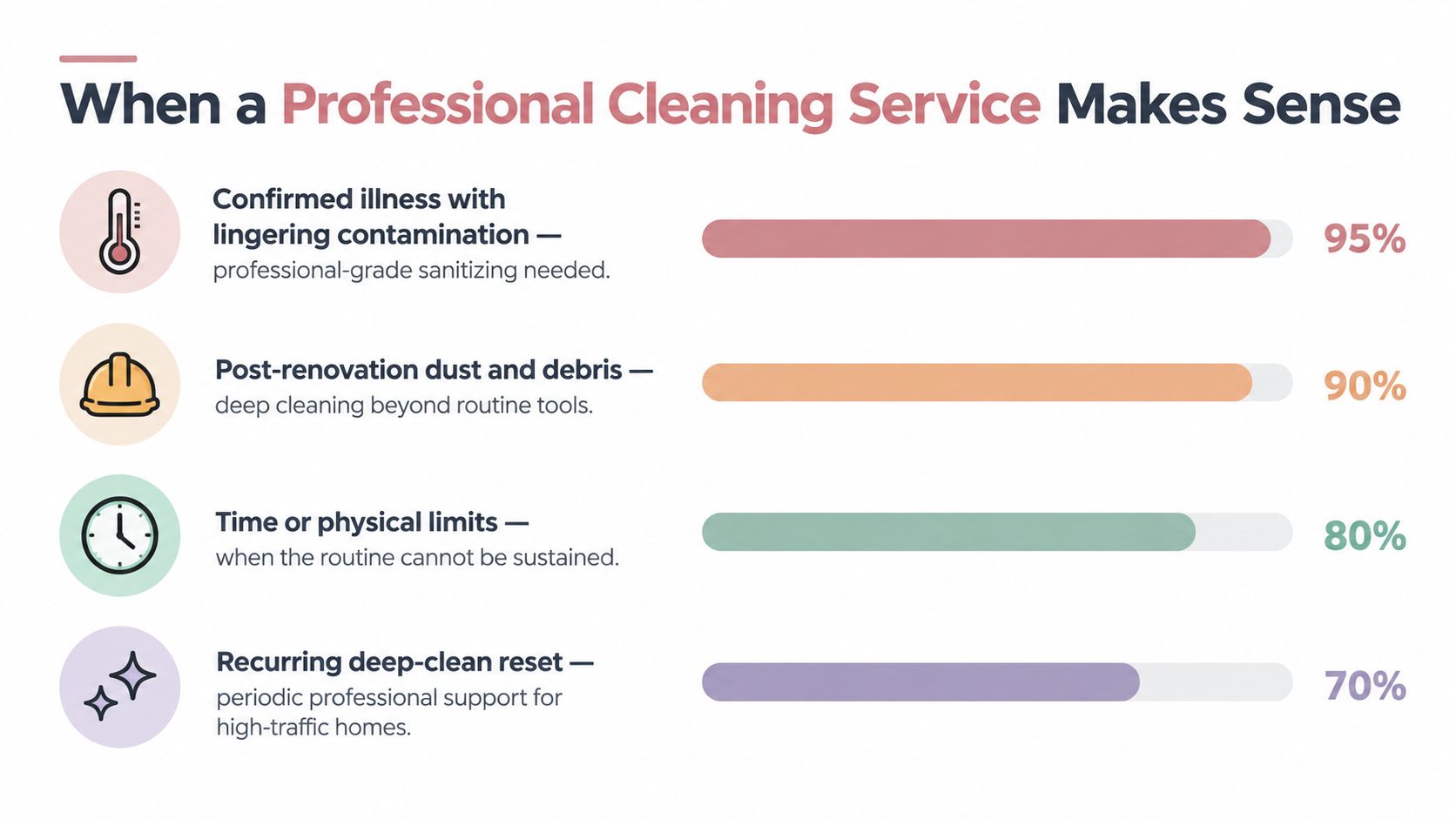
A professional service makes sense when the home needs more than targeted surface work. Consider one when illness leaves lingering contamination, renovation dust has settled into cracks and vents, water damage or visible mildew is present, a move-in or move-out deadline is approaching, hoarding recovery requires a controlled reset, or routine cleaning has been missed for more than a month.
Look for signs that a surface wipe won't solve the underlying problem:
- Persistent odors: The source may be inside upholstery, flooring, cabinetry, or ventilation paths.
- Sticky residue after mopping: Product buildup or embedded soil may need a different cleaning method.
- Recurring mold spots: Repeatedly wiping the visible area doesn't correct moisture or porous-material problems.
- Allergy symptoms that improve away from home: Dust, dander, moisture, or debris may be distributed beyond the obvious surfaces.
Ask what the service actually includes
A residential sanitizing or deep-cleaning service may offer HEPA vacuuming, steam sanitizing, and EPA-registered disinfectant application, but those are not automatic inclusions. Ask which rooms and surfaces will be treated, whether visible soil is removed first, which products are used, and how contact time will be handled.
A regular cleaning crew may focus on dusting, vacuuming, mopping, bathroom cleaning, kitchen cleaning, and surface wiping. That can maintain a home well, but it may not address post-construction residue, water-damaged materials, or a contamination event that requires specialized decisions.
If you're also weighing whether a household problem needs a specialist, a practical guide to should I do pest control myself can help separate routine maintenance from work that carries additional risks.
Before the visit, clear loose items from the surfaces you want treated, secure pets, and write down specific concerns. “Please sanitize everything” is less useful than “the bathroom was used by someone who was sick, and the toilet handle, faucet, light switch, and door knob need attention.” Targeted information produces a more useful visit than a generic wipe-down.
Putting It All Into Your Next Cleaning Day
On your next Saturday morning, use one pattern: clean, sanitize, then disinfect only where the risk justifies it. Start with the kitchen and bathroom, remove visible soil from high-touch zones, apply the product selected for each surface, and keep it wet for the label's required contact time.
Use an eco-friendly registered product for ordinary maintenance when it fits the household and surface. Ventilate, choose controlled application methods around children and pets, and keep everyone away until treated areas are dry. If illness, renovation debris, moisture damage, or persistent odors exceed what routine cleaning can handle, arrange a targeted professional assessment instead of repeatedly wiping the same symptoms.
Keep the house cleaning supplies checklist nearby, and put the recurring tasks on a visible checklist or phone reminder. That simple rhythm turns sanitizing house cleaning into a manageable finishing habit.
Aquastar Cleaning Services, LLC offers recurring housekeeping, deep cleaning, move-in and move-out cleaning, and post-construction cleanup for homes in Kennesaw and North Atlanta. If your kitchen, bathroom, or high-touch surfaces need a consistent room-by-room reset, visit Aquastar Cleaning Services, LLC to request a quote and discuss a cleaning plan.