


Deep cleaning is a targeted reset of neglected areas, while recurring housekeeping maintains the home between visits. In 2024, 80% of people performed household activities on an average day and spent about 2 hours on them, although that category includes cooking, lawn care, and household management as well as cleaning.
That distinction matters in a busy Kennesaw or North Atlanta home. You may vacuum the visible floor, wipe the kitchen counter, and clean the bathroom sink, yet still have dust on ceiling fans, residue around cabinet hardware, buildup inside an oven, and particles trapped in upholstered furniture. A regular visit keeps daily mess under control. A deep clean reaches the reservoirs that routine work usually leaves alone.
Professional deep house cleaning services are most useful when a home needs a clean baseline, after a renovation, before a move, or when a household's schedule has made neglected tasks accumulate. The right process isn't just about making rooms smell fresh. It controls settled dust, removes soil methodically, and gives you a practical maintenance plan for the weeks that follow.
Understanding the Two Types of Home Cleaning
A time-poor homeowner often faces the same choice on a Friday afternoon. The floors need attention, the bathroom looks dull, and guests are coming. A routine visit can restore order quickly, but it may not have enough time to scrub grout, wash baseboards, or degrease the inside of an oven. If those areas have been overlooked for months, adding another quick surface wipe won't solve the underlying problem.
Maintenance keeps the baseline
Recurring housekeeping is ongoing maintenance. It usually focuses on accessible surfaces, visible dust, floors, bathrooms, kitchen counters, and the small signs of daily life. The service works like watering a garden. It prevents ordinary disorder from becoming overwhelming, but it isn't designed to rebuild the soil or remove every neglected weed.
Deep house cleaning services work differently. The team moves into less accessible areas, works around fixtures and furniture, and spends time on buildup that doesn't disappear with a light wipe. A practical example is a kitchen where the counters look clean but the oven door has grease film, the cabinet handles feel sticky, and crumbs have collected beneath appliances. A deep clean treats those areas as part of the kitchen, not as optional decoration.
The comparison between deep cleaning and scaling can help homeowners understand why a reset requires a different scope from simple upkeep.
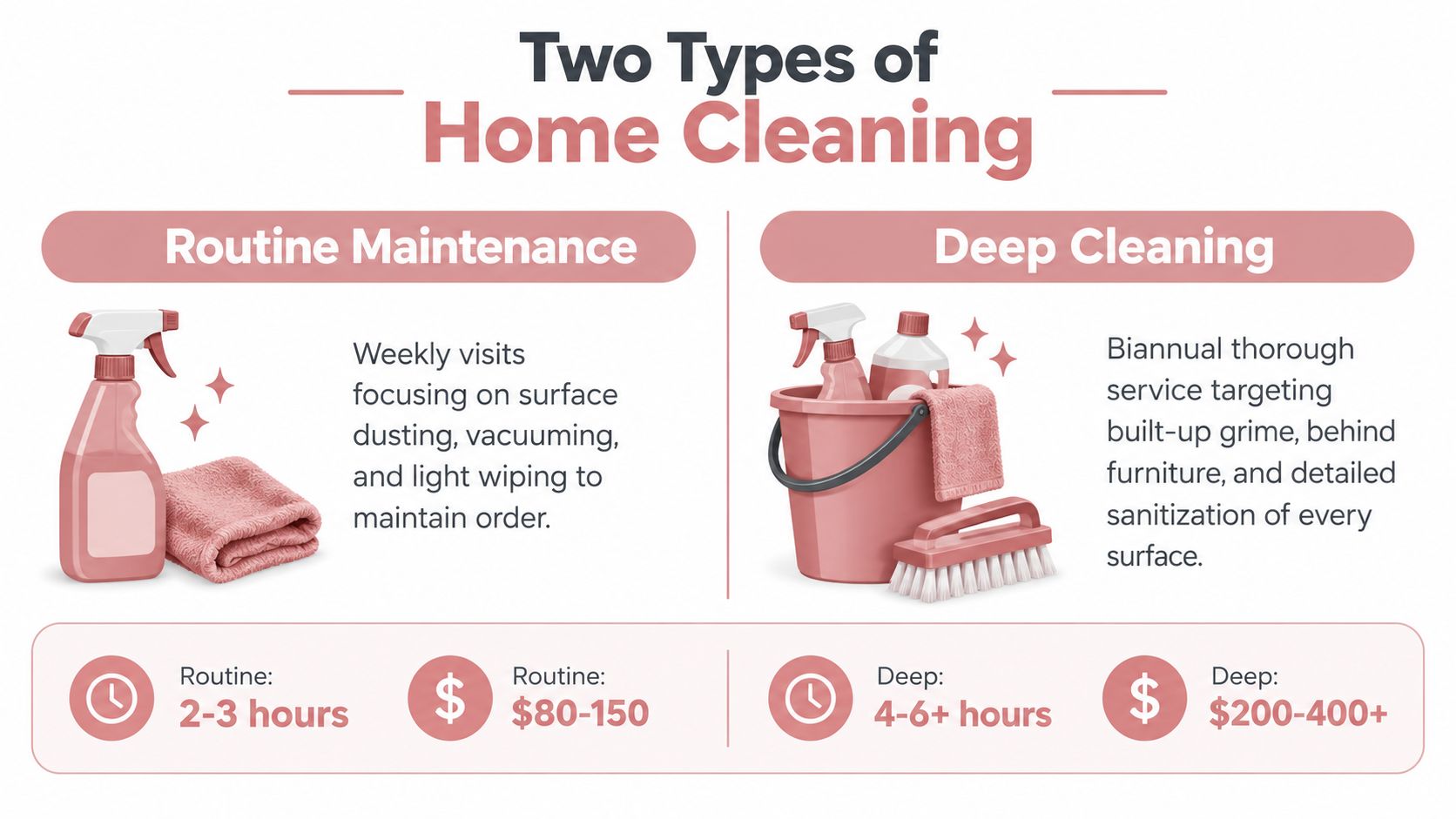
Choose the service based on the home's condition
A home that receives dependable maintenance may only need targeted detail work. A home with accumulated dust, pet hair, renovation residue, or long-neglected fixtures needs a broader reset before recurring visits can work efficiently.
The household workload also explains why professional support matters. The Bureau of Labor Statistics reports that adults living with children under age 18 who weren't employed spent about 2.9 hours per day on household activities, compared with 1.8 hours among employed adults with children, and the category includes more than cleaning alone (Bureau of Labor Statistics). A deep clean can remove a demanding backlog, while recurring service helps prevent that backlog from returning.
Practical rule: Use recurring housekeeping to preserve a clean baseline. Book a deep clean when the baseline itself needs to be rebuilt.
The Science Behind a Thorough Clean
In a Kennesaw home, dust may collect on a ceiling fan, settle into upholstery, and return to the air each time someone walks across the room. A thorough clean addresses that reservoir, so its value extends beyond a brighter-looking surface. The Environmental Protection Agency describes indoor dust as settled particulate matter from multiple sources. Cleaning, walking, vacuuming, and crawling can disturb it, allowing particles to become airborne. Fine particles may travel deep into the lungs and contribute to decreased lung function or aggravated asthma, according to EPA guidance for indoor air quality.
A deep clean is not medical treatment, and it cannot guarantee that every pollutant will disappear. It does make particle control more deliberate. A dry feather duster can shift dust from a shelf into the breathing zone. A damp microfiber cloth holds settled particles while the cleaner removes them, much like a net catching debris instead of scattering it.
Control the dust reservoir
A professional process should move from high surfaces to low surfaces. Ceiling fans, light fixtures, shelves, vents, and cabinet tops come first. Baseboards and floors come later, allowing fallen particles to be collected rather than deposited on surfaces that were already cleaned.
The EPA recommends frequent vacuuming of carpets and upholstered furniture, damp-dusting hard surfaces, ventilation, and consideration of a HEPA-filtered vacuum. HEPA filtration helps limit the dust that escapes through a vacuum's exhaust. For North Atlanta households with pets, children, or allergy-sensitive residents, reducing recirculated particles offers more practical value than masking odors with a strong fragrance.
Furniture can function as a dust reservoir too. Vacuuming a visible rug while overlooking a sofa, fabric chair, baseboards, or an air-return area leaves several surfaces that can release particles again. A cleaner should treat the room like a connected system, not a collection of isolated chores.
Cleaning isn't the same as disinfection
Cleaning removes soil, residue, and organic material through mechanical action, such as wiping, scrubbing, or washing with soap and water. Disinfection uses a product designed to destroy or inactivate germs on a compatible surface. The Centers for Disease Control and Prevention recommends cleaning surfaces first because soil and organic residue can interfere with disinfectant performance. Its home cleaning and disinfection guidance explains that disinfection is generally most appropriate when someone is sick, has recently visited, or household members face heightened infection risk. For a clearer explanation of the distinction, see this guide to the difference between sanitizers and disinfectants.
If disinfection is needed, use the product at its label concentration and keep the surface visibly wet for the stated contact time. Spraying a doorknob and wiping it immediately may make it look clean, while evaporation prevents the product from working as intended. Remove mechanical soil first, then disinfect compatible high-touch points such as faucet handles, light switches, doorknobs, and toilet touchpoints.
Room-by-Room Deep Cleaning Checklist
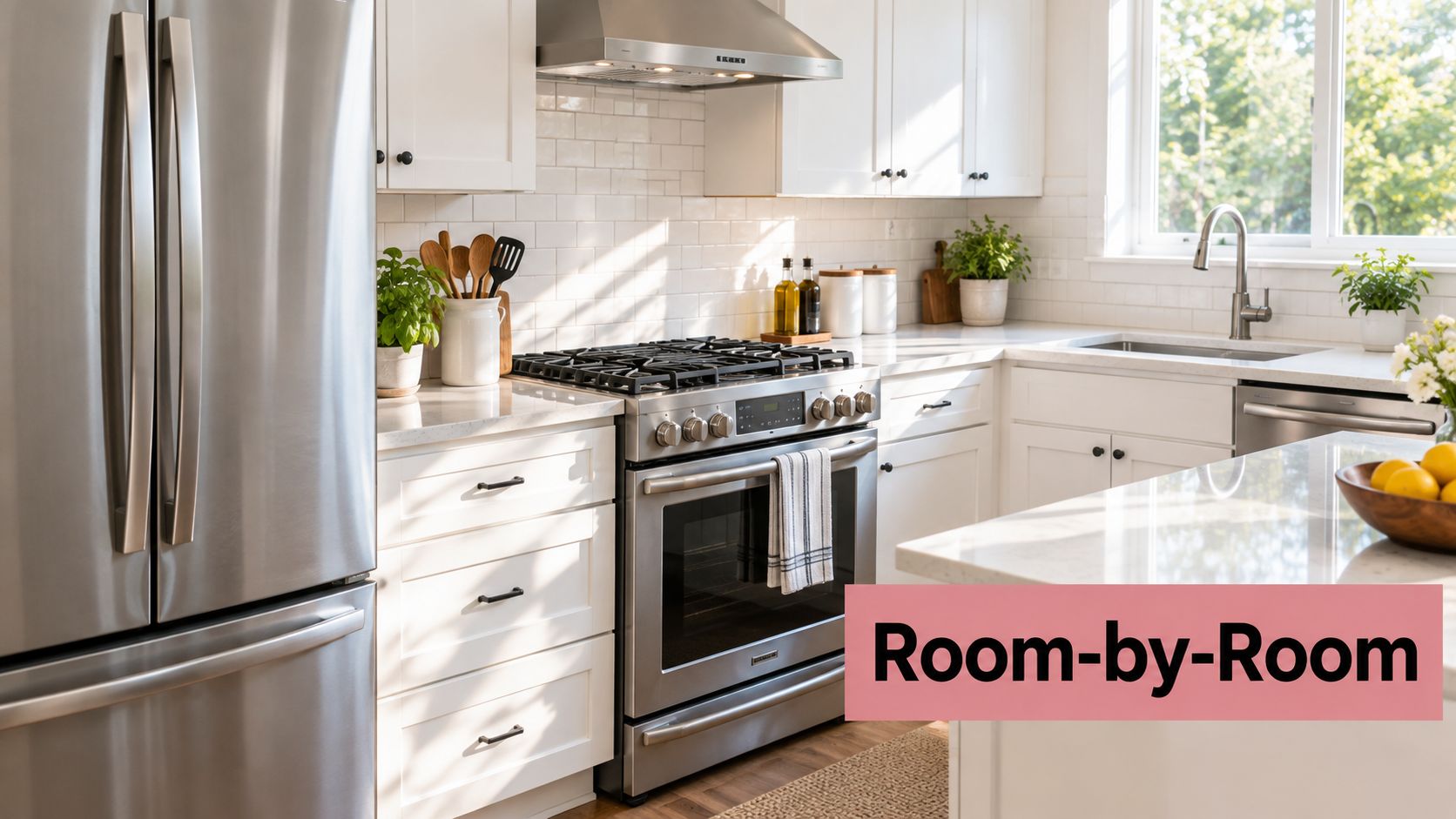
A whole-home deep clean should follow a defined route rather than a random collection of chores. The route prevents a cleaner from finishing the visible center of a room while overlooking the edges, upper surfaces, and hidden reservoirs that hold dust.
Kitchen
Start high, then work toward the floor. Wipe cabinet tops, range-hood surfaces, light fixtures, doors, and trim with a damp microfiber cloth. Clean cabinet fronts and hardware, degrease the stovetop, detail backsplash grout, and address the exterior of appliances. Interior refrigerator and oven work may be included as an add-on, so confirm that scope before the appointment.
For example, a family in Kennesaw may have a clean-looking island but greasy fingerprints around drawer pulls and dried cooking residue near the range. Those details affect how the room feels and how much soil later transfers to hands.
Bathrooms
Remove surface soil before applying any disinfectant. Scrub shower walls, tub interiors, grout, faucets, sinks, toilet surfaces, doors, and handles. Descaling may be needed around showerheads and faucets, while damp wiping of vents, baseboards, and shelving helps address settled dust outside the obvious wet areas.
The deep cleaning checklist is useful when you want to compare a proposed service scope with the areas that require attention.
Bedrooms
Bedrooms need more than bed making. Vacuum floors, rugs, upholstered headboards, and accessible furniture. Damp-wipe nightstands, lamps, baseboards, doors, and window sills. Reduce dust reservoirs by clearing clothing piles, toys, and decorative items before cleaning.
Dust-mite control deserves specific attention. The American Lung Association recommends keeping indoor humidity below 50%, washing bedding weekly in water of at least 120°F, using allergen-proof mattress and pillow encasements, and dusting with a damp microfiber cloth. Its dust-mite recommendations give a bedroom deep clean a practical purpose beyond appearance.
Living and dining areas
Move reachable furniture where safe, vacuum upholstery and rug edges, and clean ceiling fans, shelves, picture frames, doors, switch plates, baseboards, and vents. A dining room table may need careful attention around chair rails and underneath the tabletop, while a family room often needs work along sofa edges and behind media furniture.
Finish with hard floors. Vacuuming first collects loose material, and damp mopping then removes the film that vacuuming cannot capture.
Essential Add-Ons for a Complete Refresh
A standard whole-home deep clean won't address every specialized problem. The best add-on is the one that matches the source of the mess, not the one with the most impressive name.
Interior appliances
Choose refrigerator or oven cleaning when food residue, grease, or odors have accumulated inside the appliance. This is especially practical before moving into a home, after a period of heavy cooking, or before listing a property. Exterior detailing alone won't remove residue from racks, seals, shelves, and interior walls.
Windows and overlooked storage areas
Interior window glass, sills, and tracks can collect dust and pollen, while garages and basements may hold debris that migrates into living areas. Window work makes sense when the glass is visibly filmed or when tracks have accumulated dirt. Basement or garage cleaning is more useful when stored items can be grouped safely and the team can reach the floor perimeter.
Carpets and upholstery
Vacuuming is a baseline control, not a substitute for every carpet-care method. If a carpet has embedded soil or an upholstered chair has absorbed household odors, a dedicated carpet-cleaning specialist may be more appropriate than a standard deep-cleaning visit. Ask whether the service uses a separate process and whether the material requires special handling.
Renovation and construction residue
Post-construction cleaning needs a different sequence. EPA lead-safe renovation guidance recommends using a properly designed HEPA vacuum on remaining surfaces and objects, followed by wet disposable cleaning cloths until they remain clean, with thorough mopping of uncarpeted floors. A true HEPA vacuum captures particles measuring 0.3 microns with 99.97% efficiency, and the machine must be sealed so air doesn't bypass the filter, as explained in EPA renovation cleanup guidance.
A regular shop vacuum with a replacement HEPA filter isn't automatically equivalent. If older painted surfaces were disturbed, isolate the work area, keep children, pregnant people, and pets outside it until cleanup is complete, and follow lead-safe procedures rather than treating the job as ordinary dust removal.
Product choice also deserves a careful conversation. “Eco-friendly” doesn't automatically mean fragrance-free or lower-risk for every resident. Recent Purdue-led research presented at the American Chemical Society's Fall 2026 meeting found that conventional fragranced cleaners and botanical-oil products can react with indoor ozone, producing ultrafine particles, including particles measuring 1 to 30 nanometers (research coverage on fragranced cleaning products). If you're comparing options, you can find green cleaning from Living Air, then ask the cleaning company whether fragrance-free products, open windows, exhaust fans, and occupant re-entry planning are available.
Why Hire a Trained and Insured Team
A true deep clean combines chemistry, equipment, sequencing, and judgment. Someone scrubbing a bathroom needs to know which surfaces tolerate a product, when soil must be removed before disinfection, and how to prevent a strong cleaner from damaging stone, metal, finished wood, or painted trim.
Insurance and bonding provide practical protection when cleaners work inside a private home. They don't replace careful hiring, but they give homeowners a clear question to ask before booking: does the company carry appropriate coverage, and can it explain what that coverage means for the visit? You can also ask whether staff are background-checked, trained, and assigned a written room-by-room checklist. Guidance on why an insured cleaning service matters can help you evaluate those details.
A defined process protects consistency
An organized team should be able to explain:
- Product control: Which solutions are used, whether fragrance-free choices are available, and how surfaces are checked for compatibility.
- Dust control: Whether cleaners use damp microfiber methods, work from high to low, and use suitable filtration for carpets, furniture, and renovation residue.
- Scope control: Which rooms, appliances, fixtures, and add-ons are included, and what requires a separate quote.
- Safety control: How pets, children, asthma-sensitive residents, and recently renovated areas are managed.
Eco-conscious cleaning also needs precise language. A biodegradable solution may appeal to a family with children and pets, but “natural” doesn't automatically mean harmless to every person or animal. Ask about essential oils, fragrance, ventilation, and the time residents should remain out of a freshly treated room.
For a household in Kennesaw, the benefit is not just speed. It is having trained people apply a repeatable method to tasks that are easy to postpone, difficult to reach, or risky to improvise.
Preparing Your Home and Understanding Costs
A family in Kennesaw may schedule a whole-home reset before guests arrive, after renovation work, or when dust keeps returning despite regular tidying. Preparation helps the cleaners spend their visit removing soil, particles, and buildup instead of moving household items.
Before the appointment
Put loose clothing, toys, paperwork, and dishes in their normal storage places. Clear the floor around beds and sofas, protect valuable or fragile belongings, and mark rooms that need extra attention. If pets become uneasy around unfamiliar people or equipment, set up a quiet separate area with water and familiar bedding.
Share relevant household conditions before the visit, including asthma, allergies, migraines, chemical sensitivity, pets, renovation history, delicate surfaces, and fragrance preferences. Ask which rooms need additional ventilation and when residents can safely return. Purdue researchers have reported that scented cleaning activities can generate particles that ordinary home air-quality monitors may miss. A strong smell therefore does not reliably indicate a stronger result, as discussed in recent findings on indoor cleaning aerosols.

What shapes a quote
The cost of deep house cleaning services reflects the work involved, not the room count. A larger home usually takes more labor. Heavy buildup, clutter, pets, stairs, and restricted access can also affect the time and equipment required. A one-time reset generally has a different scope from recurring service that maintains the same baseline.
List add-ons separately so the quote remains clear. Interior oven or refrigerator cleaning, windows, carpets, garages, basements, and post-construction residue may each alter the plan. If window cleaning is included, a cost estimate from Professional Window Cleaning offers a useful comparison for treating that work as a separate service rather than assuming it is included.
Request a written scope naming rooms, surfaces, add-ons, products, estimated labor, and conditions that could change the price. A whole-house cleaning price guide provides another framework for asking precise questions before approving the work.
Conclusion Choosing Your Cleaning Strategy
The most sensible plan usually has two layers. Deep cleaning resets the home, while recurring housekeeping protects that reset. Treating both services as interchangeable creates confusion. A maintenance visit isn't failing when it doesn't clean behind every appliance, and a deep clean isn't excessive when buildup has accumulated in those places.
Use the home's condition as your starting point. Visible grime around fixtures, dusty baseboards, neglected vents, residue inside appliances, and renovation dust all suggest that a surface-focused visit won't be enough. A household with children, pets, asthma, allergies, or chemical sensitivity should also discuss damp methods, filtration, fragrance, ventilation, and re-entry before work begins.
Match the method to the problem
For ordinary weekly disorder, recurring service may be the appropriate tool. For a move, a seasonal reset, a long-neglected home, or a renovation, choose a defined deep-cleaning scope. For a bedroom affected by dust mites, combine damp dusting with bedding care and humidity control. For construction residue, require isolation, HEPA equipment, wet wiping, and careful floor cleaning.
A practical example is a North Atlanta family returning to a renovated home. The family shouldn't ask only whether the floors look clean. They should ask whether walls, trim, fixtures, furniture, and hard floors were cleaned in sequence, whether fine dust was captured rather than redistributed, and whether residents have a clear ventilation and re-entry plan.
The strongest cleaning strategy is specific. It names the rooms, surfaces, products, equipment, add-ons, and maintenance schedule. It also leaves room for household needs to change, because the right plan for a pet-owning family may differ from the right plan for a landlord preparing an empty property.
Aquastar Cleaning Services, LLC offers recurring housekeeping, one-time deep cleaning, move-in and move-out service, and post-construction cleanup for homes in Kennesaw and the North Atlanta area. Visit Aquastar Cleaning Services, LLC to request a cleaning plan that matches your home's rooms, surfaces, air-quality concerns, and preferred products.