


It's Saturday morning, the dishwasher isn't draining, and your white sink has become the backup dish station. You clear the plates, spray the basin, and scrub, but a gray ring and yellow shadow remain. Before reaching for a stronger white sink cleaner, check what the sink is made of and what's sitting on its surface.
Why Your White Sink Stays Dingy No Matter What You Spray
A stained sink can make you feel as though you haven't cleaned properly. But effort isn't always the problem. You might be using a cleaner designed for greasy residue on a chalky mineral deposit, or treating a damaged finish as removable dirt.
Think of cleaning like choosing a laundry treatment. You wouldn't tackle muddy trousers and a stained silk blouse with the same brush and bottle. A white basin needs that same distinction, even when every mark looks vaguely gray or yellow.
Start with the basin, not the bottle
Before applying anything stronger, make these checks:
- Identify the material. Look for installation paperwork, a model name, or the manufacturer's care guide. White porcelain enamel, acrylic, solid surface, and composite quartz shouldn't automatically receive the same treatment.
- Describe the mark. Is it a chalky ring, an orange halo, a coffee-colored patch, or a dull area with no raised residue?
- Consider the household. Choose a method you can use with the required ventilation and protective equipment, while keeping children and pets away from the work area.
For example, suppose the basin feels smooth except for a rough ring around the drain. Start by washing and rinsing it, then assess the remaining deposit. If the ring remains, investigate a material-approved mineral treatment rather than repeatedly applying a whitening cleaner.
A gray mark left after washing cookware needs a different decision. Try the sink maker's approved cleaner with a soft cloth, but stop if the area looks scratched or changes sheen.
Practical rule: Clean the deposit you can identify. Don't keep increasing chemical strength to chase a mark you haven't identified.
Your most useful cleaning tool may be the care guide rather than another bottle. The right white sink cleaner fits the material, the stain, and the conditions in your home.
What a White Sink Cleaner Actually Does
White sink cleaner describes an application, not a single chemical formula. A product might remove everyday soil, lighten colored residue, dissolve scale, or disinfect a compatible surface. Those jobs overlap, but they aren't interchangeable.
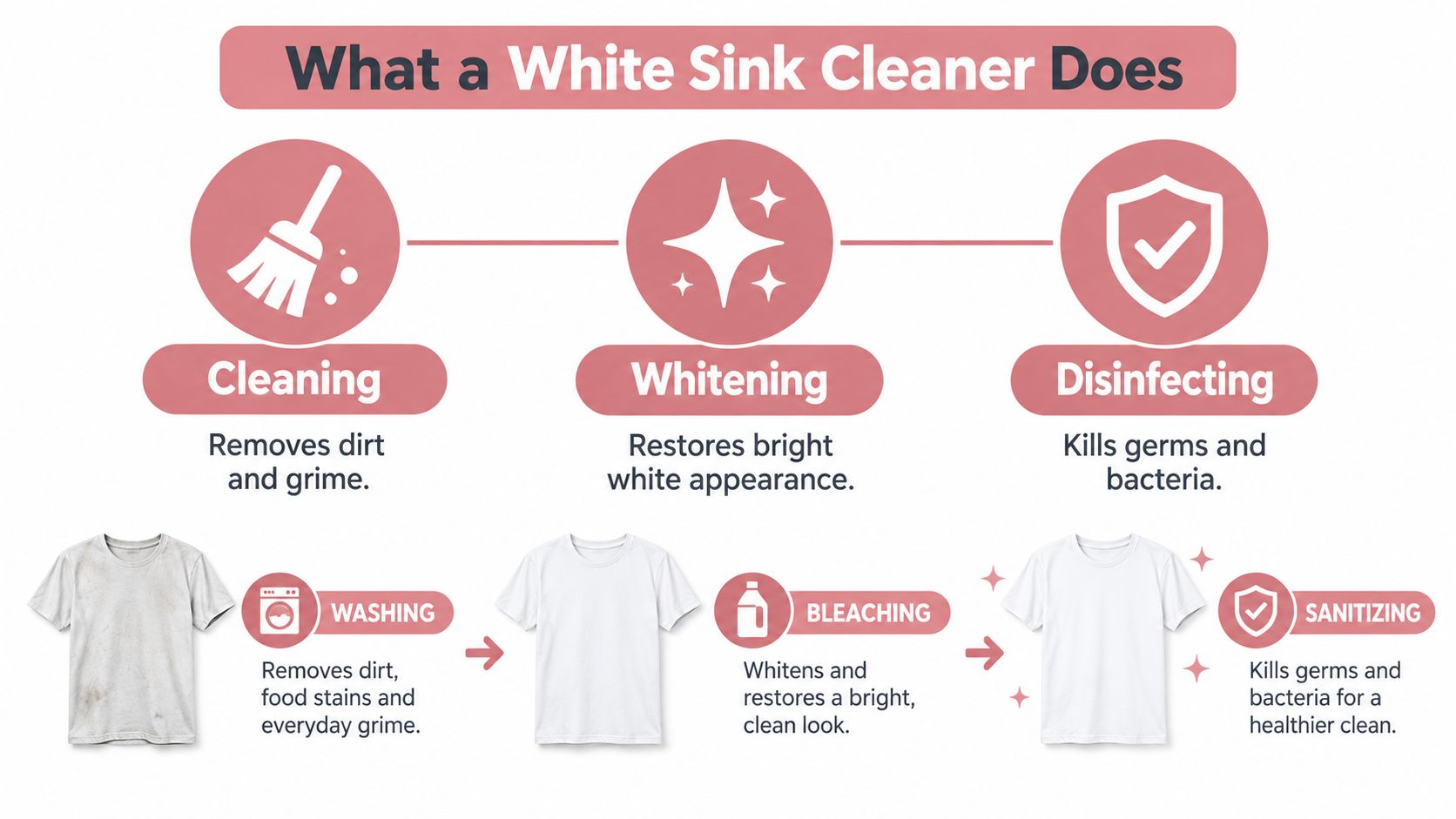
The white T-shirt analogy helps: washing removes dirt, bleaching changes visible discoloration, and sanitizing addresses microorganisms. A shirt can look bright without being sanitized. Likewise, a sink can look white while still carrying food residue.
The distinction is illustrated below.
Read the job description on the label
| Cleaner category | What you're asking it to do | Practical example |
|---|---|---|
| Detergent | Remove routine soil | Wash away greasy food film |
| Oxidizing cleaner | Treat colored organic residue | Address a compatible basin's food stain |
| Acidic descaler | Remove mineral deposits | Treat a hard-water ring |
| Labeled disinfectant | Disinfect under specified conditions | Treat an appropriate surface after contamination |
Sodium hypochlorite, the active ingredient in chlorine bleach, has a longstanding role in bleaching and disinfecting. The American Cleaning Institute's sodium hypochlorite overview describes household formulations containing roughly 1–7% sodium hypochlorite and includes sinks among bleach-product applications. That doesn't mean every white sink can tolerate every bleach product.
Dilution is part of the method, not an optional adjustment. A prepared sanitation solution and concentrated bleach are different applications, and neither should be improvised into a spot-whitening paste. Use the label's dilution, surface restrictions, and contact instructions.
For routine shopping, you can compare Astonish kitchen spray prices through N-TASH, then check the product label separately for your basin's compatibility and intended cleaning task. A kitchen-cleaner name, fragrance, or price doesn't establish disinfecting performance.
Choose the cleaning job first, then choose a product labeled to perform it.
Matching Your Cleaner to the Sink Material
A glossy white basin doesn't tell you enough about its construction. Porcelain enamel over metal, ceramic, acrylic, and composite materials may look similar from across the room. Don't identify them by color alone.
Start with the sink manufacturer's instructions. If the material remains uncertain, use a compatible mild detergent and soft cloth while you investigate, rather than testing a strong acid or abrasive powder across the whole basin.
Sink Material Versus Cleaner Compatibility
“Safe” in this table means approved for the specific sink and used as directed, not universally safe across the category.
| Sink Material | Safe Cleaner Types | Avoid |
|---|---|---|
| Porcelain enamel | Mild detergent; labeled nonabrasive cleaner; compatible descaler on intact areas | Steel wool, aggressive scouring, prolonged acid exposure around damaged edges |
| Vitreous china or ceramic | Mild detergent; manufacturer-approved ceramic cleaner | Abrasive powders and unapproved chemical treatments |
| Acrylic | Mild detergent; cleaner specifically approved for acrylic | Unapproved abrasives, bleach, or acidic treatments |
| Solid surface | Mild detergent; the maker's specified stain treatment | Assuming all finishes permit the same pads or chemicals |
| Composite quartz or granite | Mild detergent; exact manufacturer-approved stain and scale products | Improvised bleach soaks, aggressive pads, unapproved acids |
| Stainless steel | Compatible detergent or stainless-steel cleaner | Chlorine bleach and steel wool |
| Marble or cultured-marble surroundings | Cleaner approved for the particular surface | Unapproved acidic descalers or bleach |
The EPA's disinfectant-selection guidance warns about bleach compatibility with materials including stainless steel, aluminum, copper, brass, marble, and granite. A product suitable for the basin may still be unsuitable for the drain, faucet, or surrounding countertop.
Protect the finish while treating the mark
Consider an older enamel sink with a chip near the drain. An acid-compatible section of intact enamel doesn't make the exposed edge an appropriate descaling target. Keep treatment confined to approved areas, and don't scrub harder around damage.
For a composite basin, consult Aquastar's composite granite sink cleaning guide, alongside the manufacturer's instructions. Prefer a labeled nonabrasive cream or gel when permitted, and test it in an inconspicuous area before wider use.
The same finish-preservation mindset applies beyond sinks. SouthRay Kitchen & Bath's guide to avoid cloudy tubs with proper cleaning is a related resource for homeowners comparing bathroom-surface care.
If a test patch changes color, sheen, or texture, stop. A brighter patch isn't a success if you've altered the finish.
Five Common Stains and the Right Cleaner for Each
Look closely before treating the basin. The location, texture, and color of a mark help you choose a sensible starting method, though appearance alone isn't a definitive diagnosis.
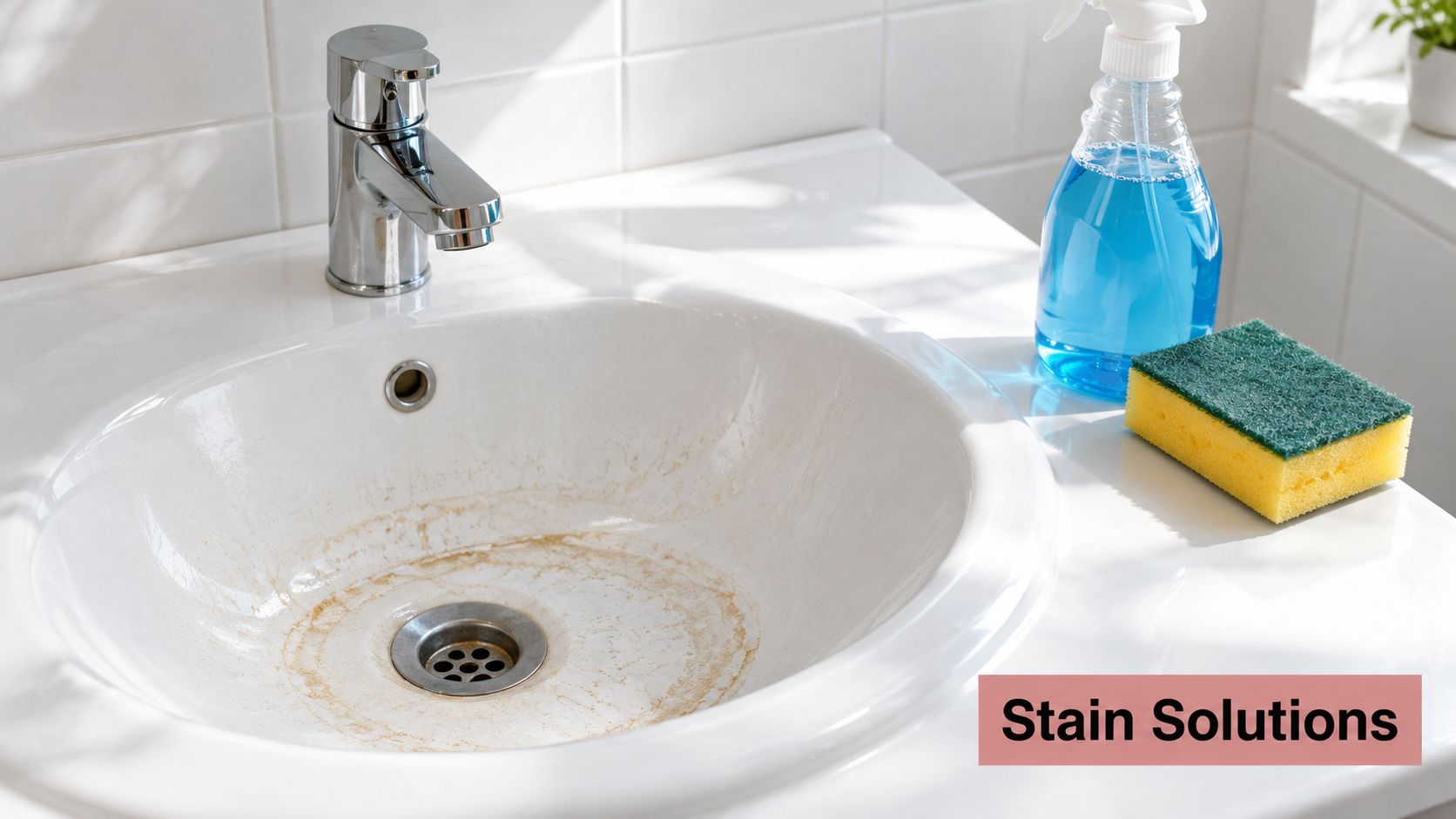
A stained bathroom sink offers several different cleaning problems in the same small space.
Chalky scale and orange rust halos
Hard-water scale: On an acid-compatible porcelain or enamel basin, wash away loose soil, rinse, and apply a labeled citric-acid descaler only to the deposit. Respect its dwell-time limit, rinse thoroughly, and dry. Acid treatment targets mineral scale rather than bleaching its appearance, as described in the Lemi Shine calcium-removal product information.
For example, treat a chalky ring locally rather than covering the faucet and countertop with descaler. Aquastar's hard-water solutions guide provides related reading for recurring deposits.
Rust-colored halos: After detergent cleaning, use a rust remover explicitly labeled for the sink material. Apply it to the orange mark, follow the stated contact period, and rinse as directed. Don't substitute extra scrubbing for a compatible treatment.
Protect adjoining stone during either job. Varun Marbles' guide to fix cloudy marble countertops is a separate resource for nearby marble surfaces, not permission to use basin descaler on stone.
Food stains, mildew shadows, and bathroom residue
A coffee-colored patch calls for a stain product, not automatically a disinfectant. Start with detergent; if color remains, consider a surface-approved oxygen-bleach or hydrogen-peroxide product whose label covers the stain. Apply it as directed, observe the label's dwell time, then rinse and assess the dry surface.
For mildew-colored shadows, clean the visible soil first. If the basin permits it, choose a labeled bleach or hydrogen-peroxide treatment for that task, using its specified dilution and contact method. Don't assume a stain disappearing proves successful disinfection.
Toothpaste and makeup residue usually deserve the gentlest starting approach:
- Prepare: Remove loose debris and wet a soft cloth.
- Clean: Apply compatible mild detergent and work over the residue gently.
- Finish: Rinse away loosened soil and cleaner, then dry before judging any remaining mark.
For example, wash a makeup smear before deciding that the basin has permanently yellowed. Escalate only after you can see what ordinary cleaning leaves behind.
DIY Recipes That Actually Work on a White Sink
DIY cleaning needs boundaries. A familiar household ingredient isn't automatically compatible with a glossy finish, and there's no universal homemade paste that belongs on every white basin.
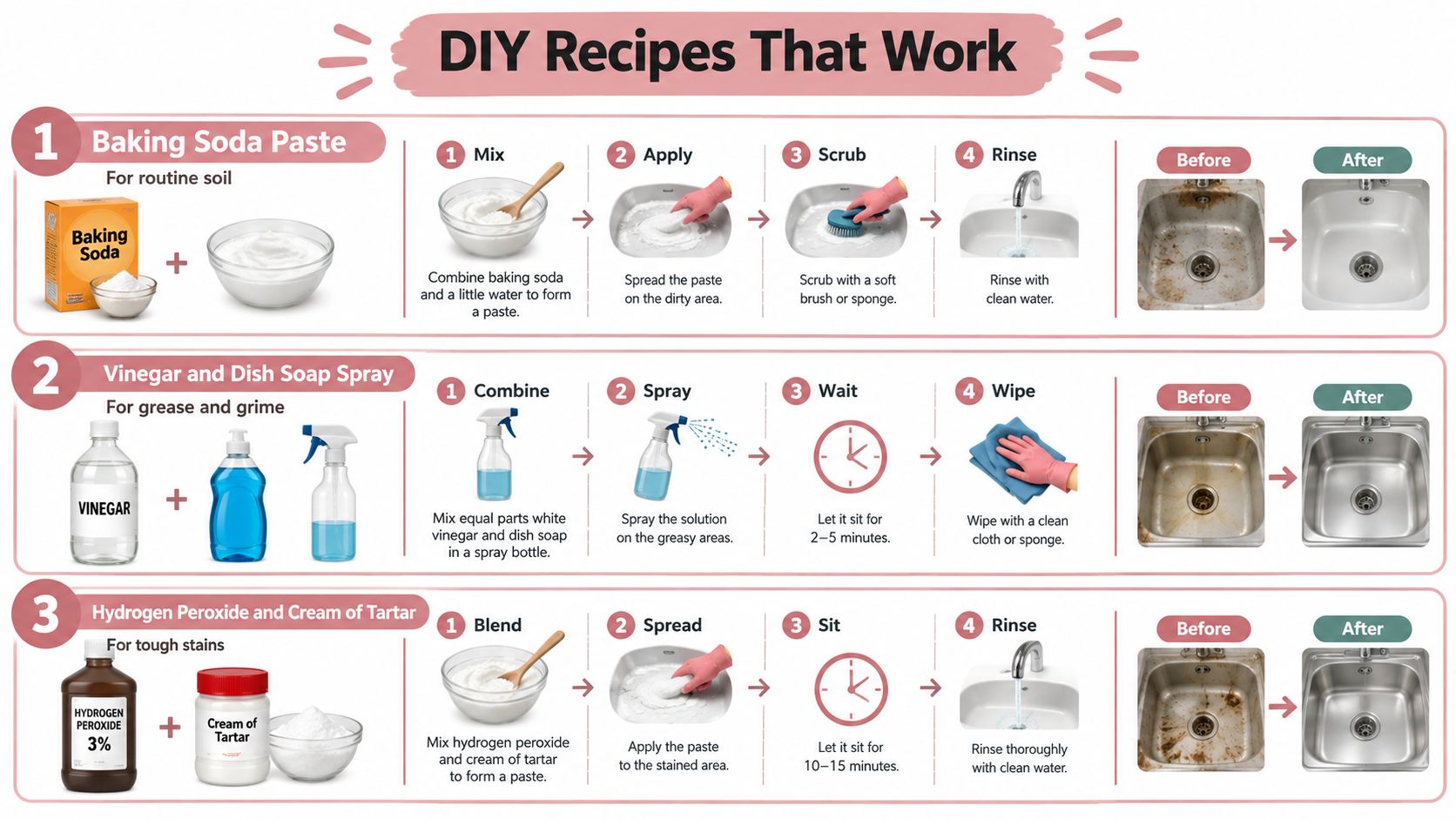
The illustration below shows household cleaning approaches. Treat it as a visual overview, not a surface-compatibility chart: its stainless-steel example and mixtures aren't blanket recommendations for white sinks.
Keep homemade treatments simple
Baking-soda paste: Use this only when the sink maker permits baking soda. Add water gradually to make a spreadable paste, apply with a soft cloth, work gently, and rinse completely. If a toothpaste patch doesn't respond, don't turn the paste into an aggressive scouring treatment.
A paste can go wrong without any dramatic reaction. For example, rubbing harder to remove a gray line may leave a changed finish instead of a clean one. Stop when the surface changes, not when you've exhausted your patience.
Peroxide-based stain treatment: Don't invent a hydrogen-peroxide-and-baking-soda formula for an unidentified basin. Use a labeled peroxide cleaner, or follow an exact manufacturer-approved method, for the material and stain. No universal mixing amount or soak time is appropriate here.
Use measured bleach only for an appropriate task
For certain non-food-contact, nonporous surfaces, including sinks, CDC bleach sanitation guidance specifies 1 cup, or 240 milliliters, of bleach in 5 gallons of water. That context-specific benchmark isn't permission for an undiluted soak, a food-contact application, or use on an incompatible sink.
Never mix bleach with another cleaner. CDC bleach safety instructions warn that acids can release chlorine gas and ammonia can produce chloramine vapors. Adding vinegar to bleach in a poorly ventilated bathroom is a hazardous combination, not an improved recipe.
If you're considering vinegar for a separate task, consult Aquastar's vinegar cleaning recipe guide and verify material compatibility first.
Use the video below as supplemental viewing, with product labels and sink-care instructions taking priority.
Eco-Friendly and Family-Safe Alternatives Worth Trying
The bleach-first approach isn't always the most useful approach. A milder cleaner that matches the deposit can be a better choice than a stronger product aimed at a different task.
For everyday food film or bathroom residue, start with a compatible detergent. For mineral buildup, consider a labeled citric-acid descaler on an approved surface. For colored organic residue, investigate a compatible peroxide-based stain product rather than assuming chlorine bleach is necessary.
Use labels as a screening tool
EPA Safer Choice certification evaluates ingredients and performance against environmental and human-health criteria. It's a useful shopping filter, but it doesn't replace the surface checks described earlier.
Likewise, plant-based or enzyme-containing detergent labels don't establish universal sink compatibility. Read the intended uses and precautions. “Natural” isn't a substitute for a care guide.
For a family bathroom, a practical low-complexity routine might be detergent, water, and a soft cloth for toothpaste splatter. If the manufacturer permits baking soda, reserve it for a specific stubborn patch rather than scrubbing the entire glossy basin.
- Choose for the task. Don't buy a disinfectant solely to remove a visible mineral ring.
- Keep products separate. Eco-friendly branding doesn't make mixing safe.
- Control access. Store cleaners and prepared solutions where children and pets can't reach them.
- Read precautions. Follow protective-equipment, ventilation, and rinsing requirements.
A gentler cleaning plan means selecting an appropriate method, not assuming harmlessness from an ingredient's name.
Aquastar's eco-friendly bathroom cleaning product guide offers related options to consider alongside your sink's care instructions.
If a mild treatment fails, reassess the mark before escalating. You may need a more targeted cleaner, or advice about finish damage, rather than a stronger general-purpose bottle.
Building a Weekly White Sink Routine That Lasts
A manageable routine separates quick care from stain treatment. You don't need to turn every rinse into a deep-cleaning session or every weekly clean into a whitening soak.
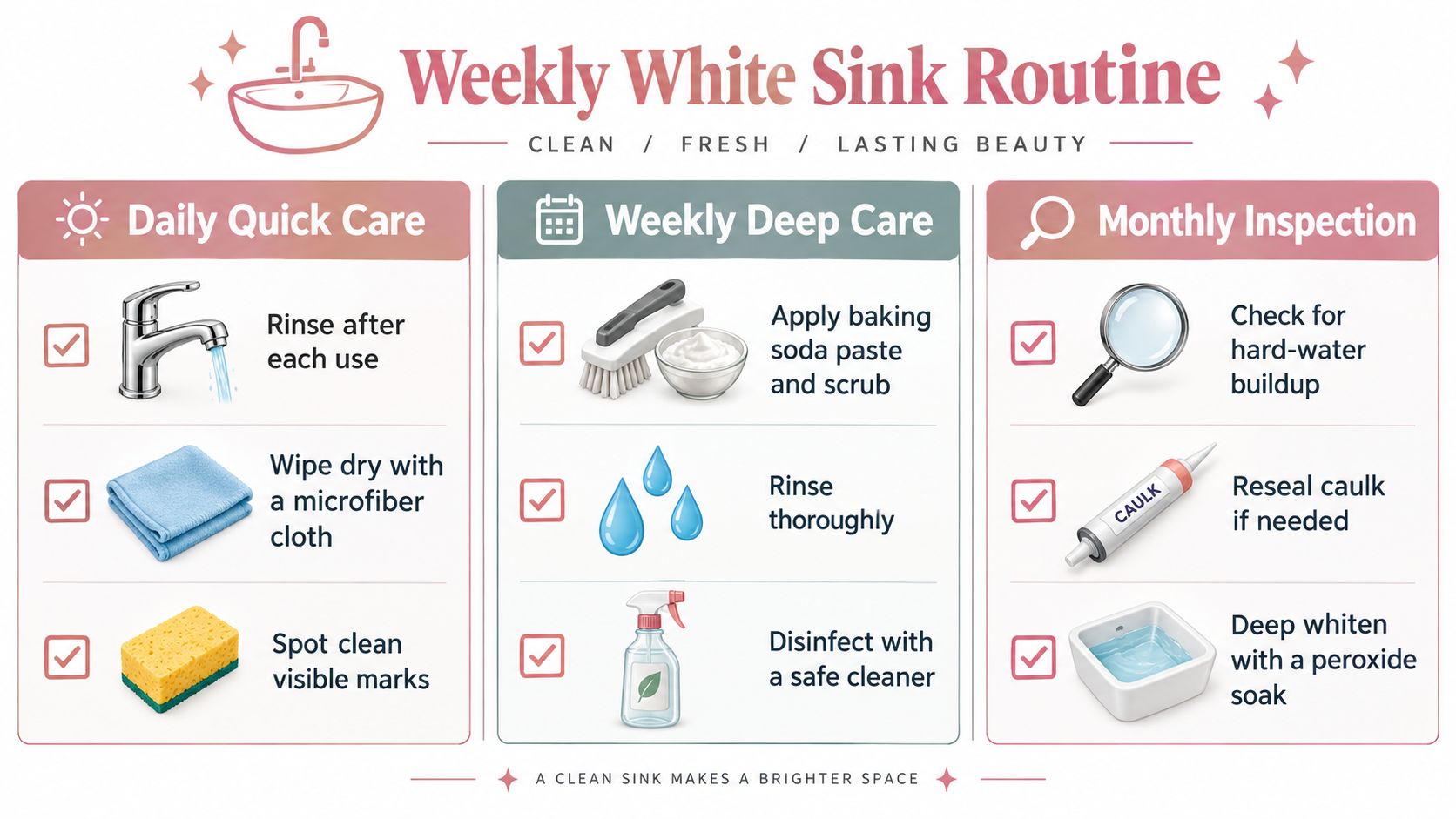
Use the schedule illustration as a reminder of the rhythm, but substitute your material-approved methods. Baking soda, peroxide, and scheduled disinfection aren't suitable defaults for every basin.
Follow a realistic household rhythm
| Routine | Practical action |
|---|---|
| Daily quick care | Remove debris, rinse residue, and wipe dry with a clean soft cloth |
| Weekly deeper care | Wash the basin, rim, and accessible faucet base with compatible detergent; assess remaining marks |
| Monthly inspection | Look for mineral buildup, chips, changed sheen, and deteriorated caulk |
Cleaning comes before sanitizing or disinfecting. The CDC's home cleaning guidance explains that dirt and impurities can reduce sanitizing chemicals' effectiveness. After raw-meat handling, for example, remove food residue and clean before using an appropriate labeled sanitation treatment.
Keep the routine supplies together:
- Soft tools: A clean microfiber cloth and non-scratching sponge.
- Routine cleaner: Detergent approved for the basin.
- Targeted treatment: A compatible product for your recurring stain.
- Safety information: Accessible product labels and the sink-care guide.
On a busy evening, clear the basin and handle visible residue. Save deliberate stain assessment for the deeper clean. That's a more practical plan than rushing several incompatible treatments into the same session.
When to Call a Professional Cleaner for Your Sink
Stop escalating DIY treatment when an approved cleaner doesn't resolve a persistent mark, or when the finish changes during cleaning. A professional assessment can help distinguish a cleaning task from a repair issue.
Useful reasons to seek help include:
- Persistent rust-colored staining: A compatible remover hasn't resolved it.
- Possible finish damage: The basin remains etched, rough, chipped, or permanently dull.
- Renovation residue: You're unsure how to remove embedded dust without aggressive abrasion.
- Moving deadlines: The sink needs attention as part of a whole-room or whole-home clean.
A cleaner can address deposits, but cleaning can't replace missing enamel or repair a failed finish. Ask whether the job needs a cleaning team, manufacturer advice, or a restoration specialist.
Aquastar's bathroom cleaning services are one local option for homeowners seeking room-specific help. When arranging service, share the sink material, previous treatments, damaged areas, and product preferences.
Common questions before you finish
How long should disinfectant stay on the sink? Follow the label's complete contact time and keep the surface visibly wet for that period. The EPA product-label example illustrates why an immediate spray-and-wipe approach isn't a reliable substitute.
Can I avoid bleach? Often, yes. Choose detergent, a compatible descaler, or an approved stain product according to the job; use a labeled non-bleach disinfectant when disinfection is appropriate.
Must every cleaner be rinsed with water? Follow the label, sink-care instructions, and any food-contact requirements. Don't assume all products have identical rinsing directions.
Aquastar Cleaning Services, LLC offers residential cleaning in Kennesaw and North Atlanta, including kitchen and bathroom sink care within recurring, deep-cleaning, move-in/move-out, and post-construction services. Visit Aquastar Cleaning Services, LLC to request a customized cleaning plan, and mention your sink material, stubborn stains, and preference for eco-friendly products.