


114,865 people. That is the U.S. Census Bureau estimate for Temecula on July 1, 2025, up from 110,003 residents in the 2020 census and 100,097 in 2010. During 2020–2024 the city held 36,536 households, averaging 3.04 people. 68.0% of occupied units were owner-occupied, the median value of those homes was $679,700, and median gross rent was $2,347.
A house that size, with that many people, builds dust, kitchen film, and bathroom soil faster than a weekend wipe can clear. Booking house cleaning in Temecula is less about a glossy room photo and more about controlling particles in a larger, mostly owner-occupied home.
House Cleaning Services Temecula Homes Book
More people per home means more baths, more cooking, and more floor underfoot than a small flat. The useful menu is the reason for today's visit, not a generic room list. Pick the row that matches that reason, then confirm the rooms in writing before anyone arrives.
Five visits, five different jobs
| Service | Best for | Typical scope | Practical example |
|---|---|---|---|
| Recurring housekeeping | Steady upkeep between deeper resets | Kitchens, bathrooms, floors, surface dusting, trash | Bi-weekly 3-bedroom in Redhawk with kids and a dog |
| Deep cleaning | Overdue homes or pre-guest resets | Doors, frames, baseboards, trim, detailed dust, reachable cobwebs | Spring reset of an Old Town house before visitors |
| One-time cleaning | A single event or a trial visit | Same core rooms as recurring, one date only | Clean the day before a holiday dinner |
| Move-in or move-out | Rental handover, sale, or new keys | Empty-home detail; appliance interiors only if added | Apartment walkthrough near Old Town |
| Post-construction | Remodel dust and fine residue | Surfaces, fixtures, and floors coated in drywall dust | After a kitchen remodel, not a routine dust |
Recurring housekeeping holds the rooms you use every day. In that Redhawk three-bedroom, two children and a dog put crumbs, hair, and bath film back within days. A bi-weekly pass resets the kitchen, both baths, the floors, and the obvious dust. Closets can wait.
Deep cleaning is the overdue layer. An Old Town house can look fine on the counters and still show a season of film on door frames, baseboards, trim, and reachable cobwebs. Book that reset before guests, then go back to a shorter rhythm. It isn't the habit you need every week.
One-time cleaning covers those same core rooms on one date. The day before a holiday dinner, you want the kitchen, baths, and floors guest-ready. There is no next visit hiding in the price.
Move-in or move-out is an empty home. An apartment near Old Town going back to a landlord has edges that sofas usually hide. Fridge and oven interiors belong on the list only if you add them. If the lease is silent, leave them off so the walkthrough matches the invoice.
Post-construction is fine powder, not ordinary dust. After a kitchen update, drywall dust coats counters, fixtures, and floors. A dry cloth smears it into a film. The first pass has to lift that residue, which is a different job from Tuesday housekeeping.
Practical rule: Pick the row that matches why you are booking, then confirm the room list in writing before the date is locked.
Dates slip when a deep reset and a bi-weekly tidy share one vague note. Many crews keep the room list, the substitutes, and the next date in cleaning crew scheduling platforms so a Redhawk maintenance visit doesn't become a full-home detail, or the reverse.
How Often to Schedule a Temecula Clean
Choose the gap first. Price comes after you know what the gap has to hold.
The Bureau of Labor Statistics' 2025 American Time Use Survey found that 80.9% of people age 15 and older did at least one household activity on an average day, spending about two hours on household activities overall. On that same average day, 23.4% did interior cleaning (15.5% of men and 31.0% of women), and 65.2% handled food preparation and cleanup. That time is unpaid labor. A booked rhythm replaces part of it. It doesn't replace the daily wipe you still do at the sink.
Four rhythms, side by side
| Rhythm | Fits best | What it holds | Example |
|---|---|---|---|
| Weekly | Pets, carpet, allergies, or heavy daily use | Baths, kitchens, and floors before soil sets | Wine Country home with shedding pets and wind-blown dust |
| Bi-weekly | Most busy families | A full reset before the house looks neglected | Temeku Hills 3-bed with two working adults |
| Monthly | Light use or a backup to the resident's own cleaning | Light maintenance only; baths slip if use is daily | Part-time condo that sits empty some weeks |
| One-time | Events, trials, or a single handover | Nothing ongoing; only the booked date | Pre-party clean with no follow-up visit |
Weekly fits a Wine Country house that tracks in seasonal dust, sheds pet hair, and uses the kitchen hard. Baths and floors get a reset every seven days, before the film sets. If allergies or wall-to-wall carpet are in the picture, this is the row that keeps up.
Bi-weekly is the working default. A Temeku Hills three-bedroom with two working adults can look fine on day three and neglected by day twelve. A full kitchen, bath, and floor pass every 14 days stops that slide. Our notes on a bi-weekly cleaning service spell out what that middle gap usually includes.
Monthly suits a part-time condo that sits empty some weeks, or a backup to cleaning you already do. It will not hold bathrooms if people shower there every day. Soil wins that race.
One-time maintains nothing. A pre-party clean handles that date. Next month starts from zero.
Shorten the gap when more than three people live there, a pet sheds, floors are carpeted, or wind leaves a visible film. Lengthen it only when the home sits empty for long stretches.
Three questions settle it. How many people and pets live there? How fast do the baths show soil? Is any floor carpeted?
Name the gap you can live with, then ask for a price on that rhythm. "As needed" isn't a schedule.
What a Thorough Visit Actually Does
A quick wipe is like washing a dusty car with a dry rag. The film moves. It doesn't leave.
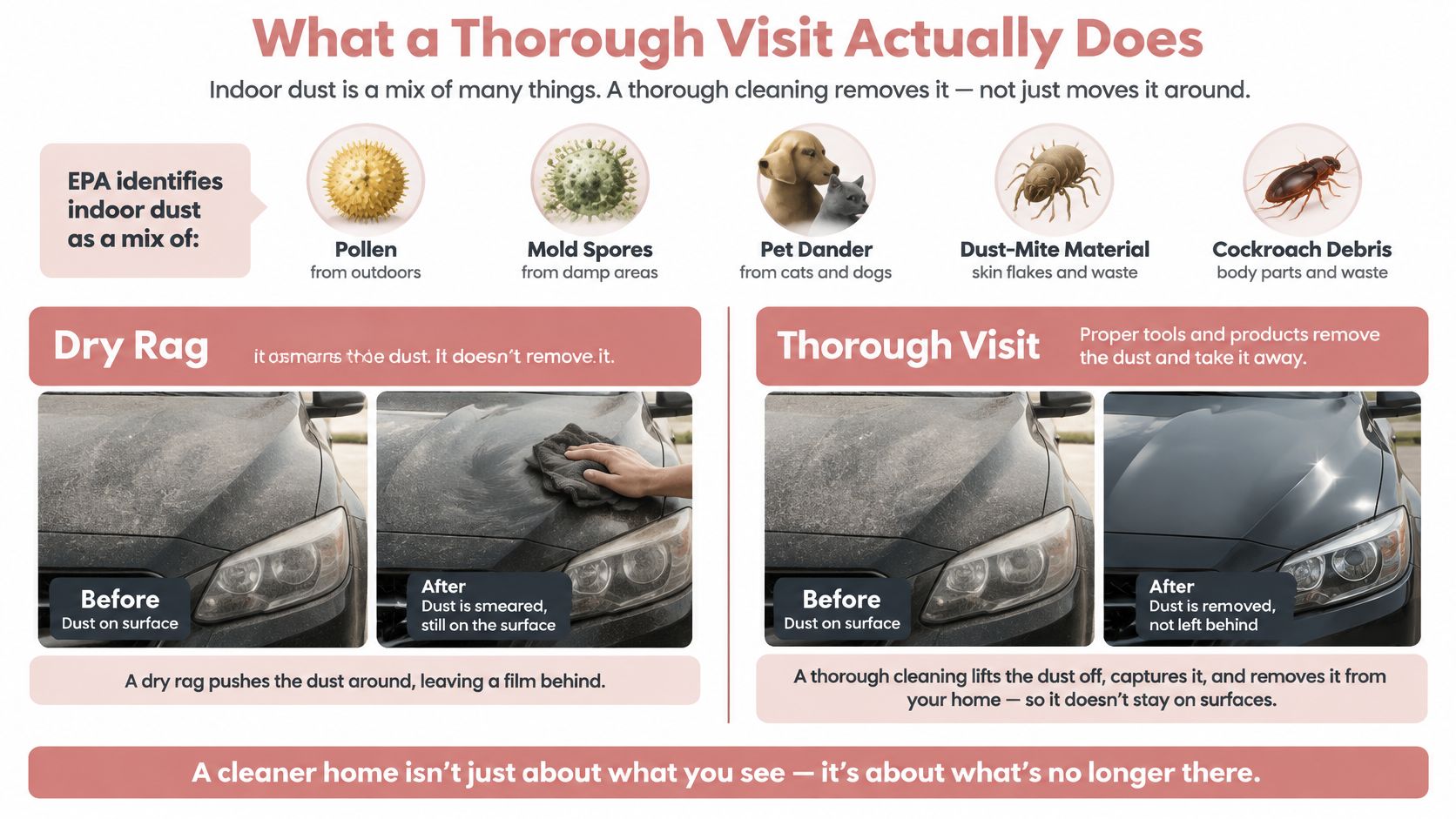
The U.S. Environmental Protection Agency describes indoor dust as a mix that can include pollen, mold spores, pet dander, dust-mite material, cockroach debris, and skin cells. Those particles can trigger allergic reactions or asthma symptoms. Vacuuming carpets and upholstery at least weekly, with a high-efficiency filter where you can, and dusting with a damp cloth, captures dust instead of flicking it back into the air you breathe.
The order that actually removes soil
- HEPA-vacuum first. Carpets, rugs, stairs, and upholstery, or the highest-efficiency bag the machine allows. Bedroom carpet comes before any shelf.
- Clear the room if asthma is in the house. Vacuuming can raise airborne allergens for a while. That person steps out, then comes back after particles settle or the room has been aired.
- Damp-wipe from high to low. Shelves, then tables, then lower ledges. A damp cloth holds the dust. A dry one launches it.
- Go under and around. Under furniture, and around return grilles, where dust sits out of sight.
- Disinfect only the high-touch points, and time it. The CDC separates cleaning, which removes soil, from disinfection, which needs a product labeled for that use. Wash visible dirt first. Apply enough to keep the surface wet for the full label contact time, then wipe. Wiping at once can pull the chemistry off before it has worked. Never mix disinfectants, especially chlorine products with acids or ammonia.
Say the visit includes a carpeted bedroom and one bath. The carpet is vacuumed. Shelves are damp-wiped after the air clears. The faucet is washed with soap and water, then kept wet with a compatible disinfectant for the time on the label.
The EPA also notes that routine duct cleaning hasn't been shown to prevent health problems, so a duct job isn't a substitute for this surface work. Skip spraying the whole house. Pets, carpet, remodel dust, or wind-blown particles are reasons to repeat the dust steps sooner, not reasons to fog every room.
A basic scope is narrower than this dust sequence. See what is included in a basic house cleaning before you assume every visit covers grilles and contact time.
This short walk-through shows the same idea, vacuum first and wipe so dust stays on the cloth.
Put three lines on the checklist you hand over: HEPA vacuum, damp high-to-low wipe, and timed disinfectant only on handles, switches, faucets, and toilet controls.
Trust Checks Before You Let a Crew In
Access to the house is the key decision. A polished photo doesn't prove the people at the door are covered if something breaks or goes missing.

Our teams are trained and insured, and a background check is part of how people are cleared to enter. You should still see the proof, not a slogan. A quote that skips these answers is incomplete, even when the price looks low. More signs of a reliable cleaner are in how to find a good house cleaner.
Ask in this order
- Insurance and bond, by name. Ask for proof of liability insurance and a bond. Write down the names on the documents. "Insured and bonded" on a flyer isn't the document.
- Who is checked. Every person who will enter should have passed a background check, including the substitute who covers a sick day.
- Keys and codes. Who holds the key or the door code, and how is access logged? One person and a written handoff beats a code shared in a group text.
- A written room list. A bath or a baseboard left "to memory" is the item that gets skipped.
- The same small team. Continuity matters when a resident can't watch every minute.
- Products. If children, pets, or fragrance sensitivity are in the home, name the products and ask for a milder biodegradable option where it still lifts soil.
A family caregiver booking for a parent in a single-story home can confirm insurance by email, limit the first visit to pathways, kitchen, baths, and laundry, and write that cleaners won't move heavy furniture. A landlord can require the same checklist at every turnover so the walkthrough doesn't depend on whichever cleaner arrived.
If the reply is a price and nothing else, you don't have a quote yet. You have a number.
After Wildfire Smoke Versus Ordinary Dust
Most local pages stop at baths and floors. Smoke residue isn't that dust.
Research with indoor and outdoor sensors in the Los Angeles and San Francisco areas found that sealing a home and using filtration could cut wildfire PM2.5 infiltration by about half, but protection is incomplete, as reported by Berkeley News. Southern California homes, including those in Temecula, can face the same smoke. A shiny coffee table doesn't mean the room is done.
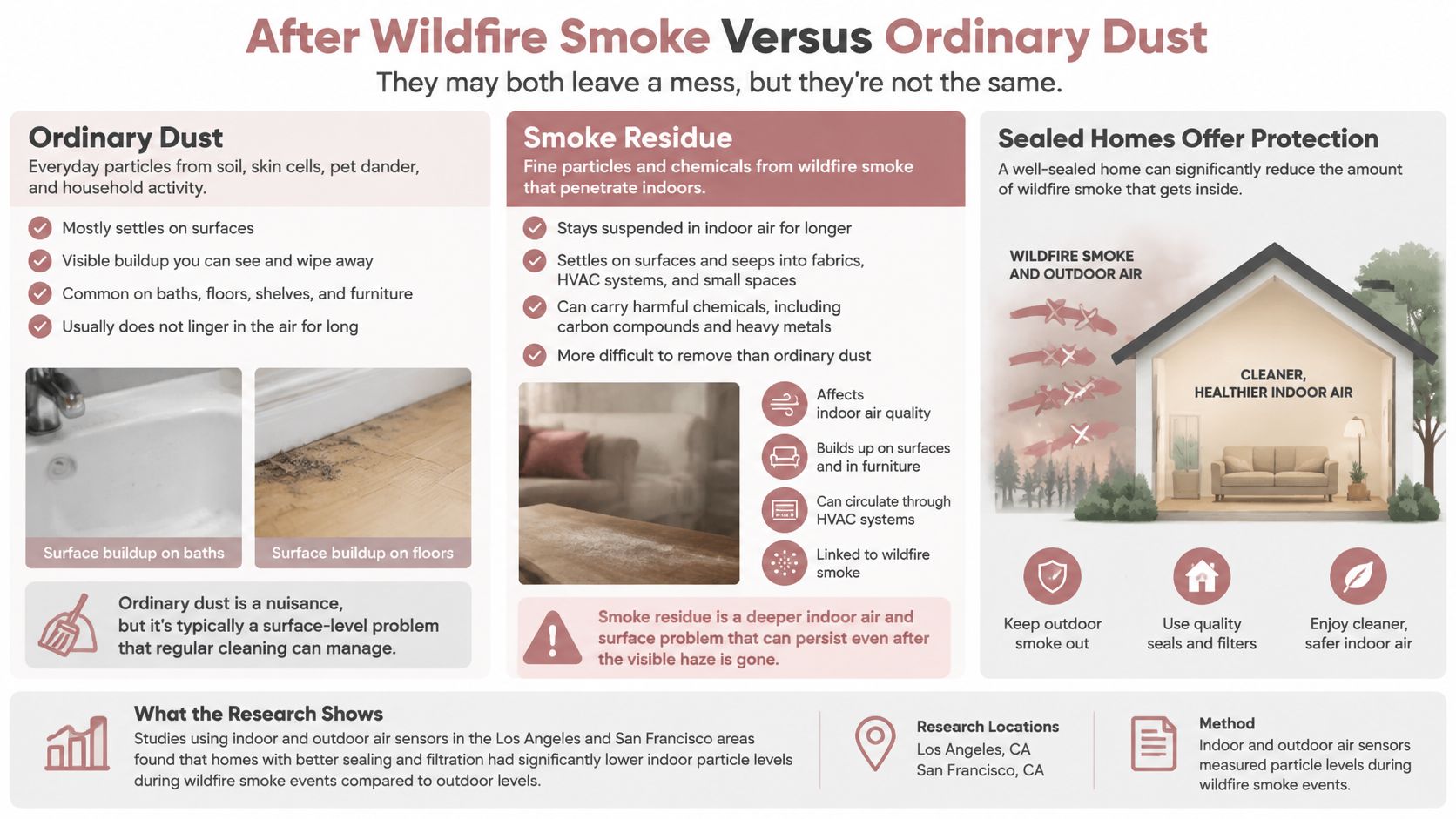
Light film versus a job for restoration
Don't start with dry dusting or dry sweeping. That puts particles back in the air. When the film is light, a practical first pass looks like this.
- Filter first, if it's safe to reach. Replace or upgrade the HVAC filter before you stir the house.
- HEPA-vacuum hard floors, carpets, and upholstery. Capture particles instead of pushing them.
- Wet-wipe and mop with a mild diluted detergent. Include walls only if residue is visible and the paint can tolerate water.
- Clean the return grilles. They collect what the system pulled in.
- Wash soft goods that hold odor. Curtains and a sofa can smell after the table already shines.
Ordinary housekeeping fits that light settled film. It doesn't fit heavy soot, soaked insulation, or an odor that hangs through the whole house. Filtration and airing out help only while they're running and the outdoor air is cleaner. Send extensive contamination to a qualified restoration or indoor-air professional. A standard booking isn't smoke remediation, and it shouldn't be sold as one.
For the everyday particle habits that sit next to this, not instead of it, see how to reduce allergens in your home.
Example Plans for Real Temecula Homes
The city's 2024 economic report counted 23,568 residents over age 60, 21.0% of the population, while Census QuickFacts puts age 65 and older at 11.7%. One plan has to fit limited mobility. The cheapest weekly pass of every room isn't automatically the better plan.
Three homes you can copy
| Household | Rhythm | Rooms covered | Limits or exclusions |
|---|---|---|---|
| Older adult, single-story home | Bi-weekly | Bathrooms, kitchen touchpoints, floors, pathways, laundry | No heavy furniture, no step stools, low-fragrance products |
| Busy family, carpeted three-bedroom | Weekly | HEPA vacuum of bedrooms, stairs, and sofa; kitchen; two baths | Baseboard dusting once a month |
| Renter leaving two-bedroom | One move-out visit | Empty home; fridge and oven interior only if the lease requires | Patio screens and garage excluded in writing |
Example A, older adult. Bi-weekly focus on the bathroom, kitchen touchpoints, floors, pathways, and laundry. No heavy furniture, no step stools, low-fragrance products. A family member or the property manager gets the arrival text. The point is safe, reliable rooms, not an identical wipe of every closet.
Example B, busy family. Weekly HEPA vacuum of the bedrooms, the stairs, and the sofa, plus the kitchen and two baths. Baseboards get a deeper dust once a month, not every visit. Carpet and school traffic set that pace.
Example C, renter leaving. One move-out on the empty two-bedroom. The fridge and oven are opened only because the lease requires it. Patio screens and the garage are excluded in writing, so nobody argues about them at the walkthrough.
After two visits, drop rooms that stay fine and add the spot that always fails, such as pet bowls or the entry tile. Fall-risk floors and baths can matter more than a shorter visit that tries to touch every closet.
Circle the example closest to your home and edit the room list before you ask for a number.
Request a Quote With the Right Details
A useful estimate needs six facts, not a guess from a photo of the living room. We offer a free cleaning estimate, and the job is billed by the package or the hourly rate you select when you book. Price usually moves with square footage, bathroom count, frequency, pets, home condition, and add-ons, so each of those should be named.
- Place and type. City area, and whether it's a Temecula house, apartment, or condo.
- Size. Bedrooms, bathrooms, and rough square footage if you know it.
- Service row. Recurring, deep, one-time, move-in or move-out, or post-construction.
- Rhythm. Weekly, bi-weekly, monthly, or a single date.
- Household limits. Pets, children, clutter, and any fragrance or product limit.
- Add-ons, only if you want them. Fridge or oven interior, interior windows, garage, or carpet.
Ask for the insurance, bond, and background-check answers in the same message. A home cleaning quote that skips scope isn't comparable to one that lists it.
A short note is enough: bi-weekly clean of an 1,800-square-foot three-bedroom in Temecula, two baths, one dog, eco-friendly products, no interior oven, first visit a bit deeper because baseboards have been skipped. Compare written replies on scope and credentials, not the lowest number alone. If the job is heavy smoke or construction debris beyond light dust, ask for a restoration referral instead of forcing it into a standard quote.
Aquastar Cleaning Services, LLC provides recurring housekeeping, deep cleaning, one-time visits, and move-in, move-out, and post-construction cleanup, with plans shaped to the rooms you use. If you want a written scope for dust control, a safer rhythm for an older adult, or a clear quote before anyone has a key, start with a free estimate. Visit Aquastar Cleaning Services, LLC and send the six facts from your home.