



You walk into the bedroom and the air has gone sour. The smell sits near the closet wall, stronger than anywhere else in the house, and nothing on the floor explains it. That pattern is how a dead animal in wall problem usually starts.
The smell is the part you notice. The health risk is the part you cannot see: urine, droppings, nesting material, and a carcass drying in a cavity. Covering the odor and opening the wall are different jobs. One hides a symptom. The other can lift contaminated dust into the room your family uses.
I would read the signs before anyone cuts drywall. If the carcass is reachable and the area around it is clean, a careful homeowner can handle it. If it sits behind sealed drywall, or a child sleeps in that room, call a professional first.
How to Tell a Dead Animal Is in Your Wall
A sour smell in one bedroom, tight against a closet wall, with no visible source, is the scene callers describe first. Smell is the usual first sign. It is not proof by itself. Odor moves through gaps, vents, and insulation, so the room that stinks may not be the cavity that holds the remains.
Match what you can see, hear, or smell with a likely cause, then make one check today. Leave the wall closed until that check is done.
| Sign | Likely cause | Next check |
|---|---|---|
| Sweet or rotten smell strongest at one wall | Carcass in that cavity, actively decomposing | Mark the strongest spot and check vents and outlets on that wall |
| Flies near a window, vent or baseboard gap | Active decay, flies entering through gaps | Inspect gaps around vents and trim for fly entry points |
| Scratching at night, then sudden silence | Animal trapped, died or left the wall | Listen for two or three nights at the same hour |
| Dark greasy stain or wet spot on drywall | Urine or residue from nesting material | Photograph it and do not wipe it |
| Odor that slowly fades over several weeks | Carcass drying out after active decay | Track the change weekly and note any new spots |
Say a Marietta family hears scratching for three nights, then nothing. The next afternoon, flies gather beside the bathroom vent on that same wall. Scratching that stops, plus insects at a gap, fits an animal that was moving and then died. If the smell sits by the laundry, also rule out birds in a dryer vent before you blame the stud bay.
A short test before you open anything
Write down three facts and stop.
- Strongest spot: Mark the wall, not the whole room.
- Peak time: Note whether the smell is worse in afternoon heat or after the HVAC runs.
- Flies: Yes or no, and which gap they use.
Practical rule: If you cannot point to one wall and one gap, you do not know enough to cut drywall.
Those three notes are what you take into the search. The wall stays closed until the spot is narrow and the contamination question is answered.
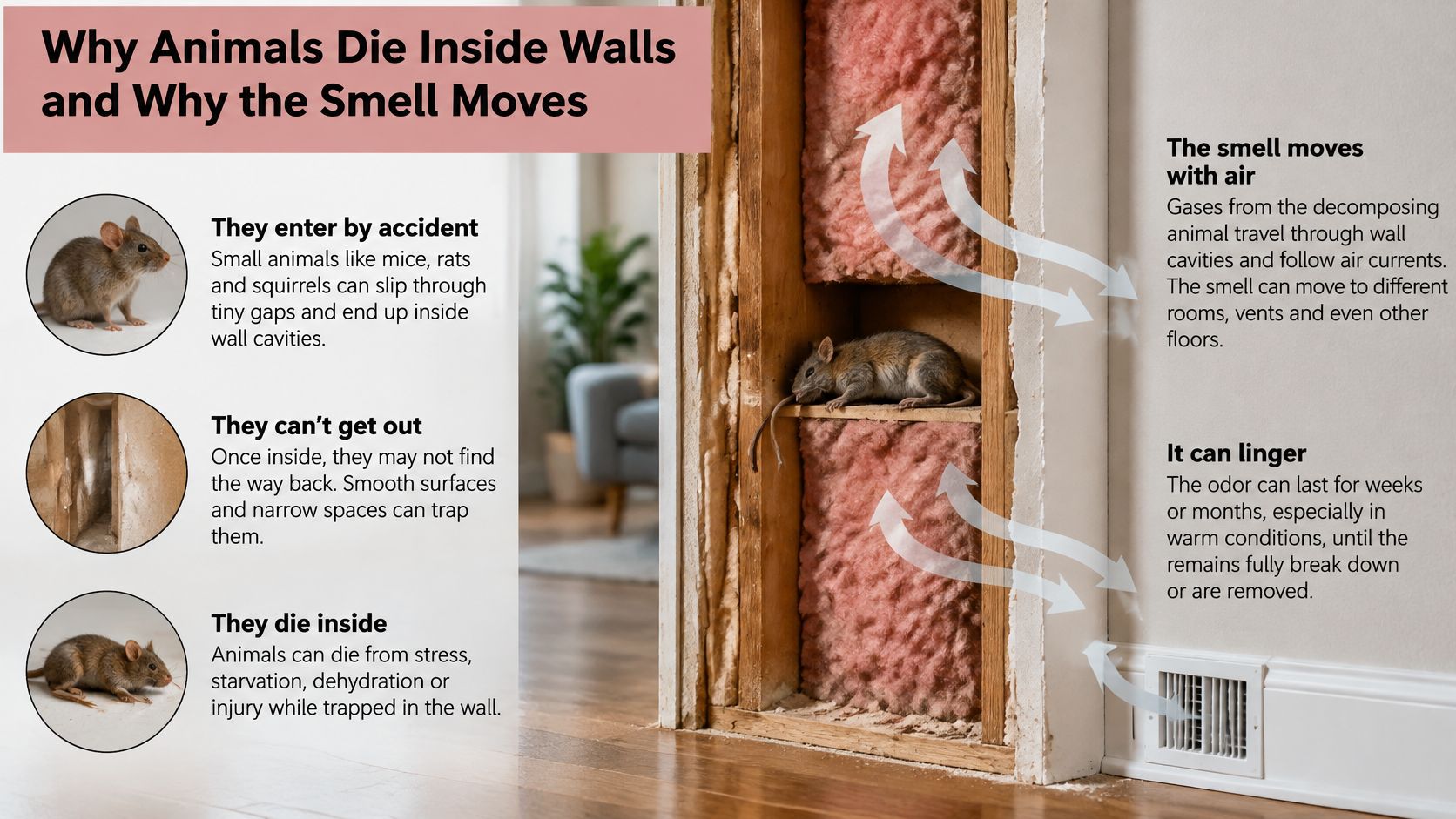
Why Animals Die Inside Walls and Why the Smell Moves
Wall cavities serve as shelter and a travel path. Mice, rats, squirrels, and bats climb in to nest or sleep, then get stuck, injured, or sick where nobody can reach them. Raccoons, squirrels, opossums, and skunks are among the wildlife most often reported inside wall, attic, and foundation voids, and a small rodent can die in the same kind of space a larger animal used to travel.
The smell behaves like smoke from a fire in another room. It reaches you through every crack even when the source is a bay away. That gap matters, because odor shows where air moves through the house. The contamination stays put with the carcass, the urine, and the nesting material, and those are two different problems to solve.
Three stages you can picture
Bloating comes first. Microbes inside the body make gas, the carcass swells, and the odor starts.
Breakdown is next. Tissue softens, insects move in, and this stretch usually smells the worst. It is also when the most residue ends up on the insulation and wood around the body.
Drying is last. Moisture leaves the body and the odor usually weakens, though stained insulation can still hold a trace and still count as contaminated material.
In a split-level, the hallway smells worst. The homeowner cuts a square of drywall there and finds clean insulation. The remains sit one stud bay toward the closet, along with the droppings and soiled batting that need attention. The nose found the area. It did not find the cavity.
A bird that nested in the eaves can die in a similar void. If feathers and twigs point that way, removing a bird nest from the structure is a different job from opening a stud bay.
Read the odor as a locator, not the problem itself. The strongest smell marks the general area, while the exact spot, and whatever the animal left behind, takes a search that does not start with demolition.
Decide Whether to Call a Pro or Handle It Yourself
Handle it yourself only when the carcass is visible in a reachable spot, no urine, droppings, or dirty insulation sits beyond it, and no vulnerable person uses the room. Call a professional first when the body is behind drywall, when insulation is soiled, or when children, pets, asthma, or a weakened immune system share the home.
The split is odor control versus contamination control. A bad smell is annoying. Disturbed urine, feces, nesting material, or carcass residue can put dust in the air. The Washington State Department of Health warns that hantavirus can result from inhaling dust contaminated with rodent waste. Routine wiping of a counter may cut surface residue. Opening a wall or pulling insulation is not ordinary housekeeping, and it should be coordinated with pest-control, remediation, or a contractor.
| Situation | Who to call | Reason |
|---|---|---|
| Carcass visible in a reachable spot, no urine, droppings or insulation contamination, no vulnerable occupant | Homeowner with gloves and disinfectant | Small, contained and reachable, so the standard procedure applies |
| Carcass behind drywall or in a sealed cavity | Pest-removal professional | Opening the wall risks spreading contamination and damaging structure |
| Contaminated insulation, heavy droppings or urine | Remediation or pest-control professional | Contaminated dust can become airborne and needs controlled handling |
| Children, pets, asthma or an immunocompromised occupant in the home | Professional first, before any home handling | Lower tolerance for exposure to contaminated dust |
| Odor persists after removal and interim measures | Pest professional to confirm nothing remains | A remaining source may still be inside the wall |
A Marietta couple with a toddler finds a mouse behind a removable baseboard in the bedroom the child uses. Urine stains show on the insulation beside it. The child sleeps there and the cavity is dirty, so they call a pest-removal professional and keep the child out until the cavity is cleared. If any single row above fits your house, the answer is professional first.
Whole-room cleaning comes after that work, not instead of it. We do not clean biohazards such as mold, blood, or animal waste, we do not move furniture heavier than 25 lbs, and we do not climb ladders higher than 3 feet. If a smell remains after the source is gone, an odor removal service is a later step, once a pest pro has confirmed the cavity is clear.
If flu-like illness with fever, muscle aches, or shortness of breath follows time near that wall or nest, seek medical care and tell the clinician about possible rodent exposure.
How to Find the Spot Without Tearing Open Drywall
The Wildlife Damage Management Extension cautions against tearing out a wall because the carcass may be only one stud bay from the spot you suspect. Your job is to narrow the search to a bay, not to expose the body yourself.
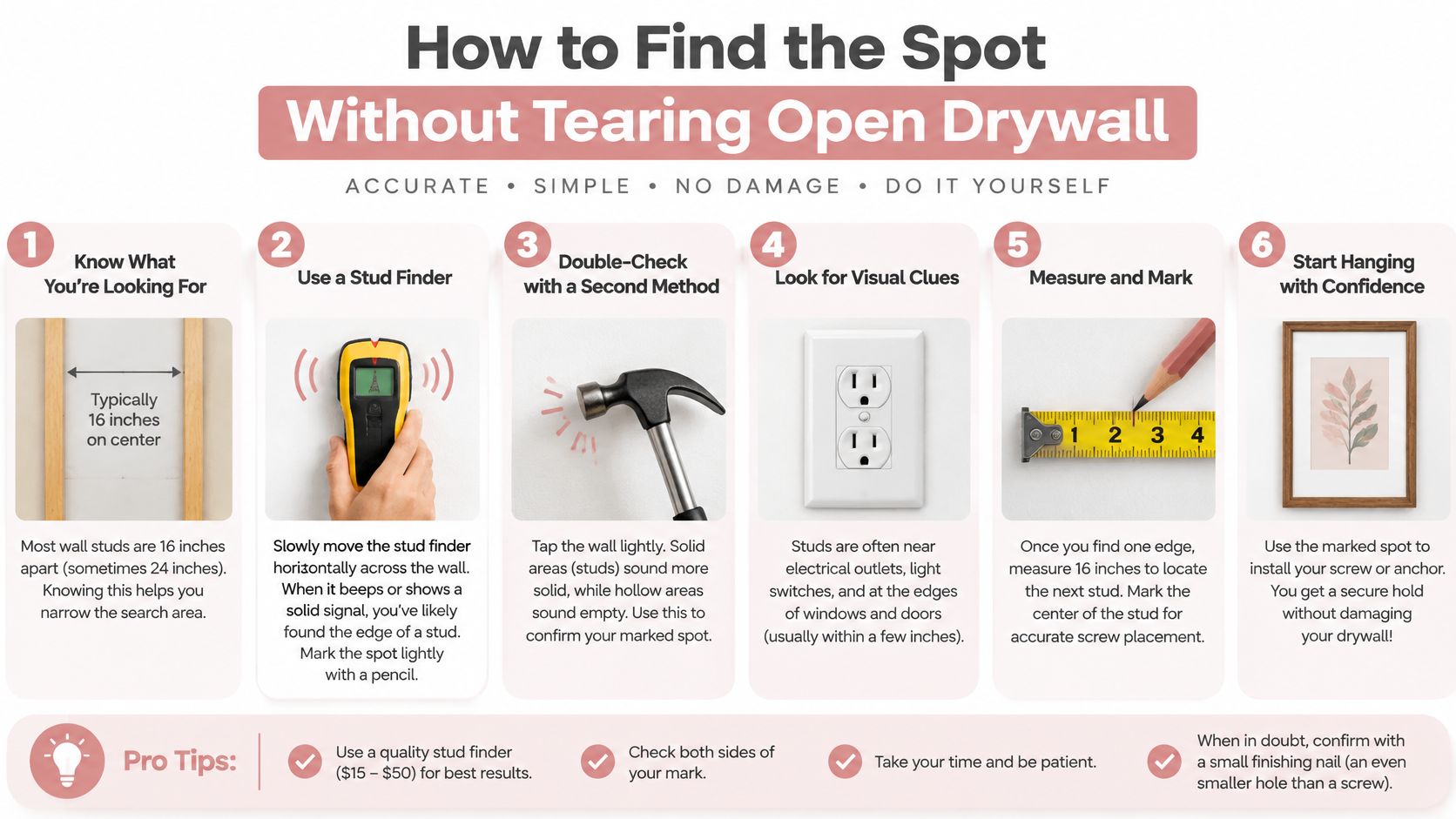
Treat the odor as the map and contamination as the stop sign.
- Walk the house at night with the windows closed and note where the smell is strongest. Closed windows keep outdoor air from diluting the trail, and lower HVAC noise makes small differences easier to notice.
- Mark that wall and check the rooms above and below it. A cavity often runs past one floor, so the odor can show upstairs while the body sits lower.
- Inspect outlets, switch plates, vents, and any crawl access on that wall. Look for flies or stains at those openings before you think about access.
- Compare the odor at each opening and move toward the place where it grows. A stronger smell at one outlet than at the next narrows the likely bay.
- Stop at the marked wall if the carcass is still hidden. Do not cut drywall to find it; give a pest-removal professional the bay, the strongest opening, and any fly or stain location.
- Handle it yourself only if the carcass is already visible in a reachable spot. If reaching it means opening a sealed cavity or disturbing dirty insulation, leave the access work to the professional.
A marked bay is useful information. A random hole is not, and even a small cut can spread dust from insulation you cannot see.
A Kennesaw homeowner finds the smell strongest at a hallway outlet and sees flies near a switch plate. The shared closet wall gives the pest professional a cleaner access point, and the carcass is found one stud bay over rather than behind the outlet plate.
This short walk-through shows the same idea of checking before anyone cuts.
Before access is opened or the wall is closed again, write down the date, the strongest spot, and whether flies were present. Those notes matter if the smell returns a week later.
Controlling Odor and Dust Until the Carcass Is Removed
The carcass may stay inside for days while you arrange access. Interim steps only buy time. A CDC technical publication states that removing the dead rodent is preferable when possible, and that an unreachable carcass may be managed for a while with fans or suitable odor-control products.
| Measure | What it does | Limit |
|---|---|---|
| Fans for airflow | Moves stagnant air and can reduce odor build-up | Does not remove the carcass or contaminated insulation |
| Odor-control product | Masks smell for a short period | Temporary, and it hides the problem rather than solving it |
| Wet cleaning of reachable surfaces | Reduces visible residue on accessible surfaces | Does not reach the cavity and should not replace removal |
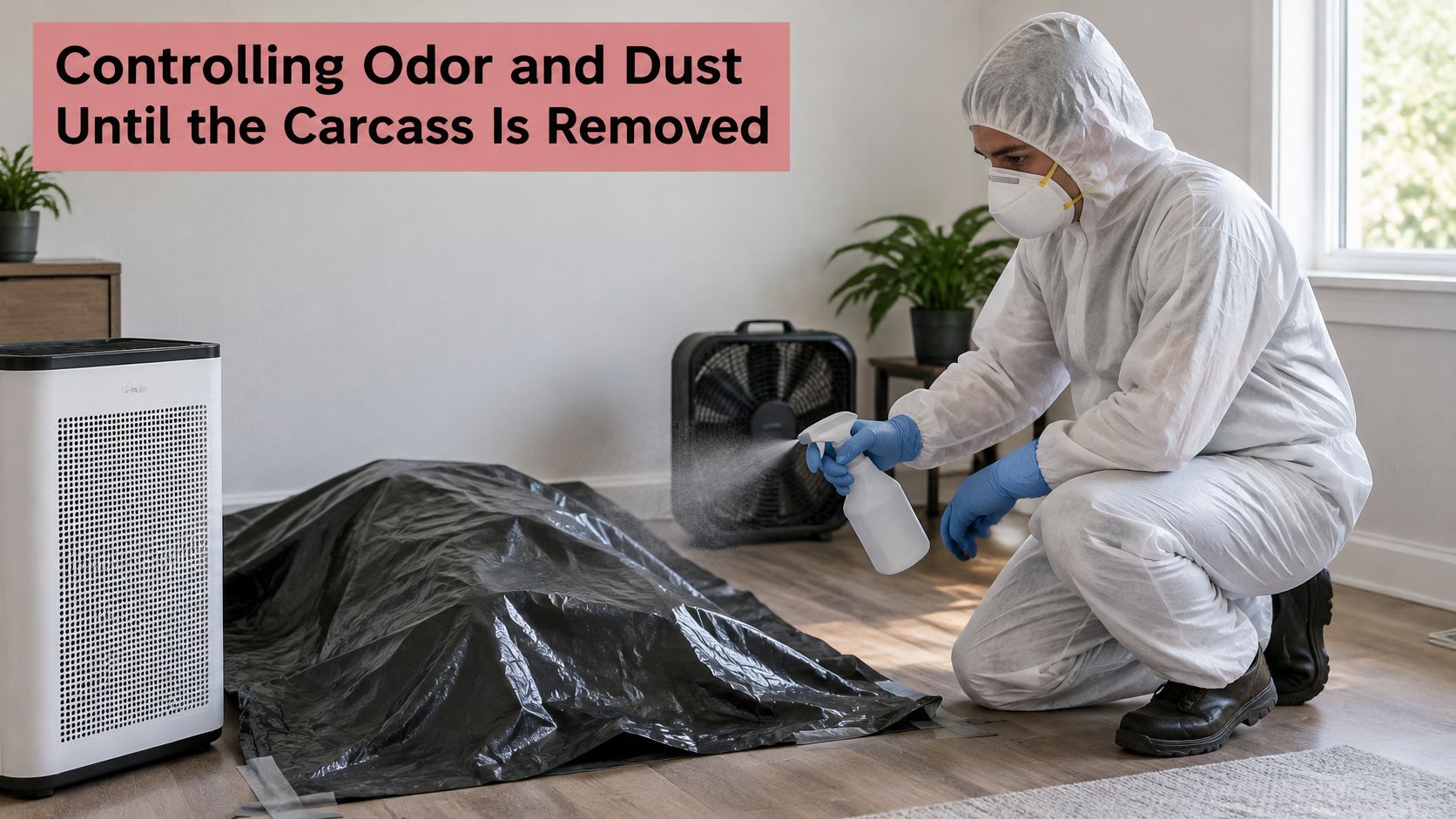
What each option stops short of
A box fan in a hallway moves stale air so the smell does not pool in one room. It does not touch the body or the insulation around it. Run it with a door closed to the worst room, not aimed into a return vent that could push odor through the house.
An odor-control product covers the smell for a short stretch and then fades. It also makes it harder to tell whether the source is still active. FullScope Pest Control's notes on removing dead animal odor indoors are useful once you are choosing products after the body is out, not as a substitute for getting it out.
Wet cleaning of baseboards and nearby hard surfaces cuts residue you can reach. It does not enter the cavity. If cutting or sanding has already left a film, the best way to clean up drywall dust is a damp method, not a dry sweep that sends particles up.
A Cobb County renter sets a box fan in the hallway, shuts the bedroom door, and keeps the children out until the landlord arranges access. That is a holding pattern, not a fix.
Do not tape over vents, do not heat the wall to speed decay, and do not keep spraying fragrance over a source you have not found.
Heat can push odor into other rooms. Tape can block the only air path you have. These measures stay temporary until someone can reach the carcass.
How to Remove a Reachable Carcass Safely
Getting the body out ends the odor at its source, and it also removes the contamination the odor was warning you about. The carcass, the nesting material around it, and the dust it sheds are the health risk, so treat this as contamination work with a smell fix attached.
Use these steps only when you can see the animal and an opening already exists. Illinois Department of Public Health guidance on rat cleanup calls for soaking carcasses and droppings with disinfectant before any handling, so nothing goes airborne dry. Mix a bleach solution at the strength stated on the product label, or use a commercial disinfectant labeled for rodent waste. Either way, work with gloves on and fresh air moving through the room.
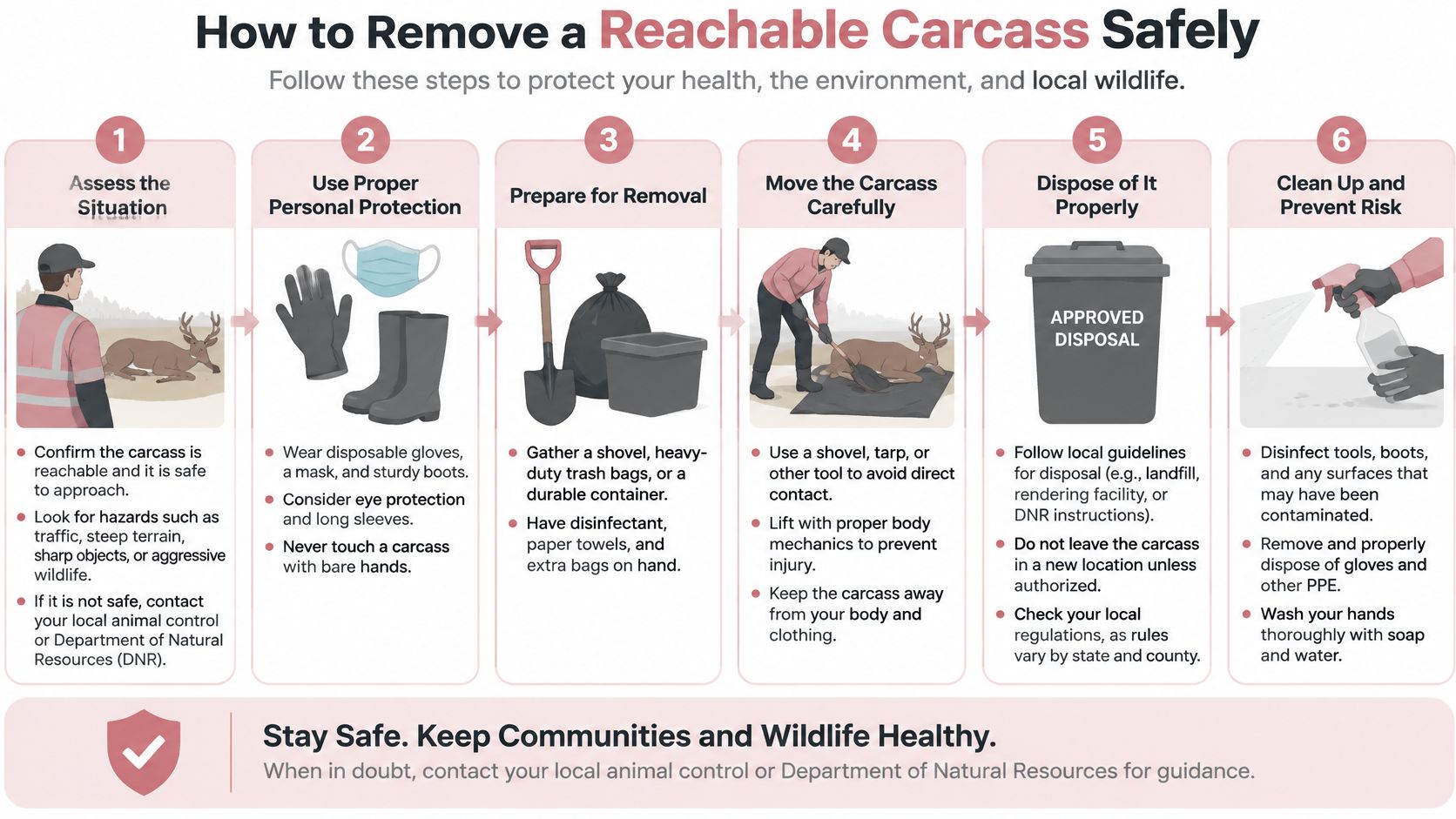
- Put on rubber or plastic gloves and open a window or a door before you start.
- Mix the bleach solution at the label strength, or set out the disinfectant labeled for rodent waste. Get the liquid ready before you touch anything.
- Spray the carcass and the soiled material around it until everything is thoroughly wet. A dry body sheds dust, and wet material is safer to lift.
- Pick it up with a tool or gloved hands and place it in one plastic bag. Do not carry it uncovered through the house.
- Put that bag inside a second bag, seal both tightly, and set them in a trash container with a tight-fitting lid.
- Disinfect reusable tools and every surface the animal touched. A disinfection cleaning service follows the same order you want here: wet contact, dwell time, then wipe.
- Remove the gloves, then wash your hands with warm water and soap. Gloves come off before the sink, so you do not smear the faucet.
A mouse under a removable baseboard is the easy version of this job. Spray until wet, lift with gloved hands or a tool, double-bag, lid the trash, wash after the gloves come off. Done right, mixing the spray takes longer than bagging the body.
Do not vacuum and do not sweep anywhere near the spot, before or after. Both push contaminated dust into the air you are standing in.
Three checks before the wall goes back
- Carcass: Out of the cavity entirely, with nothing left behind in a corner of the bay.
- Flies: No new activity at the gap the following day.
- Odor: Fading steadily instead of shifting toward a different wall.
If all three pass, patch and paint. If flies return or the smell relocates, the cavity likely holds a second animal or soaked insulation, and that is a pro call.
If residue remains on reachable floors and trim after a pest or remediation pro has cleared the cavity, a residential cleaning company can handle ordinary whole-room work. Aquastar Cleaning Services, LLC does that kind of cleaning, though its crews stay out of biohazard territory: no carcass handling, no insulation removal, no animal waste. That contaminated work belongs to the pest pro.
Aquastar Cleaning Services, LLC provides recurring housekeeping, deep cleaning, and move-in or move-out cleans for homes in Kennesaw and North Atlanta, including whole-room cleaning after a pest professional has already removed a carcass and cleared contaminated cavities. Trained, insured teams can follow a custom checklist for floors, trim, and living areas once that hazardous work is done. When the wall is closed and the source is gone, visit Aquastar Cleaning Services, LLC to request a quote for the room cleanup.