



Expect to pay between $25 and $80 per cleaner-hour for professional house cleaning, with a national average near $50 per hour. That's a customer-facing service price for a managed visit, and it isn't the wage of the person holding the vacuum.
The distance between those two numbers is where quote confusion starts. In May 2023, the U.S. Bureau of Labor Statistics counted 836,230 maids and housekeeping cleaners across the country and put the median wage for the occupation at $16.08 an hour. Nobody gets a bonded, insured, fully supplied visit for $16. The $50 hour buys a scheduled service with payroll taxes, liability coverage, products, equipment and a person coordinating the calendar behind it. Once that split makes sense, hourly quotes stop looking arbitrary and start looking checkable.
Three numbers get flattened into one confusing figure: what a cleaner earns, what a company's labor-hour costs, and what an hour on your clock delivers. Keeping them apart is the whole trick. Everything below runs on small worked bills you can copy onto your own kitchen table math.
House Cleaning Cost per Hour Right Now
Professional house cleaning was reported at $25 to $80 per hour in 2025, averaging about $50 per hour, according to HomeAdvisor data summarized by Everhour. That answers the search in one line. The range is the interesting part, so set four recent benchmarks next to each other and the spread turns into a map rather than noise.
Published house cleaning hourly benchmarks
| Benchmark | Hourly figure | What the figure means |
|---|---|---|
| HomeAdvisor summary 2025 | $25 to $80, average about $50 | Typical customer-facing cleaner-hour |
| Standard service band 2024 | $20 to $50 per cleaner | Common company rate for ordinary housekeeping |
| Independent cleaners 2024 | $50 to $100 | Solo cleaner prices, often without a full company overhead stack |
| Six-city indexed median 2024 | about $41 | National midpoint, not a local Atlanta quote |
Every row is a customer price, never an employee wage. The first two describe companies carrying insurance, supplies and staff. The third describes independent cleaners, who often carry less of that overhead and less of that protection. The fourth averages six indexed cities into one figure, so it's a national midpoint rather than a quote for any single street.
Read the table as a range, not a price list. Your quote lands somewhere inside it based on how the visit is staffed and how much time the home really takes.
What a cleaner-hour actually means
A cleaner-hour is one person working one hour. It's the unit hiding inside every hourly quote, and it multiplies by headcount. Two cleaners for two hours is four cleaner-hours, even though your door is open for only two of them. Companies quote this way because labor time is the thing they're buying from their teams.
Here's the arithmetic in practice. One cleaner for four hours at $50 is about $200. Two cleaners for two hours at $50 is also four labor-hours and about $200, but the house is finished in half the day. Same money, faster finish, and a very different experience if you're working from home while it happens.
The first question about any hourly rate: is it per cleaner or per visit? A quote that says "$50 an hour" hasn't told you which.
Three fields to note on a quote you already have
Pull out the estimate you were given, or the one you were about to accept, and find these three things. With those numbers you can price any structure against any other.
- Rate per cleaner: the dollar figure attached to one person's hour.
- Number of cleaners: one person, a pair, or a three-person crew.
- Expected hours: the estimate of time on site, not the time you'll spend answering the door.
If a quote gives only a total, that's fine. Divide the total by whichever field you know and you'll have the missing one. A $240 total from a two-person crew working three hours is six labor-hours, which works out to $40 per cleaner-hour.
A second market to compare against
Published rates differ by metro, and seeing another city's numbers is a fast way to judge whether your quote reflects local labor or a particular service model. The team at South Mountain Window Cleaning, LLC publishes a breakdown that lets you compare house cleaning prices in Phoenix against the ranges above. Different market, identical math.
Why the Bill Beats the Cleaner's Wage
A cleaner's wage is one part of a cleaning bill, not the hourly price a household pays. The U.S. Bureau of Labor Statistics reported a national mean wage of $17.83 per hour for maids and housekeeping cleaners. That figure describes employee pay. A company's bill also has to cover the work and costs surrounding the cleaning visit.
For example, four hours at that wage comes to about $71.32 in direct pay. The household's charge covers more than those four hours of labor.
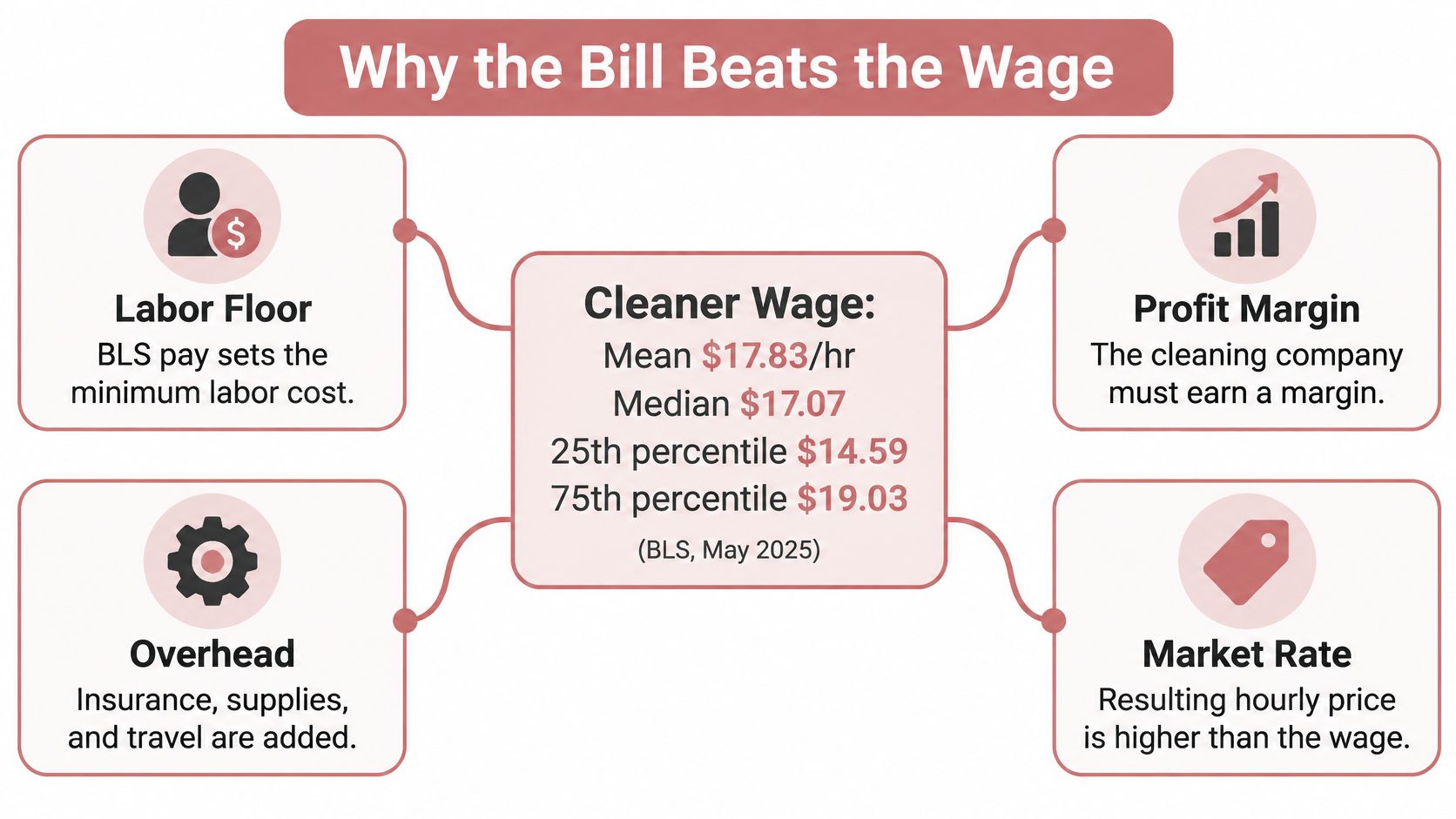
What sits between a wage and a bill
- Employer payroll taxes
- Workers' compensation and liability insurance
- Bonding and background checks
- Gas, vehicle wear, and travel between homes
- Cleaning products, mops, vacuums, microfiber, and equipment use
- Scheduling, dispatch, and supervision
- Training and quality checks
- A business margin that helps cover operating costs
A restaurant check offers a useful comparison. The cook's wage is part of the price, but the bill also helps pay for the kitchen, dishwasher, lease, server, and business operations. A cleaning invoice works similarly. The cleaner's pay is one component, while the service also has to account for the resources needed to arrange and complete the visit.
Two meanings of per hour
Per labor-hour counts each cleaner's time. Per clock-hour counts the time the crew spends at your home. Two cleaners working for two hours produce four labor-hours but occupy the home for two clock-hours. A $200 invoice for that visit equals $50 per labor-hour and $100 per clock-hour on site. Both calculations are correct; they answer different questions. A quote stating “$40 an hour” is hard to compare until you know which measure it uses.
Ask directly: “Is that rate per cleaner, and how many cleaners will come?” That clarifies whether the quoted hour means one person's labor or the crew's time at your home.
Housekeeping includes routine tasks such as making beds, cleaning rooms and halls, and vacuuming. For a clearer picture of the work involved, see this guide to house cleaner duties.
The rule for comparing quotes
Convert both estimates to total labor-hours and total dollars before judging them. A company labor-hour counts one cleaner's hour, while a clock-hour measures how long the visit takes at home. With both figures, you can compare an hourly rate with a flat quote on the same basis.
What Sets the Hourly Price and Add-Ons
The base is simple: rate per cleaner times labor-hours. The hours are where homes diverge, because hours depend on size, bathroom count, visit type and how often the crew comes. Two homes in the same metro can share the same rate per cleaner and still produce bills hundreds of dollars apart.
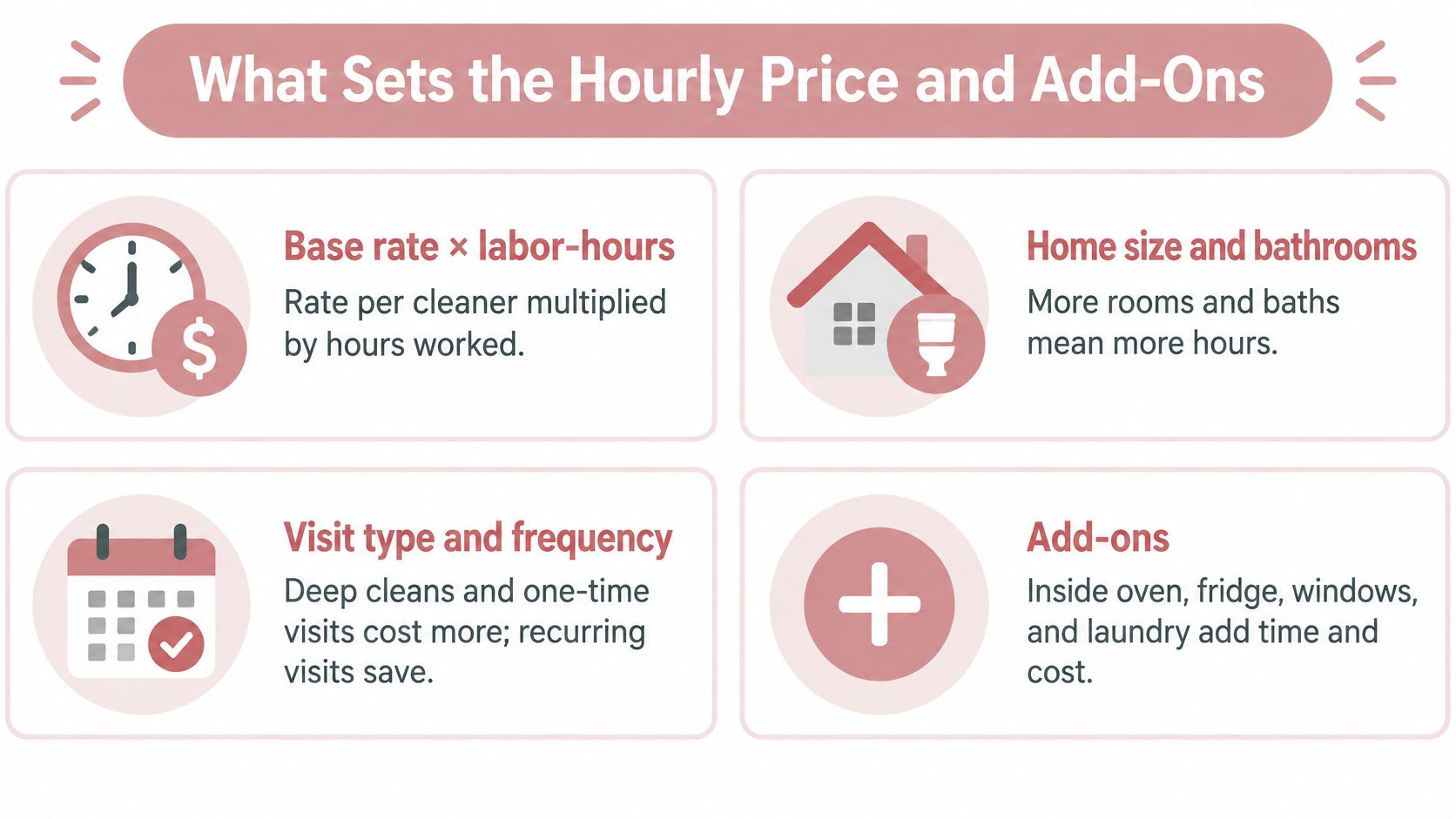
Two homes, one market
Home A is a maintained 1,200 square foot, two-bedroom, one-bath condo on a biweekly plan. No pets, light clutter, ordinary products. A crew finishes it in a tight window because there's barely anything to reset.
Home B is a 3,000 square foot, four-bedroom, three-bath house on a first visit. Two dogs, counters piled with mail and small appliances, fragrance-free products requested. Same metro, same company, and the hours multiply. The rate per cleaner may even step up for the product switch and the extra bathroom detail.
Maintenance visits take less time than first visits or monthly resets, and that difference is the biggest lever on a recurring bill. A first visit often runs about twice a later maintenance visit: six hours to open a home, roughly three hours on the plan at the same rate.
What adds time to a visit
- Interior oven or fridge: 45 to 90 minutes of extra labor, depending on buildup.
- Interior windows, a dusty garage or a finished basement: usually another cleaner-hour, sometimes a separate line item.
- Two shedding pets: about an hour per visit once hair reaches the corners and the soft furniture.
- Post-construction dust or an empty-cabinet move-out: a scope question, not a reason to distrust a $45 rate.
Those figures move with the home. What matters is that the add-on is named on the quote before the clock starts rather than discovered at the door.
Two things to settle before anyone arrives
Our pricing depends on home size, cleaning frequency, pets, preferred products and clutter levels, so the intake conversation is where an estimate is built. The first cleaning also generally takes longer than a recurring visit, and how much longer depends on the home's condition and the agreed work.
Practical rule: mark the add-ons you want and the exclusions you accept on the estimate itself. A note in a text message disappears; a line on the quote doesn't.
Cleaners don't move furniture heavier than 25 pounds, clean biohazards such as mold, blood or animal waste, or climb ladders above three feet. Knowing that up front prevents a surprise on the day.
The checklist to have ready
Six answers prepare you for any honest estimate: square footage, bedroom and bathroom counts, when the home was last professionally cleaned, pets and how many, clutter level room by room, and the must-do rooms. Add your product preference and any add-on you're weighing. Write it once and reuse it for every company you contact.
If you want help organizing that list, this estimate template advice from HomeProBadge shows how to lay out scope and exclusions so nothing stays verbal. Pair it with our breakdown of what is included in a basic house cleaning and you'll know which line items to question. Estimates from Aquastar Cleaning Services in Kennesaw and North Atlanta follow these same inputs.
Hourly Rates Compared with Flat Quotes
Hourly billing charges for the time used. Flat or package pricing charges a set amount for a written scope. National figures put professional house cleaning at $25 to $75 or more per cleaner-hour, while flat-rate visits typically run $120 to $600 or more, according to HomeGuide's pricing guide. Neither structure wins on its own. The job decides.
| Situation | Better structure | Why | Lock this in writing |
|---|---|---|---|
| Recurring weekly or biweekly care | Flat or package | Time becomes predictable after the first visits | Rooms, frequency and exclusions |
| First deep clean | Hourly with a cap | Condition can add hours | Maximum hours and the rate per cleaner |
| Move-in or move-out | Detailed flat or capped hourly | Empty homes still hide buildup | Cabinets, appliances and inside windows |
| Post-construction residue | Hourly | Dust volume is hard to guess | Which surfaces and debris are included |
| Heavily cluttered home | Hourly | The team cannot know the pace | Who clears items before cleaning |
| Fridge or oven interior | Flat add-on | The task is known and separate | Each appliance named and priced |
For recurring housekeeping, flat pricing is usually kinder to the household because the company absorbs the risk of a visit that runs long. That only holds if rooms, frequency, inside appliances, interior windows, pet hair and exclusions are written down. For uncertain scope, hourly is more honest, ideally with a maximum so a four-hour guess can't become an eight-hour surprise.
The conversion that makes them comparable
Take a two-person team booked for two hours. That's four labor-hours. A $200 flat invoice works out to $50 per labor-hour. Bill the same team at $45 per cleaner-hour and the invoice is $180. Same visit, two structures, a $20 spread that has nothing to do with quality.
That division is what makes a flat quote judgeable. Divide the total by the labor-hours the company expects and you hold an hourly figure beside any competitor's rate. Do it before deciding which number is smaller, because a low rate with a longer crew can cost more than a higher rate with a tighter one.
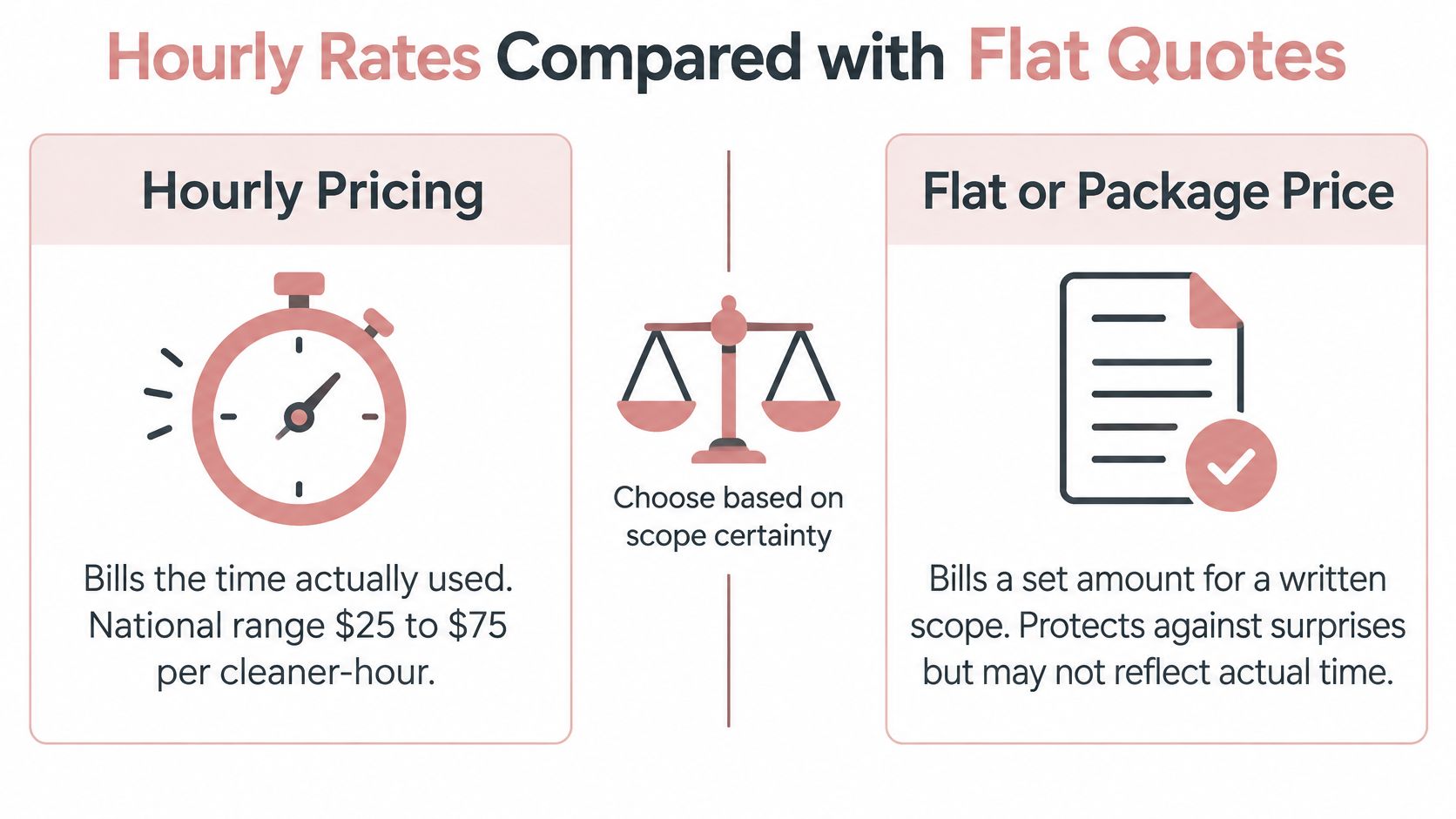
We bill by the package or the hourly rate chosen when the visit is booked, so it's worth asking which structure applies before comparing totals. A structure you can name is a structure you can check.
The short verdict: if the home and the checklist are stable, buy the flat price. If the condition is unknown, buy hourly time with a ceiling.
If you're still narrowing the field, our guide to how to choose a cleaning company covers the insurance and vetting questions that matter more than a $5 rate difference.
Worked Bills for Typical Homes
A bill becomes easier to judge when you separate the time spent in your home from the total cleaner-hours being charged. The examples below use the same five fields: team size, clock time, labor-hours, rate and total. Match one to your situation, then replace its numbers with the figures in your quote.
Example 1, a maintained three-bed home. One cleaner works four hours at $40 per cleaner-hour. That is four labor-hours and a $160 total. The cleaner-hour rate tells you the charge for one cleaner's hour, while the invoice shows the full visit cost.
Example 2, a two-cleaner visit. Two cleaners work for two and a half hours on the clock at $45 per cleaner-hour. Multiply the team size by the time: that gives five labor-hours and a $225 total. The visit lasts two and a half hours, but it includes twice that much labor.
Example 3, a flat biweekly visit. The invoice is $180 flat. If one cleaner takes three and a half hours, the equivalent hourly calculation at $50 per cleaner-hour is $175. Those totals are nearly the same. With a flat price, the invoice stays at $180 if the team finishes efficiently, and it does not rise if the work takes longer.
Example 4, the first reset. Six hours at $55 per cleaner-hour comes to $330. A later recurring visit taking three hours at the same rate comes to $165. The first cleaning generally takes longer than recurring visits, with the time depending on the home's condition and agreed work. For that reason, compare an initial visit with another initial visit, not with a routine maintenance appointment.
| Example | Team and clock time | Labor-hours | Rate | Total |
|---|---|---|---|---|
| Maintained three-bed home | 1 cleaner, 4 hours | 4 | $40 per cleaner-hour | $160 |
| Two-cleaner visit | 2 cleaners, 2.5 hours | 5 | $45 per cleaner-hour | $225 |
| Flat biweekly visit | 1 cleaner, 3.5 hours | 3.5 | $50 per cleaner-hour ($175 hourly equivalent) | $180 flat |
| First reset | 1 cleaner, 6 hours | 6 | $55 per cleaner-hour | $330 |
| Recurring visit | 1 cleaner, 3 hours | 3 | $55 per cleaner-hour | $165 |
Your formula: cleaners × hours × rate = total. To compare a flat price with an hourly quote, divide the flat price by its labor-hours.
For a quick note, write: number of cleaners ____ × hours ____ × rate ____ = total ____. The calculation is straightforward, but keep the units consistent: use cleaner-hours for the rate, not just the time the team is in the home. Aquastar's house cleaning cost information can accompany your estimate comparison.
A cleaning bill is one part of a household budget. For another kind of home-cost comparison, see Jacky Levi's Vancouver maintenance breakdown.
Get a Quote You Can Compare
Send the identical brief to every company you're considering. Uniform inputs produce comparable outputs, and the brief takes four minutes to write.
- The home: square footage or bed and bath count, plus your city.
- The schedule: preferred day, and whether you want weekly, biweekly, monthly or one time.
- The conditions: pets, clutter level, and any product preference such as fragrance-free.
- The extras: oven, fridge, windows, garage or basement.
Then ask each reply for five fields: package or hourly, the rate per cleaner if hourly, how many people will come, the expected hours or a flat total, and a written list of exclusions. Convert every reply with the formula from the worked bills before you judge the cheapest line. A lower hourly rate with a longer crew can cost more than a higher rate with a tighter one.
A free estimate can arrive in minutes online or after a short call. A clear company states there's no hidden fee once size and needs are known, and gives an exact price rather than a starting-at figure. For homeowners in Kennesaw and North Atlanta, Aquastar Cleaning Services is one local option that prices by the package or the hourly rate selected at booking, sends insured and bonded teams, and builds the visit around the home instead of a single unexplained hour. You don't need to be home while the work happens.
If you're unsure what a finished quote should contain, our guide to home cleaning services quotes breaks one down line by line. Request your estimate with the brief above, and accept only a quote that shows hours or a flat scope. A bare hourly number leaves you doing the comparison math alone.
Aquastar Cleaning Services, LLC gives you a free estimate built on your home's size, its condition and the schedule you want, with no hidden fees and an instant estimate available in minutes. If you're weighing a first deep clean against recurring housekeeping in Kennesaw or North Atlanta, we'll price both structures so the difference is visible on paper before you book. Visit Aquastar Cleaning Services, LLC to request your quote.