


Your carpet probably looks fine from the doorway. Then your toddler drops crackers into the family room pile, the dog tracks in wet dirt by the back door, and last weekend's spill still smells faintly when the sun hits it. That's the moment most homeowners realize vacuuming isn't the same as deep cleaning carpet. The surface tells one story. What's settled below it tells another.
Why Deep Cleaning Carpet Matters More Than You Think
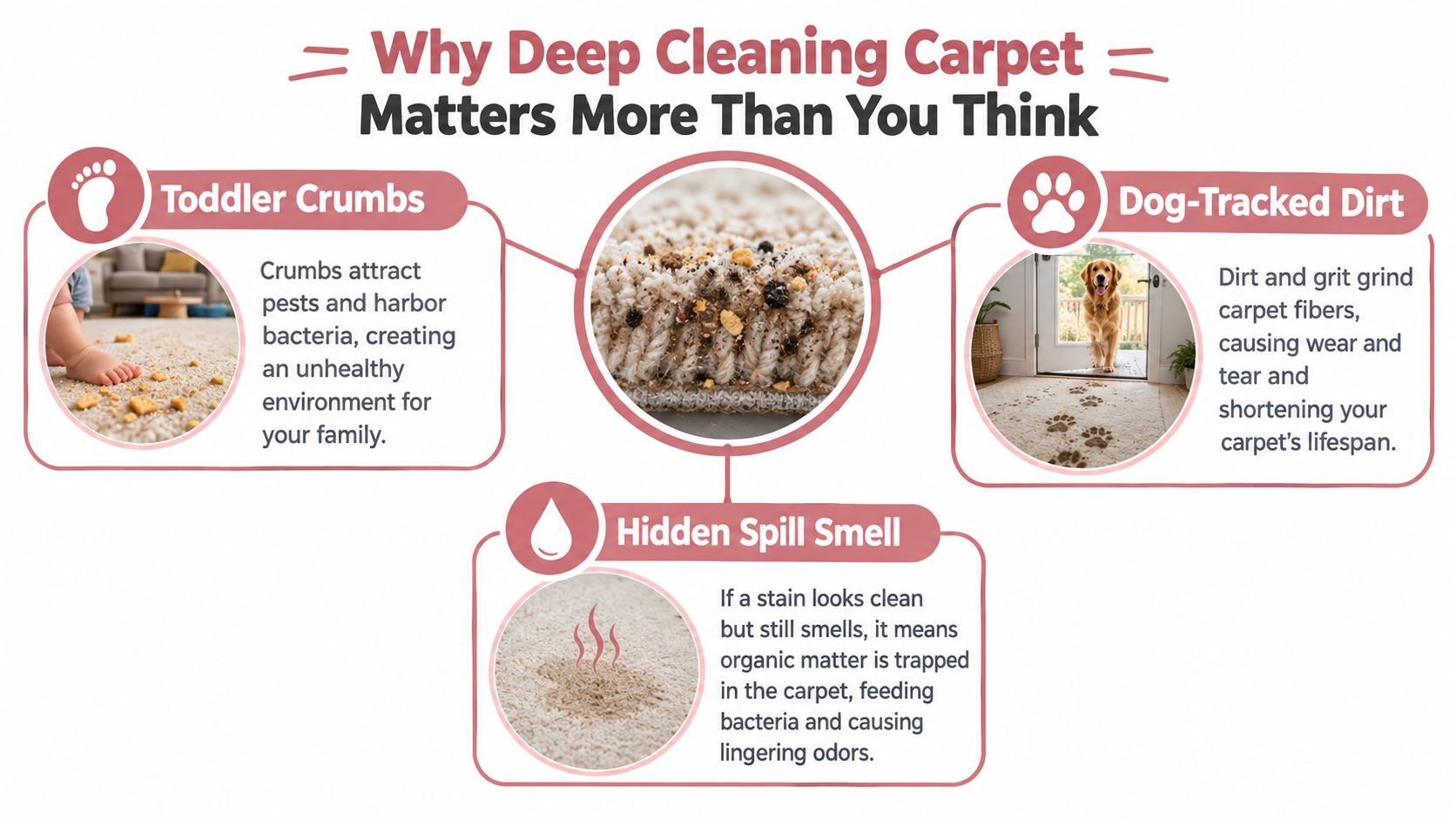
Carpet works as a filter you walk on, trapping dust, dirt, pollen, mold spores, pesticides, and other indoor or outdoor contaminants at floor level, where children crawl, pets nap, and bare feet land first thing in the morning. That makes it part of the home's air-quality system, not a decorative surface. Every step can lift a little back into breathing space if the pile is overloaded.
Regular vacuuming matters, and it does remove loose material. It doesn't reach embedded soil that's been ground into the base of the fibers by shoes, chair legs, and months of traffic between the kitchen and the couch. Wet cleaning without good recovery can also leave residue and moisture behind, so method and drying matter as much as effort.
What You Cannot See in the Pile
A beige bedroom carpet can look clean and still hold allergen-bearing dust. The EPA describes carpet as a reservoir for particles and identifies dust mite allergens as important asthma and allergy triggers, including an acute asthma risk level of 10 micrograms of Der p 1 allergen per gram of dust, equivalent to approximately 500 mites per gram, in EPA guidance on carpet and indoor air quality in schools.
A playroom rug after a week of snacks shows the pattern. Crumbs get vacuumed, but fine dust, skin flakes that feed mites, and tracked pollen settle deeper. Deep cleaning targets that layer.
If allergies are part of life in your house, pair carpet work with broader habits covered in practical ways to reduce allergens at home. Carpet is one reservoir, not the only one, and bedding, curtains, and upholstered furniture need the same attention.
Treat deep cleaning as indoor air maintenance, not a cosmetic splurge. You're removing what the carpet has been holding for you.
There's also a fiber life argument. Grit at the base of the pile acts like sandpaper every time someone pivots on it in sneakers. Removing that grit slows wear in hallways and in front of sofas, where traffic lanes form first. Clean fibers dry faster, hold less residue, and leave fewer particles available to rise back into the room.
A Defensible DIY Deep Cleaning Workflow
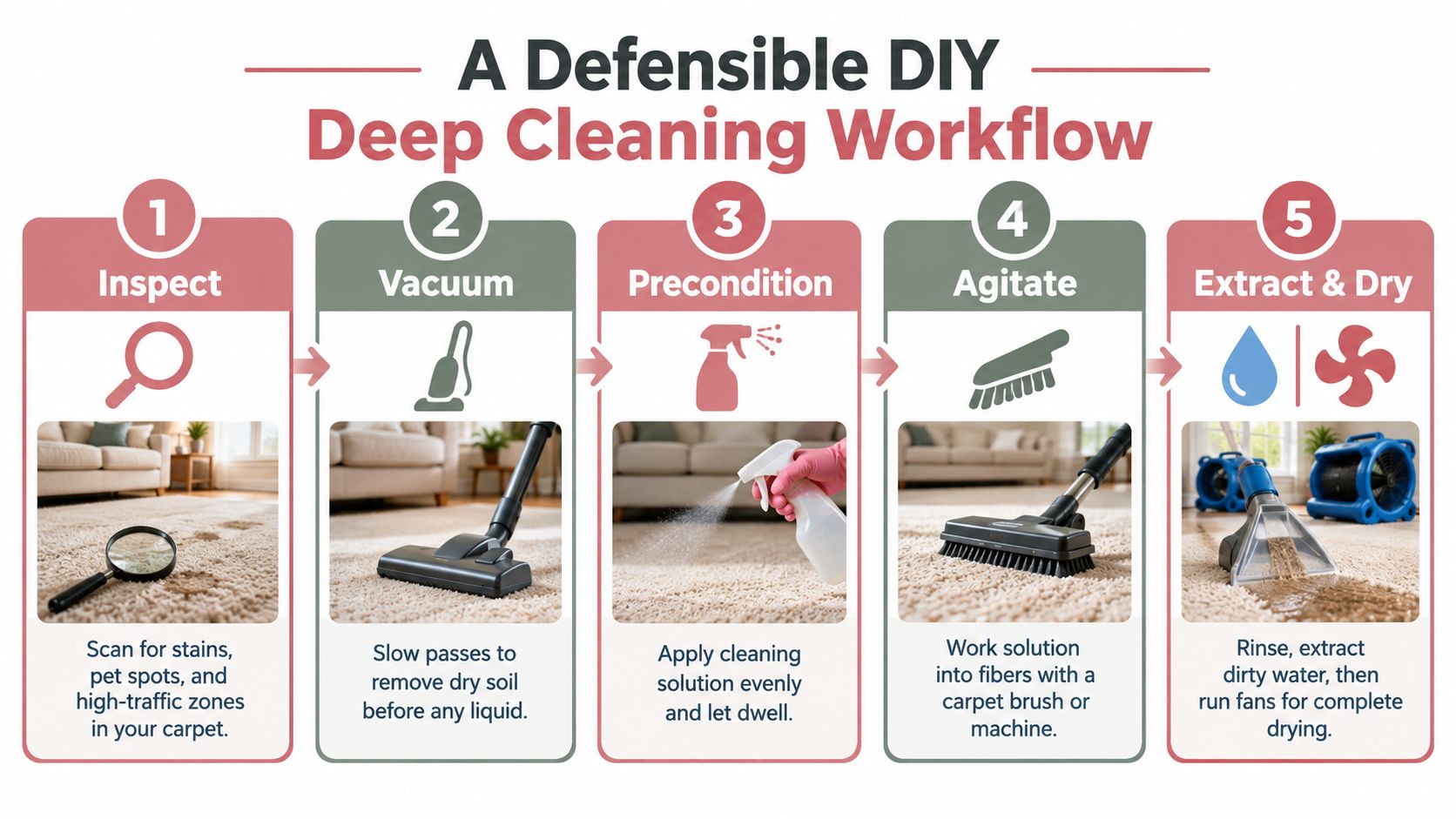
Use one connected sequence, not a spray and hope routine. Take a dull beige family room carpet with no obvious stains. It doesn't need more scrubbing. It needs dry soil removed first, chemistry given time to work, and dirty water recovered from the fibers.
The order below mirrors how a technician runs a room, scaled down for a rental machine or a home extractor.
Inspect, Test, and Vacuum Dry Soil First
Walk the room slowly. Note pet spots near doors, dark lanes in front of the couch, and any area that smells musty when you kneel down. Check fiber type and backing if you can, then test your solution in an inconspicuous corner behind a door for dye bleed, texture change, and browning.
Next, pre-vacuum thoroughly before any liquid touches the carpet. Go slowly in overlapping passes, then change direction in traffic lanes. Dry grit that you'd otherwise turn into mud comes out far more easily now. If pet odor is your main complaint, mark those zones now and review targeted pet odor cleaning guidance before you precondition the whole room.
Precondition and Respect Dwell Time
Apply your preconditioning solution at the manufacturer's dilution, coverage, and dwell time. More chemical isn't better. Excess concentration leaves residue that attracts new soil, so the carpet looks bright for a week and then dulls faster than before.
Agitate where the fiber allows it, using a soft carpet brush or the machine's brush on loop pile with care. Then wait. The Carpet and Rug Institute laboratory protocol measures soil removal as a percentage, with certification thresholds of 55 to 69% for Bronze, 70 to 79% for Silver, 80 to 89% for Gold, and 90 to 100% for Platinum, and CRI guidance specifies approximately 10 to 20 minutes of dwell time between preconditioning and rinse extraction so chemistry can suspend soil before recovery, as set out in CRI Test Method 119 for deep cleaning systems.
Practical rule: If you extract thirty seconds after spraying, you've skipped the step that actually loosens bonded soil.
Watch the extraction and dry pass technique in action before you start your own room.
Work in small sections, for example one half of the family room at a time. Make controlled extraction passes at the equipment maker's recommended rate, overlap each pass slightly, and watch the recovery water. When it runs noticeably clearer, switch to vacuum only dry passes over the same section.
Don't judge success by temporary brightness alone. A carpet that feels sticky once dry, or that resoils in the same lanes within weeks, usually kept too much residue or dirty water. Slow down, rinse thoroughly, and add dry passes rather than another round of detergent.
Finish by ventilating the room and keeping traffic off the damp pile. Reset crushed fibers with your fingers or a carpet rake in doorways, where foot pivot marks show most.
Hot Water Extraction vs Dry Compound vs Steam
No single method wins every room. The right choice depends on how much soil you're removing, how much moisture your carpet and pad can handle, and how quickly the space has to go back into use.
| Method | Moisture Level | Typical Drying | Best Fit For |
|---|---|---|---|
| Hot water extraction | High, controlled | Longest of the three | Neglected family rooms, heavy embedded soil |
| Dry compound | Low | Short, room returns to use sooner | Hallways, maintenance cleans between visits |
| Steam | Very low | Short | Light surface refresh, moisture sensitive areas |
Hot Water Extraction for Built Up Soil
This is the rental machine or truckmount people picture. Heated solution goes down, suspended soil gets rinsed, and strong vacuum recovers the water. For a family room ignored for a year, with snack grease near the couch and a dark lane to the kitchen, extraction gives you the deepest reset because you're physically removing the dirty solution, not just loosening it.
The trade off is moisture management. You need time, airflow, and discipline with dry passes. CRI soil removal benchmarks mentioned earlier give you a useful reality check here. Equipment and technique vary widely, so a rushed extraction can underperform a careful low moisture clean.
Intensive cleaning also affects the air, not just appearance. Research summarized by the National Center for Healthy Housing links intensive carpet cleaning with a measurable reduction in airborne particulate matter, with one cited study finding a 50% reduction in airborne fine particles, bringing indoor concentrations to levels similar to those measured outdoors, as reported in an EPA hosted review of healthy housing research.
Dry Compound and Steam for Lower Moisture Jobs
Dry compound works differently. You vacuum, spread a moist compound, brush it in with counter rotating brushes, let it dry, then vacuum it out with the soil it absorbed. In a high traffic hallway between bedrooms, that's practical. You can treat the lane, keep disruption low, and avoid a damp pad under a runner. For more detail on that approach, HomeProBadge dry carpet cleaning tips walk through the low moisture process step by step.
Steam cleaning uses high temperature vapor with very little water. It's useful for a light refresh and for households that want to limit chemical use, but it won't recover the same volume of embedded grit as a thorough extraction on a heavily soiled carpet. If you're weighing those two directly, a side by side look at carpet cleaning versus steam cleaning helps sort out the terminology, since many people use the labels interchangeably.
Match the method to the room. Extraction for the annual reset, dry compound for hallway maintenance, steam for a quick refresh before guests arrive.
Stain-Specific Techniques That Actually Work
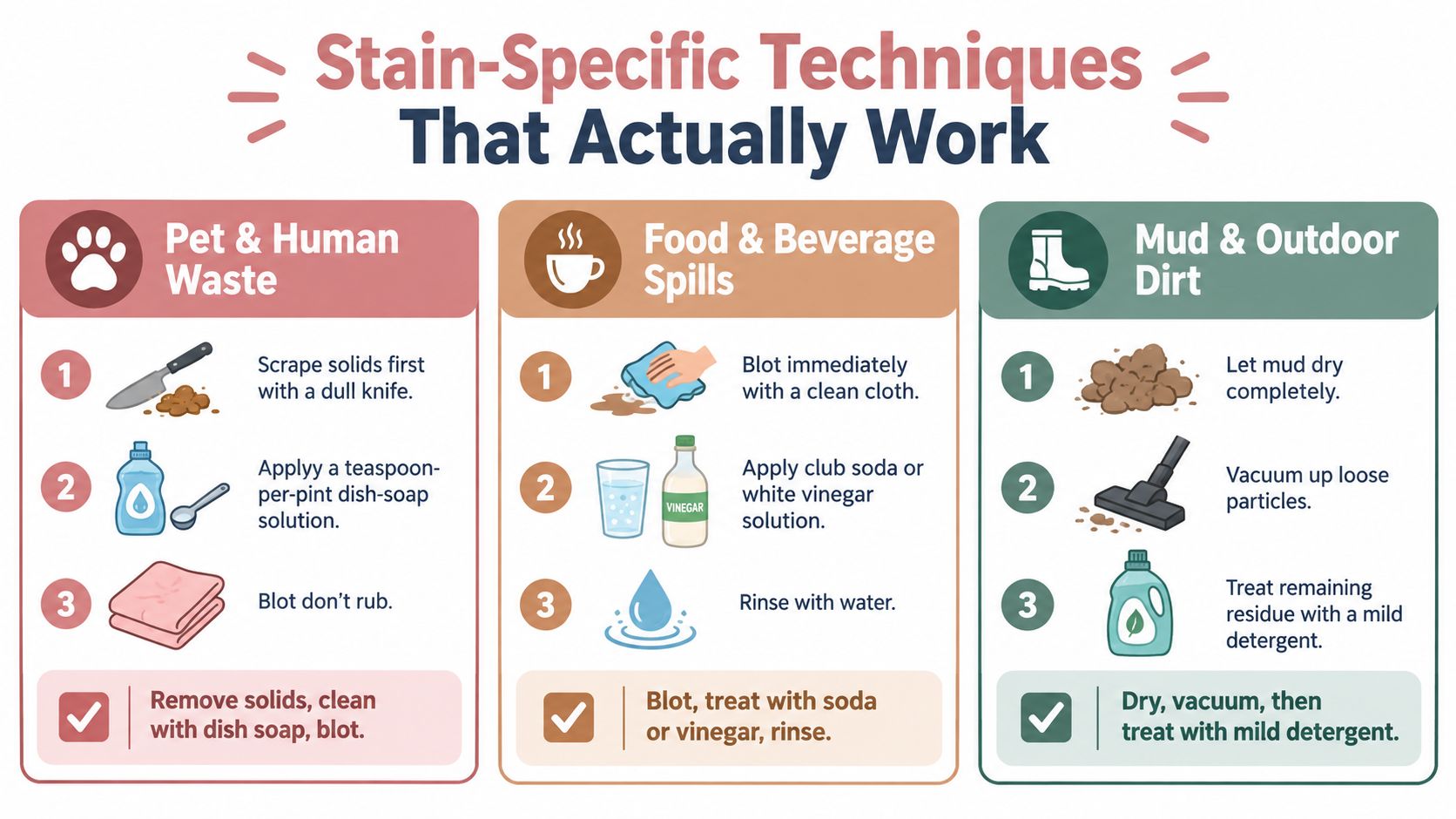
General cleaning won't fix a specific stain if you treat it with the wrong chemistry or too much water. Work stain by stain, match the treatment to the substance, and always finish by removing moisture and residue.
Pet and Human Waste on Bedroom Carpet
Say the dog has an accident beside the bed at 6 a.m. Remove solids first so you don't drive contamination deeper. University of Georgia textile care guidance instructs users to scrape solids gently to avoid pushing material into the carpet, then sponge with 1 teaspoon of mild white dishwashing detergent in 1 pint of lukewarm water and repeatedly blot with an absorbent pad until no more stain transfers, as detailed in University of Georgia guidance on feces stain removal.
- Scrape gently: Lift solids with a dull knife, working inward so you don't spread the spot.
- Blot, don't rub: Press a clean pad down and lift. Rubbing frays fibers and widens the stain.
- Repeat until clear: Change pads as they pick up color, and stop adding solution once no transfer shows.
Odor can linger after the visible stain is gone, especially with vomit. If that sour smell persists in a child's bedroom, follow specific steps to eliminate vomit smell from carpet rather than masking it with fragrance, which only layers scent over residue in the pad.
Berry, Jam, and Grease Spots
Now picture a toddler dropping a bowl of raspberries on a light area rug. For red fruit, jam, or jelly, apply a laundry pre-soak lightly, cover the spot with a pad kept moist for 10 to 15 minutes, and keep the wet area from spreading, following University of Georgia guidance on controlled stain treatment. Sponge with clear water afterward and blot thoroughly to remove residue.
Treat the spot locally. Soaking the whole rug to fix a hand sized berry stain over-wets backing and foam padding, and solvent based cleaners used for grease can damage that backing if you flood the area. For an oily food spot near the dining table, use small amounts, blot from the outside in, and rinse.
Removable rugs give you another option, since you can sometimes wash them separately. Before you submerge one in a tub, check how to wash rugs safely so you don't shrink backing or bleed dyes across a patterned border.
Whatever the stain, reset the pile with your fingers before it dries. Crushed, damp fibers dry in the wrong direction and leave a visible patch even after the color is gone.
Drying, Moisture Control, and the Mold Question
Drying isn't the waiting period after the work. It's a hygiene checkpoint, and it's where most post cleaning damage happens. Carpets that feel dry on the surface can still hold moisture in the padding underneath.
A Post Cleaning Sequence That Works
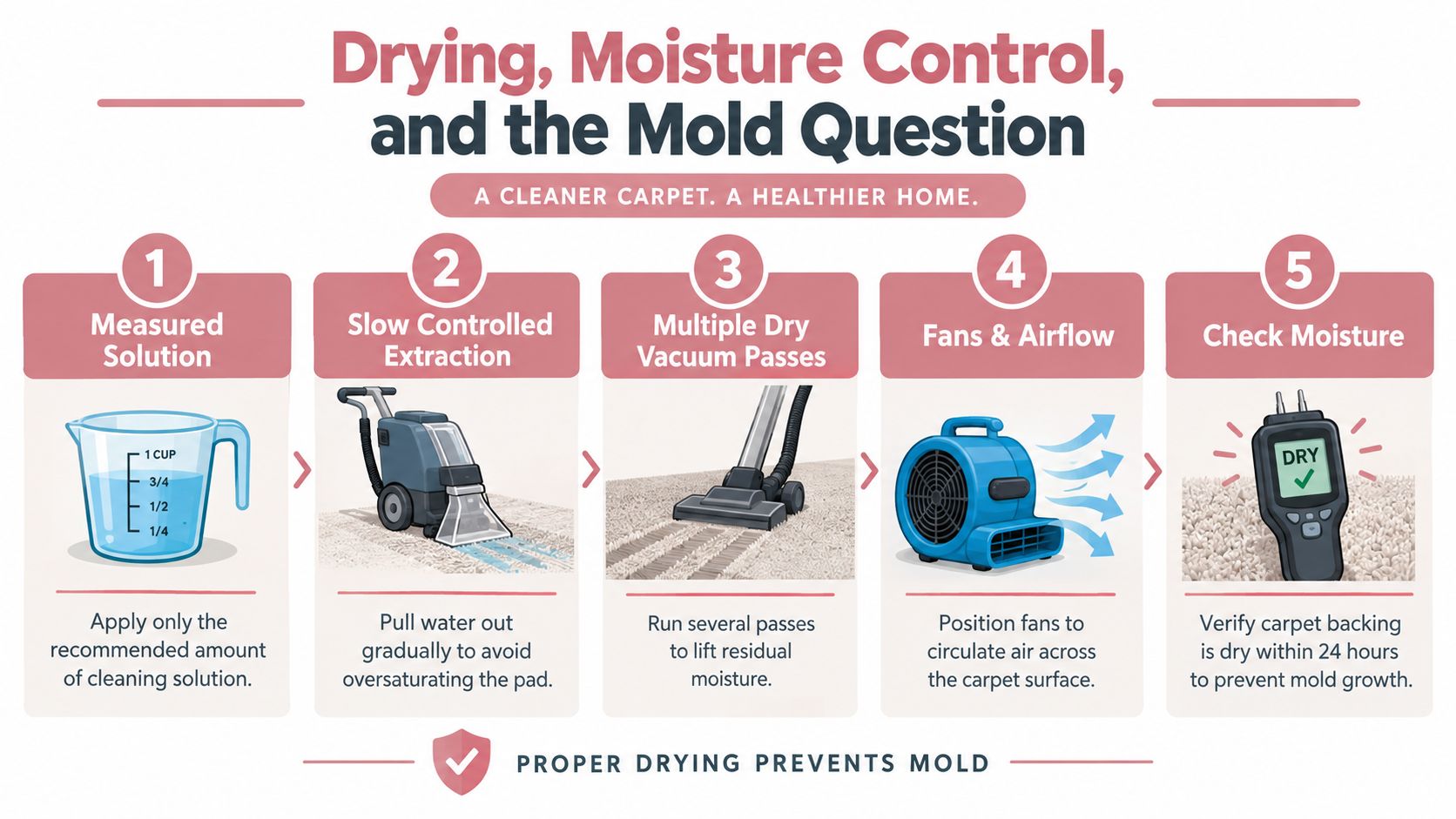
Start during the clean itself. Apply measured solution instead of soaking, extract slowly so the vacuum can recover water, then make multiple vacuum only passes. Put fans or air movers across the surface, keep HVAC running when it's safe to do so, and open doors to improve circulation between rooms.
- Keep furniture off: Wait until the carpet is fully dry before returning sofas, beds, or plastic protectors.
- Watch slow zones: Check pad seams, corners behind doors, and areas under heavy furniture, since they dry last.
- Control room humidity: Use a dehumidifier in a closed basement or shaded ground floor room.
The U.S. Environmental Protection Agency recommends keeping indoor relative humidity below 60%, ideally between 30% and 50%, and says wet materials should be dried within 24 to 48 hours to reduce mold risk. EPA also warns that carpet padding may require separate drying and that wet vacuuming alone is insufficient, as explained in EPA mold course guidance on moisture control.
The Basement Leak Example
Take a carpeted basement after a small pipe leak on a humid North Georgia weekend. Remove standing water first, run fans and a dehumidifier continuously, and evaluate the carpet and pad inside that same 24 to 48 hour window rather than leaving it damp under a storage bin. If the pad stays wet, surface drying hasn't solved your problem.
A musty odor after cleaning is information, not a fragrance problem. Find the moisture before you add scent.
If that sour, wet smell sets in despite your efforts, fix waterlogged carpet smell covers the remediation side, including when porous material can't be saved. Persistent dampness, visible mold, or a known ongoing leak means you should pause routine cleaning and call a remediation specialist. Carpet can retain excess moisture after room humidity falls, and trapped dust supplies nutrients that encourage fungal growth, so verifying the pad matters more than trusting your palm on the pile.
When to DIY and When to Hire a Professional
Decide based on the room, the soil load, and who lives with the carpet. Price matters, but a flat number tells you little. Local services typically quote based on home size, room count, pet presence, clutter, and product preferences, so compare scope rather than a headline figure.
When DIY Makes Sense
A single bedroom with a recent spill is a reasonable DIY job. So is a hallway refresh with dry compound, or a rental machine extraction on one family room when you've got a free Saturday, good ventilation, and no one in the house with chemical sensitivities. You'll control the schedule and learn how your carpet responds.
Keep expectations realistic about drying. Residential guidance recommends waiting until carpet is dry before replacing furniture or resuming normal use and states that drying can take 6 to 12 hours, and carpet remaining wet beyond 12 hours warrants investigation, according to CRI Test Method 118 on residual moisture. Question any promise that every carpet dries in two hours regardless of pad, weather, or humidity.
When Hiring Out Is Smarter
Multi room jobs, years of buildup, warranty carpet with specific care requirements, and severe pet staining that has reached the pad all favor professional equipment and stronger recovery. The same applies in homes with small children, asthma, or environmental sensitivities, where product disclosure matters as much as soil removal.
Ask what pre-spray, deodorizer, stain protector, and fragrance products will be used, whether residues get fully extracted, and whether a fragrance free or biodegradable option is available. Deep cleaning can remove embedded dust, but it can't reliably strip every chemical from fibers, and it doesn't replace remediation for contaminated materials.
As one local option, Aquastar Cleaning Services, LLC offers carpet cleaning by dedicated specialists alongside its residential cleaning services in Kennesaw and North Atlanta, with eco friendly product options on request. You can review scope and scheduling through their carpet cleaning specialists page and compare it against doing the work yourself room by room.
A Practical Recap and Your Next Step
Tape this sequence inside a utility closet door and run it in order. Skipping steps is how carpets end up damp, sticky, or dirty again within a month.
- Inspect first: Find pet spots, traffic lanes, and musty areas before any liquid goes down.
- Vacuum dry soil: Slow overlapping passes, two directions in hallways and doorways.
- Precondition with dwell time: Correct dilution, agitate gently, then let chemistry suspend soil.
- Extract and rinse: Controlled passes, clear recovery water, then vacuum only dry passes.
- Blot stains, never rub: Work outside in, rinse residue out, reset pile with your fingers.
- Dry with airflow: Fans, HVAC, dehumidifier if needed, furniture stays off until fully dry.
- Check after 12 hours: Kneel and check seams and corners for lingering dampness or odor.
One candid limit. If you find visible mold, saturation from a known leak, or a musty smell that predates the cleaning, don't deep clean over it. Fix the moisture source and get remediation advice first, since adding water to an existing problem makes it worse.
For busy households with kids, pets, or allergies in a humid climate, periodic intensive cleaning is part of indoor air maintenance. Pair it with regular vacuuming using a HEPA equipped machine, keep sensitive occupants out of the room during and right after cleaning since fine particles can temporarily re-suspend, and your carpet stops being a hidden reservoir and goes back to being a floor you're comfortable sitting on.
If your family room, bedrooms, or pet zones need deep extraction, stain treatment, and proper drying without a weekend of rental equipment, Aquastar Cleaning Services, LLC provides professional carpet cleaning for homes in Kennesaw and North Atlanta, with eco friendly options for households with children and pets. Visit Aquastar Cleaning Services, LLC to request a quote suited to your home size, room count, and product preferences, and schedule a clean that treats your carpet as part of your home's air quality, not just its appearance.