


A freshly wiped kitchen can look cleaner while the air becomes more polluted. Household cleaners release volatile organic compounds, or VOCs, which help explain why a sharp smell can linger after the cloth is put away. Choosing eco friendly cleaning agents means looking beyond a leaf on the bottle to the ingredients, the dose, the airflow, and the job you need done.
Why Eco Friendly Cleaning Agents Matter Indoors
The bathroom sink shines, the mirror is clear, and the floor has just been mopped. Yet the room still smells sharply of cleaner. That scent isn't a useful measure of cleanliness, and adding an air freshener doesn't address what you're breathing.
The European Commission reports that consumer products contribute approximately 10–20% of indoor VOC concentrations, a share comparable to transport-related pollution entering from outdoors, depending on outside air quality; it identifies air fresheners, general-purpose cleaners, and floor-care products as major household sources and notes that 33 of 45 product categories examined emitted selected VOCs, while semi-volatile compounds were assessed mainly through household dust (European Commission household pollution findings).
Clean surfaces and cleaner air are different goals
For household decisions, think of eco friendly cleaning agents as products selected to complete a cleaning task with less lasting indoor pollution and less environmental harm after disposal. That isn't the same as buying anything labeled natural.
A plant-derived formula can still contain fragrance ingredients or volatile solvents. A biodegradable cleaner can still create exposure while you're using it. In a closed home where someone cleans frequently, exposure can continue after the visible work ends.
Practical rule: Judge the result by the cleaned surface and the product directions, not by how strongly the room smells.
For example, after mopping a bathroom, skip the plug-in freshener. Ventilate when practical instead of adding another scented product, and check whether the floor cleaner needs rinsing.
Make a gentler routine specific
At the kitchen sink, start with a task rather than a shopping category. Are you removing everyday crumbs and smears, tackling a stubborn deposit, or dealing with a situation that needs disinfection? Those aren't interchangeable jobs.
For more everyday ideas, Everti's guide to gentler home cleaning is a useful companion, provided you treat chemical-free wording as shorthand rather than a literal description. Water and plant ingredients are chemicals too.
If your household also struggles with dust or sensitivities, pair product decisions with a broader plan to reduce allergens at home. A different bottle alone isn't a complete housekeeping strategy.
What Makes a Cleaner Truly Eco Friendly
You're standing over the kitchen sink with a used mop bucket. The floor looks good, but the cleaner's environmental story doesn't end there. What happens after the wastewater leaves your home matters too.
The useful questions are more precise than “Is it biodegradable?” Ask how quickly it breaks down, what it breaks down into, and how harmful it is to aquatic life.
Follow the ingredient beyond the drain
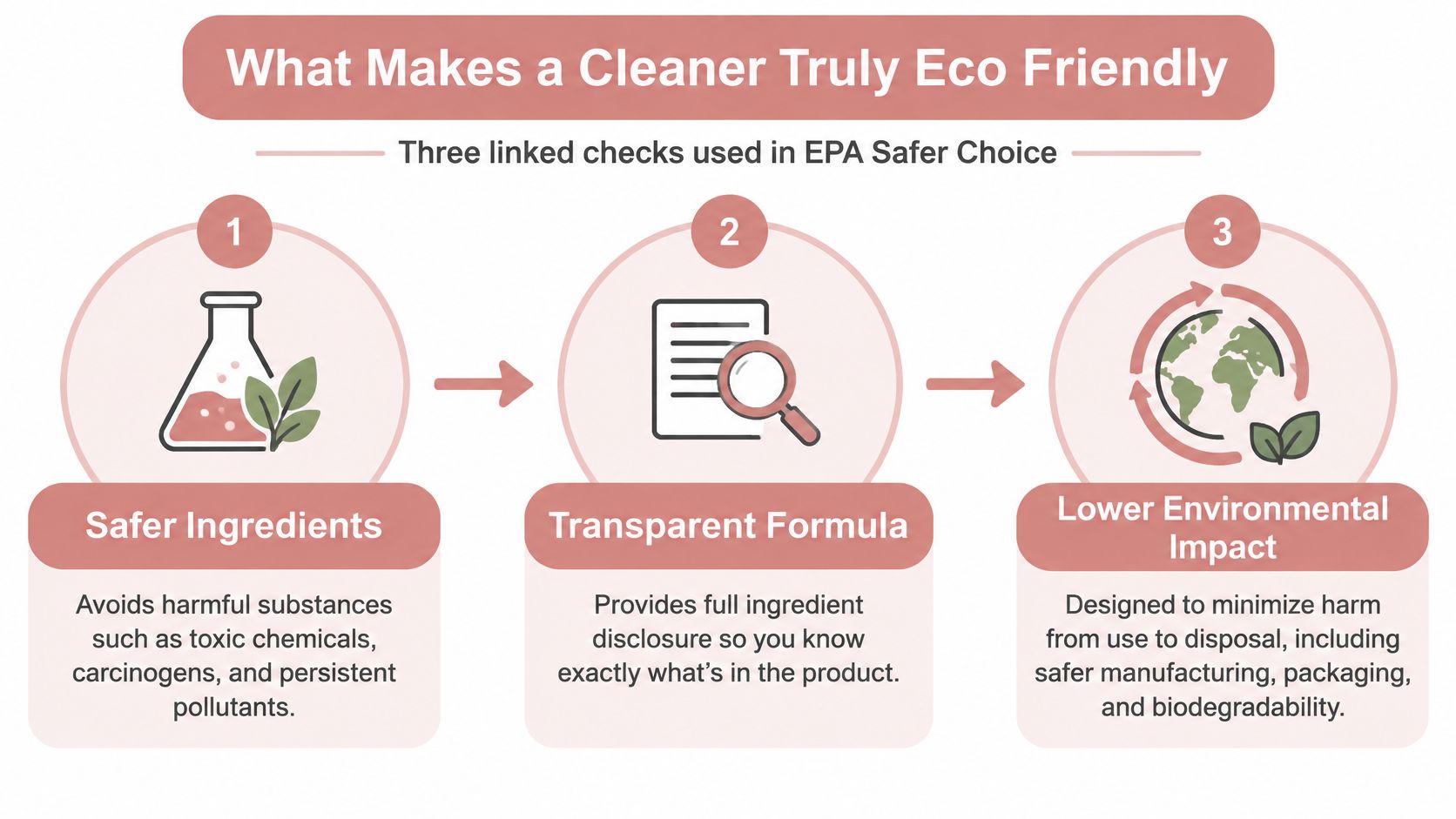
Surfactants are cleaning ingredients that help loosen and remove dirt. The EPA's Safer Choice surfactant criteria connect their biodegradation with aquatic toxicity rather than judging either characteristic alone.
Under those criteria, a surfactant with acute aquatic toxicity at or below 1 ppm may qualify if it biodegrades within a 10-day window without producing chemicals of concern, while one above 10 ppm must biodegrade within 28 days under the applicable testing framework (EPA surfactant criteria). Lower toxicity values indicate harm at lower concentrations, so these aren't instructions for household dilution.
EPA also describes ready biodegradability as relatively rapid breakdown in an aerobic aquatic environment, meaning water where oxygen is available. A supplier should identify the relevant test, not merely substitute the word natural.
The broader product checks fit together like this.
Compare claims rather than packaging
Suppose you're comparing bathroom floor cleaners. Both bottles say biodegradable, but only one explains its testing standard. The documented claim gives you something meaningful to evaluate.
European detergent rules use ultimate biodegradation, where surfactants break down into carbon dioxide, water, and mineral salts under recognized testing requirements (European detergent biodegradability framework).
Use these shopping questions:
- Testing: Does the manufacturer name a recognized biodegradability method?
- Breakdown products: Does the assessment consider what remains afterward?
- Suitability: Will the formula do the intended job without repeated applications?
A specialized kitchen appliance adds another consideration: manufacturer compatibility. PureHQ Inc.'s discussion of a universal cleaner for coffee makers provides a task-specific resource, but a universal description doesn't replace your machine's care instructions or establish environmental certification.
The stronger choice is the product supported by relevant evidence and suitable directions, not the prettier leaf icon.
How to Read Labels and Certifications
At the bathroom cabinet, you're comparing a heavily scented plant-derived spray with a fragrance-free all-purpose cleaner carrying an EPA Safer Choice mark. Don't choose by the front label alone. Turn each bottle around and look for evidence behind the wording.
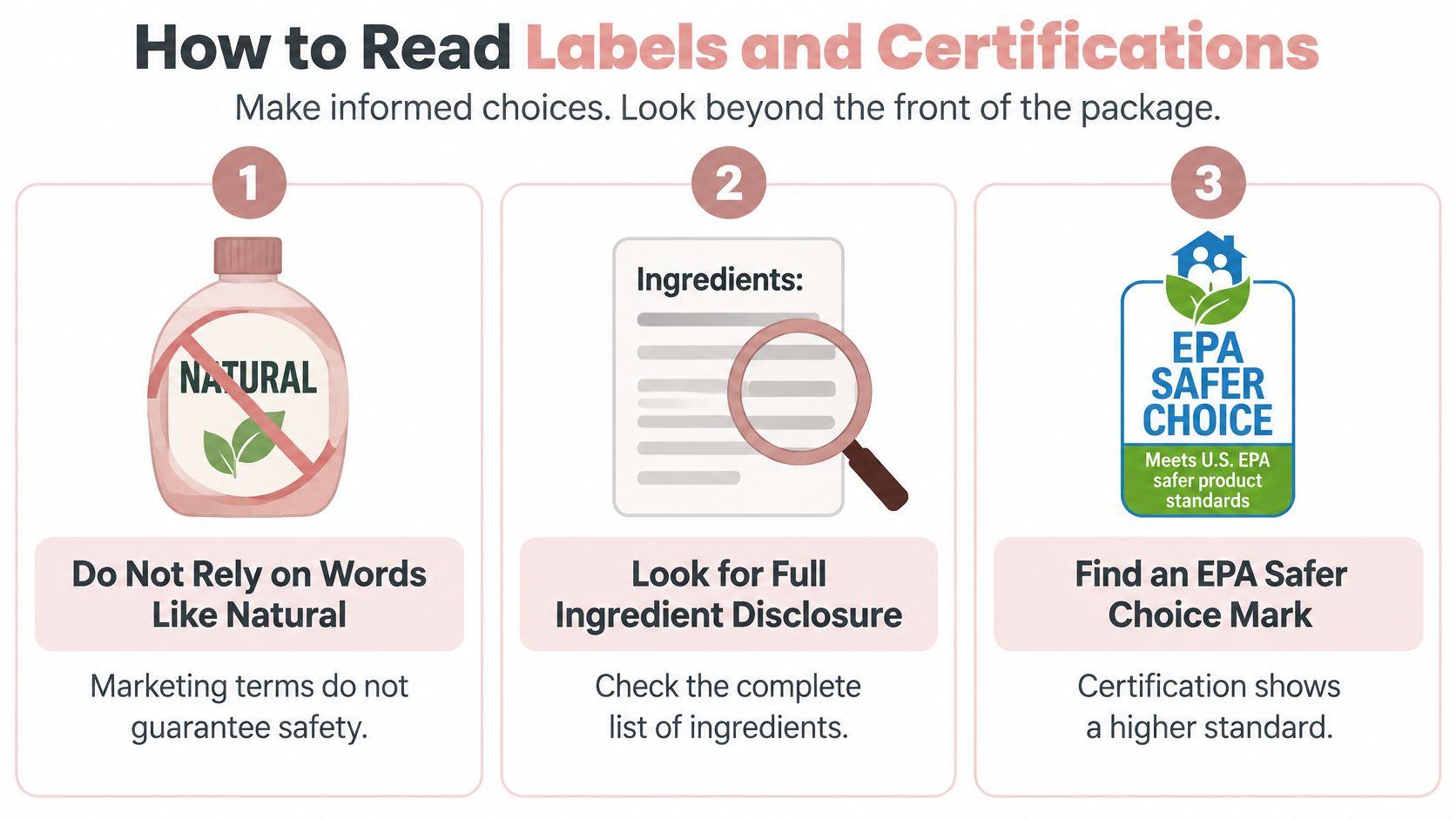
Natural, plant-based, biodegradable, and independently screened describe different things. None should stand in for all the others.
Read past the marketing language
Start with the complete ingredient disclosure. Look for the formula's cleaning ingredients, solvents, preservatives, and fragrance information rather than assuming a short front-label description tells the whole story.
EPA Safer Choice evaluates every ingredient against human-health and environmental criteria, including surfactants, preservatives, solvents, and other functional ingredients. It also expects products to perform, so the program isn't just a list of ingredients to avoid.
For direct-release products, the standard excludes ingredients with aquatic toxicity values below 10 mg/L and restricts persistent, bioaccumulative, and toxic ingredients using criteria that generally include a persistence half-life above 60 days, a bioaccumulation factor above 1,000, or aquatic toxicity below specified thresholds (EPA Safer Choice standard). Those technical limits aren't household dosing rules, and the direct-release requirements shouldn't be confused with the separate surfactant criteria.
This checklist helps translate the label into a purchasing decision.
Make the comparison practical
For an ordinary bathroom wipe-down, the fragrance-free certified cleaner would be my preferred starting point, assuming its label permits the surface and task. Its advantages are a defined screening framework and the absence of added fragrance, not a promise of zero risk.
If the plant-derived spray doesn't disclose enough information, don't fill in the gaps with assumptions. Ask the manufacturer for the full ingredient information and the basis for its environmental claims.
Certification is a screening tool, not permission to swallow a cleaner, ignore its warnings, or use it on every surface.
A helpful shopping checklist is:
- Match the surface: Check that the product is appropriate for your countertop, floor, or fixture.
- Identify the claim: Separate environmental screening from disinfectant claims.
- Read the directions: Confirm dilution, application, rinsing, and storage requirements before buying.
For context on the terminology, consult this explanation of green cleaning certification. The aim isn't to memorize chemistry names. It's to recognize when a manufacturer offers a defined standard instead of reassuring language.
Benefits Risks and Products You Should Not Mix
A kitchen counter doesn't need a strong perfume to be clean. Switching products can reduce emissions, but replacing a conventional bottle with a green one isn't permission to stop checking the formula.
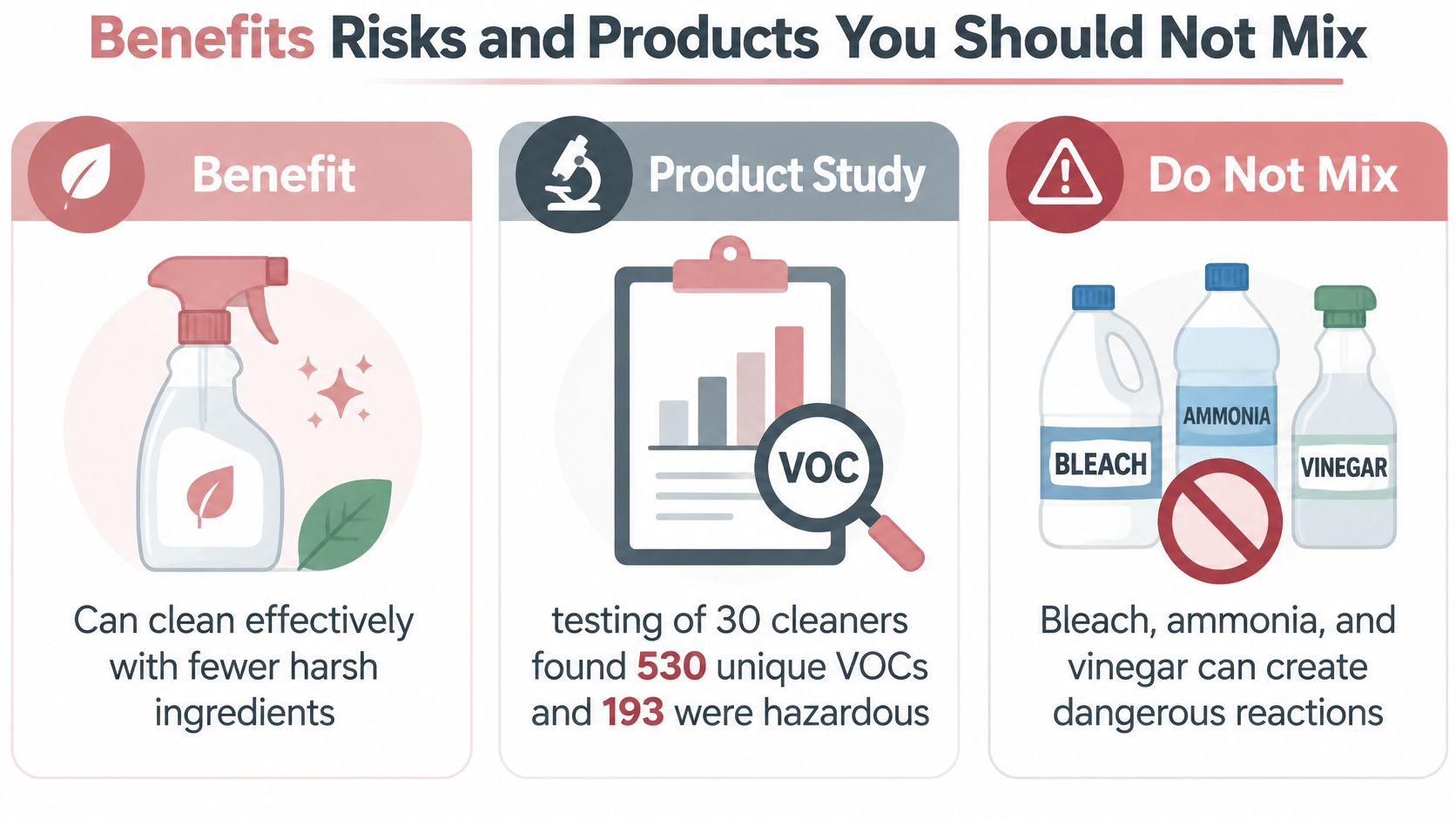
Testing of 30 cleaners found 530 unique VOCs, including 193 classified as hazardous, and green-marketed products emitted roughly half as many VOCs on average as conventional products (cleaning-product emissions study summary). These are findings from tested products, not a guarantee about every bottle on a shelf.
Lower emissions don't mean no exposure
A related investigation found that 75% of the highest measured VOC emissions came from conventional products, while some green all-purpose cleaners still increased fragrance chemicals of concern (Lawrence Berkeley National Laboratory indoor-air research). Fragrance-free products produced the lowest hazardous VOC quantities in the broader product-testing evidence.
For a household managing asthma or fragrance sensitivity, that distinction matters more than a citrus scent or a botanical illustration. Prefer a suitable fragrance-free liquid applied to a cloth, where the directions allow, rather than unnecessary aerosols or air fresheners.
Keep the benefit and the safety boundary together.
Keep incompatible products separate
At the bathroom sink, don't add a second cleaner because the first didn't remove a mark immediately. Stop, check the directions, and choose an appropriate next step without combining chemicals.
- Never mix bleach: Keep chlorine bleach separate from vinegar, ammonia, and other cleaners.
- Limit the amount: Use no more than the label recommends.
- Control exposure: Ventilate, protect skin, and use eye protection where splashing is possible.
- Store deliberately: Label diluted solutions and keep chemicals away from children and pets.
CDC guidance discusses diluted bleach for some surfaces at at least 1,000 ppm sodium hypochlorite, referencing products containing 5%–6% sodium hypochlorite; these figures aren't a mixing recipe, and the product directions still govern preparation and use (CDC chemical safety guidance).
Don't assume every cleaning task calls for that approach. Understanding the difference between sanitizers and disinfectants helps you avoid choosing a stronger job category than the situation requires.
Practical Examples for Kids Pets and Daily Rooms
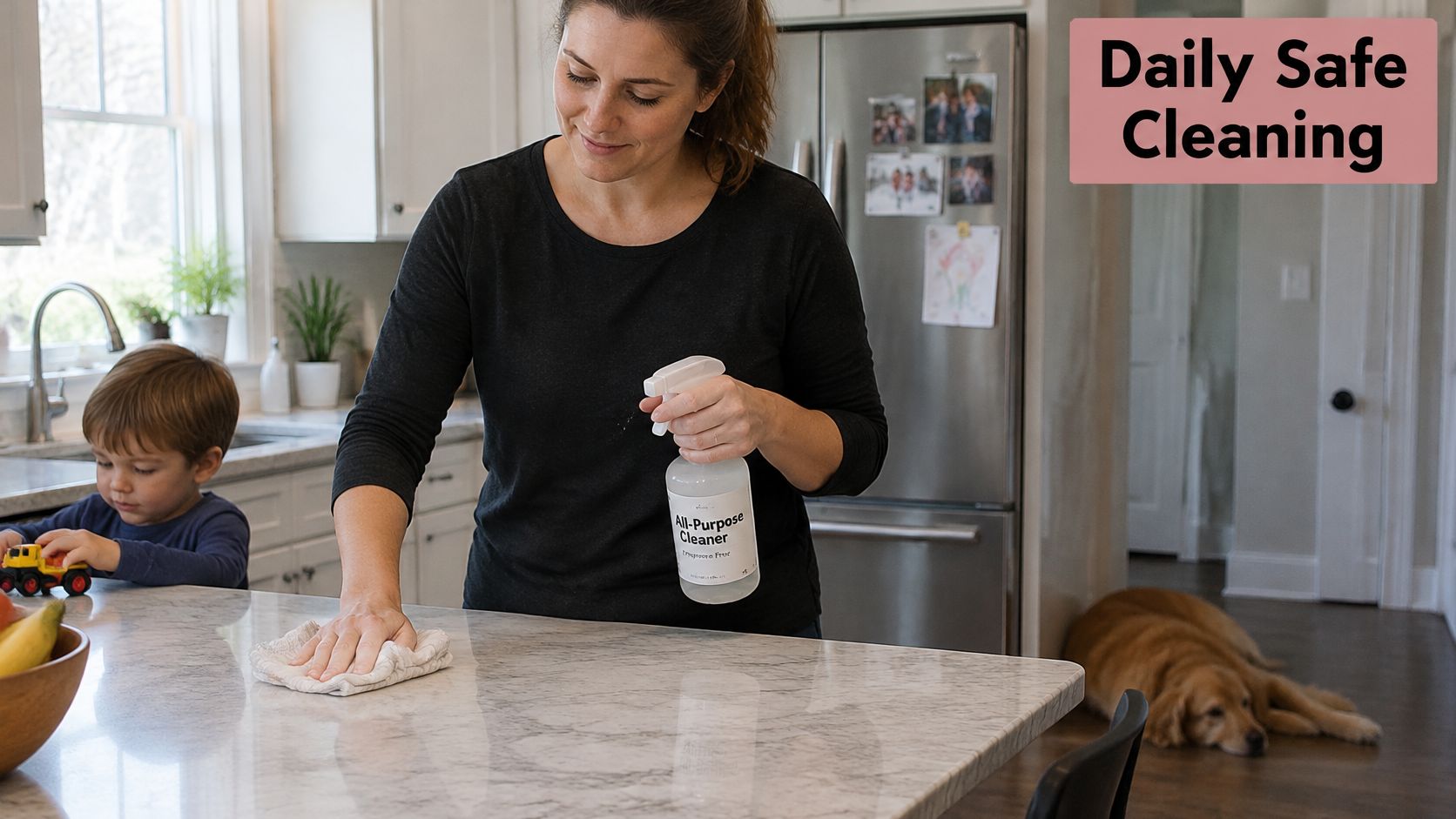
Breakfast is finished in a North Atlanta kitchen, the dog is waiting nearby, and a child wants to help. Put cleaning products beyond their reach before starting, then choose the method that fits the counter.
Keep children and pets away from the active work area, even when the product is marketed as gentle.
Kitchen counters and pet traffic
Apply a suitable fragrance-free all-purpose cleaner to a microfiber cloth instead of spraying broadly, if the label allows that method. Wipe the crumbs and smears, then complete any required rinsing. The aim is controlled surface coverage, not a cloud over the breakfast area.
For the kitchen floor, measure the product rather than pouring an extra splash into the bucket. Keep the dog away until the floor is dry and any label-required rinsing is complete, then return the bottle to a secure cabinet. This guide to safe floor cleaners for dogs can help you evaluate the whole routine.
If you're also renovating, cleaning isn't the only product decision worth reviewing. Flawless Painting's discussion of pet-safe paint choices for families offers a related resource for planning work around household occupants.
Bathroom cleaning and disinfection
After illness, a bathroom counter may need more than routine wiping. CDC recommends cleaning with soap and water before disinfecting when disinfection is needed, then keeping an EPA-registered disinfectant visibly wet for its full label contact time; dilution should use room-temperature water unless the directions specify otherwise (CDC home cleaning and disinfection guidance).
Drying the counter immediately can interrupt that required wet period. Don't shorten it to make the routine feel gentler.
For an additional visual resource, the following video is available.
Keep these everyday boundaries clear:
- Children nearby: Choose low-exposure methods and ventilation rather than relying on a pleasant scent.
- Stubborn residue: Give a cleaner its directed dwell time and work with the cloth instead of adding extra concentrate.
- DIY limits: Vinegar may help with some shower-door soap film on compatible surfaces, but it isn't a substitute for a registered disinfectant.
EPA notes that homemade cleaners typically don't perform as well as commercially formulated products (EPA Safer Choice frequently asked questions). Homemade vinegar, citrus, or essential-oil mixtures aren't automatically superior.
How to Choose a Cleaning Approach
At the kitchen sink, a greasy pan may need a different method from a bathroom floor or a move-out clean. Choose by the task, the time available, and whether you can use the product as directed. “Plant-based” or “biodegradable” alone does not tell you how much fragrance a cleaner releases, what it contains, or whether it suits the job.
Three Ways to Clean with Less Exposure
| Approach | Best use | Main limit | Kids and pets |
|---|---|---|---|
| Homemade mix | A limited task on a compatible surface, when its purpose is clear | Performance and surface suitability may be uncertain | Familiar ingredients still need secure storage |
| Store-bought certified cleaner | Routine cleaning when you want disclosed ingredients and clear directions | The product still needs correct measuring, use, and cleanup | Choose an appropriate fragrance-free option and follow precautions |
| Professional service | Recurring upkeep, detailed work, moving, or renovation cleanup | Agree on the products and scope beforehand | List household sensitivities and access restrictions |
At the kitchen counter, a homemade mixture may suit one narrow task, while a certified cleaner can make repeat use easier through documented directions. For a large or demanding job, a service may help when time or physical effort makes consistent cleaning difficult. The right choice depends on the whole job, not a green label alone.
Compare the whole job
At the sink, concentrate can seem economical, but overpouring may waste product and increase exposure. Compare dose per completed job, packaging and refill options, fragrance, and whether the task needs disinfection.
A detergent study shows why concentration affects comparisons. A cellulose-and-corn-protein detergent was slightly less effective than laundry powder at equal dilution, while a 5% solution outperformed a 1% powder solution on tested stains. On stainless steel, it removed 92% of chili-oil staining, compared with 87% for commercial dish soap at the comparison concentrations (cellulose-and-corn-protein detergent research summary). Those results do not mean you should change another product's dilution. They show that formulation and dose matter when comparing performance.
For households in Kennesaw and North Atlanta, Aquastar Cleaning Services is one professional option. The family-owned company has operated since 1996 and offers recurring housekeeping, deep cleaning, moving cleans, and post-construction cleanup, with insured, bonded, background-checked teams and custom checklists (Aquastar service information).
At a bathroom doorway, check practical details before booking: weekly, bi-weekly, and monthly visits are available, and gentle biodegradable products can be requested. Pricing reflects home size, visit frequency, pets, product preferences, and clutter. Discuss children's needs, pet access, fragrance preferences, and product suitability beforehand. Green marketing is not a measure of exposure; disclosure, fragrance, ventilation, dose, and the work itself all shape the choice.
A Simple Routine and Your Next Step
At the bathroom sink, a small set of suitable tools can make cleaning easier to repeat. A routine works like a recipe: keep the steps clear, and you are less likely to guess at the dose or skip a label precaution. Keep the product directions accessible, along with a cloth and any measuring tool the label requires.
Build a routine you can repeat
Start with the job, then follow a consistent sequence:
- Choose for the task: Select an appropriate everyday cleaner, with a fragrance level that suits your household.
- Measure deliberately: Use the label's stated amount. Smell and foam do not show how much cleaner a surface needs.
- Work the surface: Follow the directions for contact time and apply with a cloth when appropriate, rather than spraying into the air.
- Manage the air: Ventilate the room when practical.
- Finish securely: Rinse if directed, label any diluted solution, and store supplies out of children's and pets' reach.
For a routine bathroom clean, a suitable everyday product, cloth, and ventilation may be enough. If illness-related cleanup calls for disinfection, use a registered disinfectant and keep the surface wet for the contact time on its label. The job determines the product; a weekly clean does not automatically require disinfection.
A useful household standard: Use the right product correctly and give it time to work.
Put the plan on the calendar
At the kitchen table, assign the work and choose a time that fits the household. A renter preparing for handover may need a different checklist from a family keeping bathrooms clean between school and work. Landlords can clarify the property scope and product preferences before arranging a visit.
A house cleaning schedule for a busy family can help turn intentions into assigned tasks. Keep the schedule realistic, so no one has to rush through directions or skip precautions.
Homeowners, renters, landlords, and families in Cobb, Cherokee, Fulton, and DeKalb counties can use a household routine or request professional cleaning. When asking for an online estimate or phone quote, name the service and ask to include biodegradable products on the custom checklist. Mention fragrance sensitivities, children, pets, and surfaces that need special care. Green marketing alone cannot tell you how much fragrance a product releases or whether it suits a particular job.
Biodegradable does not mean edible or safe to mix. The aim is a clean home through a manageable routine that accounts for product disclosure, fragrance, dose, ventilation, and the task.
Aquastar Cleaning Services, LLC offers recurring housekeeping, deep cleaning, move-in and move-out cleaning, and post-construction cleanup, with biodegradable product options when requested. Ask for an estimate and describe your household's needs and product preferences for the custom cleaning checklist.