


The glass tips, and merlot splashes across your shirt and the carpet beside the dinner table. Grab a white towel before reaching for a cleaning spray. Your next move depends on what got wet: washable cotton can handle treatments that could permanently mark a wool rug or silk cushion.
Removing wine stain marks starts with controlling the spill, not finding the strongest cleaner. Lift what you can, identify the material, and stop before a small stain becomes a bleached patch or soaked carpet pad.
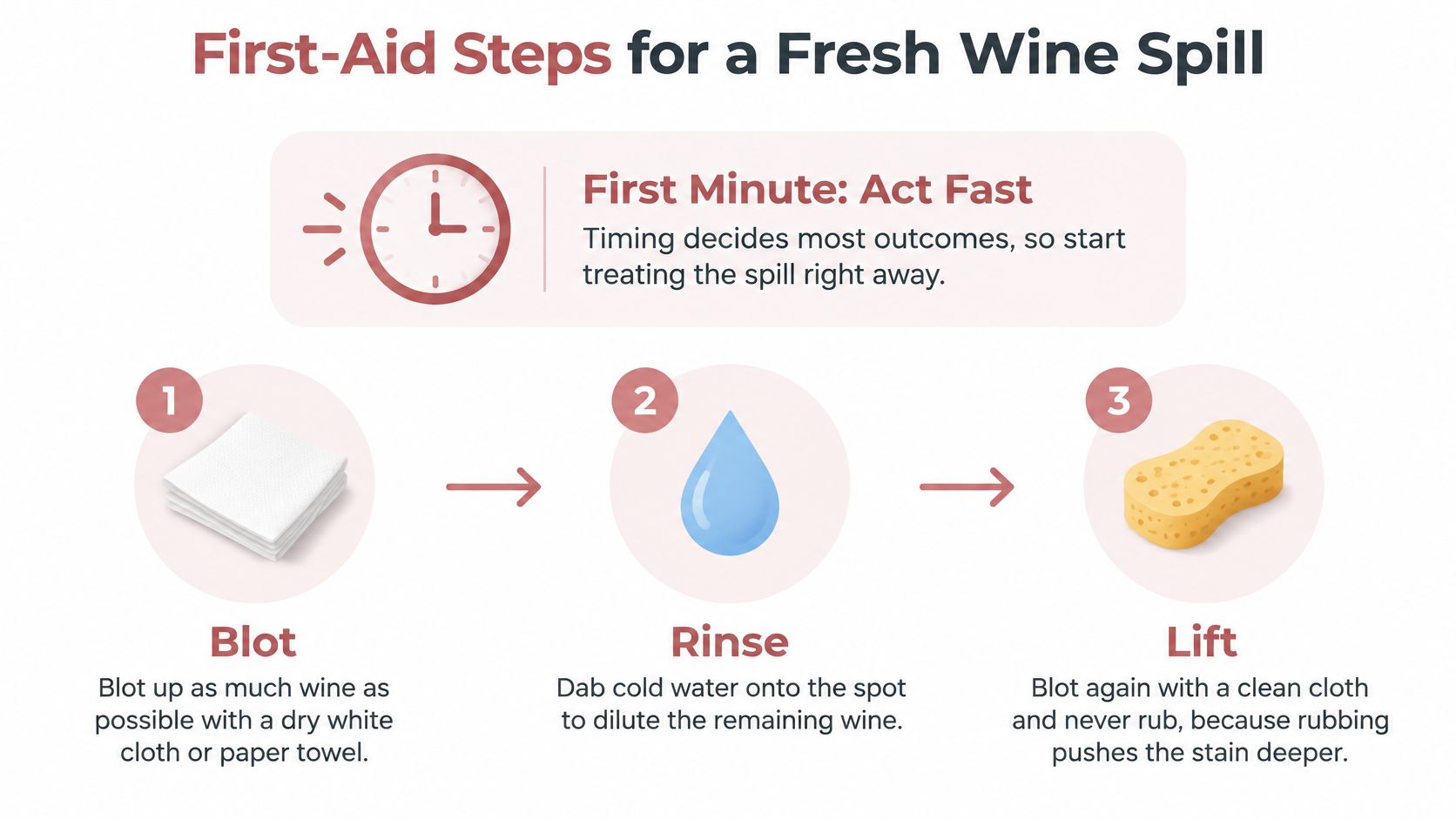
First-Aid Steps for a Fresh Wine Spill
- Blot immediately. Press a dry white cloth or paper towel onto the spill, then lift straight up. Move to a clean part of the cloth as it picks up wine. Don't rub or brush.
- Use cold water appropriately. On washable clothing, hold the stained area under a cold tap with the reverse side facing the water. This pushes pigment outward. On water-safe carpet or upholstery, dab with a barely damp cloth instead of flushing.
- Keep heat away. Don't use a hair dryer, iron, radiator, or tumble dryer to hurry things along. Let the material air-dry after treatment so you can inspect whatever color remains.
These actions keep the response simple while you check the care label.
A 2002 University of California, Davis comparison, described by Wine Spectator, tested eight treatments on cotton, polyester-cotton blend, nylon, and silk, with treatments applied either 2 minutes after the spill or 24 hours later. That comparison makes fresh and aged stains meaningfully different treatment situations. It doesn't establish a universal deadline after which every spill becomes permanent.
A cotton shirt at dinner
Say merlot lands on a white cotton shirt. Spend the first minute blotting and checking its label rather than hunting through the kitchen for salt. If it's washable, take it off, rinse from behind, and place a clean towel underneath before applying a compatible treatment.
Watch the cloth, not just the shirt. At first, each press may collect a strong pink mark. As you remove the liquid, the transferred tint should become lighter and the wet patch shouldn't expand.
For washable items, keep the sequence straight: blot, flush, treat, wash, then air-dry and inspect. Wash at the care-label temperature after pretreatment. If a faint outline remains once dry, reassess it before putting the garment into normal dryer use.
Practical rule: A fading stain is progress. A spreading wet patch means you're adding more liquid than you're removing.
White wine needs the same immediate attention, even though its pale color is harder to see. Continue blotting until there's no visible transfer, and check for dampness rather than assuming a nearly clear spill has disappeared.
Keep a small spill kit where you can reach it:
- White cloths or plain paper towels for seeing what transfers.
- Cold water for controlled dilution.
- Mild dish soap for a surface-compatible treatment.
- A clean absorbent towel to protect nearby layers and collect moisture.
For another grape-based spill on washable clothing, the guide to getting grape juice out of clothes offers related garment-care guidance.
Measured Mixtures and Options by Surface
The right mixture depends on what it touches. A treatment suitable for washable cotton can discolor wool, silk, upholstery, or carpet backing. Match the method to the material, test where needed, and stop if color transfers or the test area changes.
| Surface or Stain | Mixture | How to Apply | Test First |
|---|---|---|---|
| Washable cotton or linen | University of Georgia Extension specifies 1 tsp neutral detergent in 1 cup lukewarm water, followed by 1/3 cup white vinegar in 2/3 cup water | Blot with a white cloth, apply diluted vinegar, repeat the detergent step, then rinse with clean water | Test dyed fabric; plain, colorfast washable fabric is less likely to need a test |
| Upholstered fabric | Good Housekeeping specifies 1/2 tsp liquid dish soap in 2 cups cool water | Sponge lightly, blot, finish with cold water, then blot dry | Yes, on a hidden seam; use only on water-cleanable upholstery |
| Carpet | The Home Depot recommends 1 tbsp dish soap and 1 tbsp white vinegar in 2 cups water | Apply small amounts and blot frequently as the mark fades | Yes, on a hidden corner |
| Set-in stain on washable cotton or synthetic | Equal parts hydrogen peroxide and dish soap | Dab on, blot, and rinse thoroughly; follow product and fabric labels | Yes. The mixture can lighten color |
| Fresh stain on carpet or upholstery | Club soda | Apply sparingly and blot thoroughly | Test unknown dyes; use only on known water-safe material |
| Washable clothing presoak | Oxygen-based laundry product | Presoak at the product's permitted dilution and temperature, then wash and air-dry | Yes. Dyed fabric may change color |
| Commercial stain remover | Product labeled for carpet or upholstery | Follow its dilution, contact-time, and residue-removal directions | Yes. Check for color change and residue |
| Silk, wool, or dry-clean-only | None at home | Stop DIY treatment and seek material-specific advice | Not applicable |
Apply the cotton mixture without soaking everything
For a washable cotton shirt, place a folded white towel beneath the stained layer. It catches solution that passes through the fabric. Dampen a separate white cloth with the detergent mixture and work from the stain's edge toward its center.
Neutral detergent means a mild detergent without added bleach or alkalies. Do not substitute automatic dishwasher detergent, heavy-duty degreaser, or strongly colored cleaning liquid.
Apply the diluted vinegar with another cloth, then repeat the detergent application. Finish with clean water and remove excess moisture before laundering. Keep these as separate applications. Do not combine them in a bowl.
The trade-off is straightforward: gentle treatment is less likely to harm fabric, but it may leave a faint outline that needs a compatible laundry stain remover. Adding more solution can spread moisture without improving the mark.
Give an old tablecloth a controlled presoak
For a week-old stain on a white cotton tablecloth, first check for colored embroidery, decorative trim, or a stain-resistant finish. Do not treat a detailed or finished cloth as plain white cotton.
Choose an oxygen-based laundry product approved for the fabric. Test the prepared solution on a hidden hem, let it dry, and compare it with untreated fabric. If the test area remains unchanged, presoak according to the package directions, wash at the care-label temperature, and hang to dry.
Do not combine an oxygen presoak with a peroxide-and-soap treatment. Rinse between methods and inspect the dry cloth before trying anything stronger.
Peroxide-and-soap mixtures can lighten color. Use one only after testing a hidden area, and follow the product directions for strength and contact time rather than extending the treatment. A white fabric may still have vulnerable finishes, stitching, or trim.
Compare club soda, temperature, and commercial products
Club soda can dilute a fresh stain, but it does not remove the need to blot away moisture. A 2026 Better Living consumer test reported that club soda and white vinegar removed approximately 85% of a fresh red-wine stain on cotton. That result applies to the tested cotton stain, not automatically to carpet backing or sofa foam.
Temperature depends on the material and washing method. The materials and washing-process summary describes controlled cotton tests in which higher detergent and bleach concentrations generally favored removal at 60°C, 75°C, and 90°C, while ozone-assisted combinations were more useful at 30°C and 40°C. These are controlled washing conditions. They are not a reason to apply heat to an unknown garment.
Choose commercial products by surface. A laundry stain remover is not automatically suitable for upholstery, and a carpet spotter is not automatically safe for wool. Use the product's stated dose and removal directions. A thicker application can leave more residue without helping the stain.
Baking soda may absorb surface moisture, but it is not a general color-removal treatment. This baking soda stain-removal guide explains the difference. Stop if a treatment changes the fabric's color or texture.
How to Treat Carpet and Upholstery Stains
Once the initial blotting is done, check that the material allows water-based cleaning. On upholstery, look for a W or WS care code; solvent-only or unknown fabrics need professional advice before you add a solution.
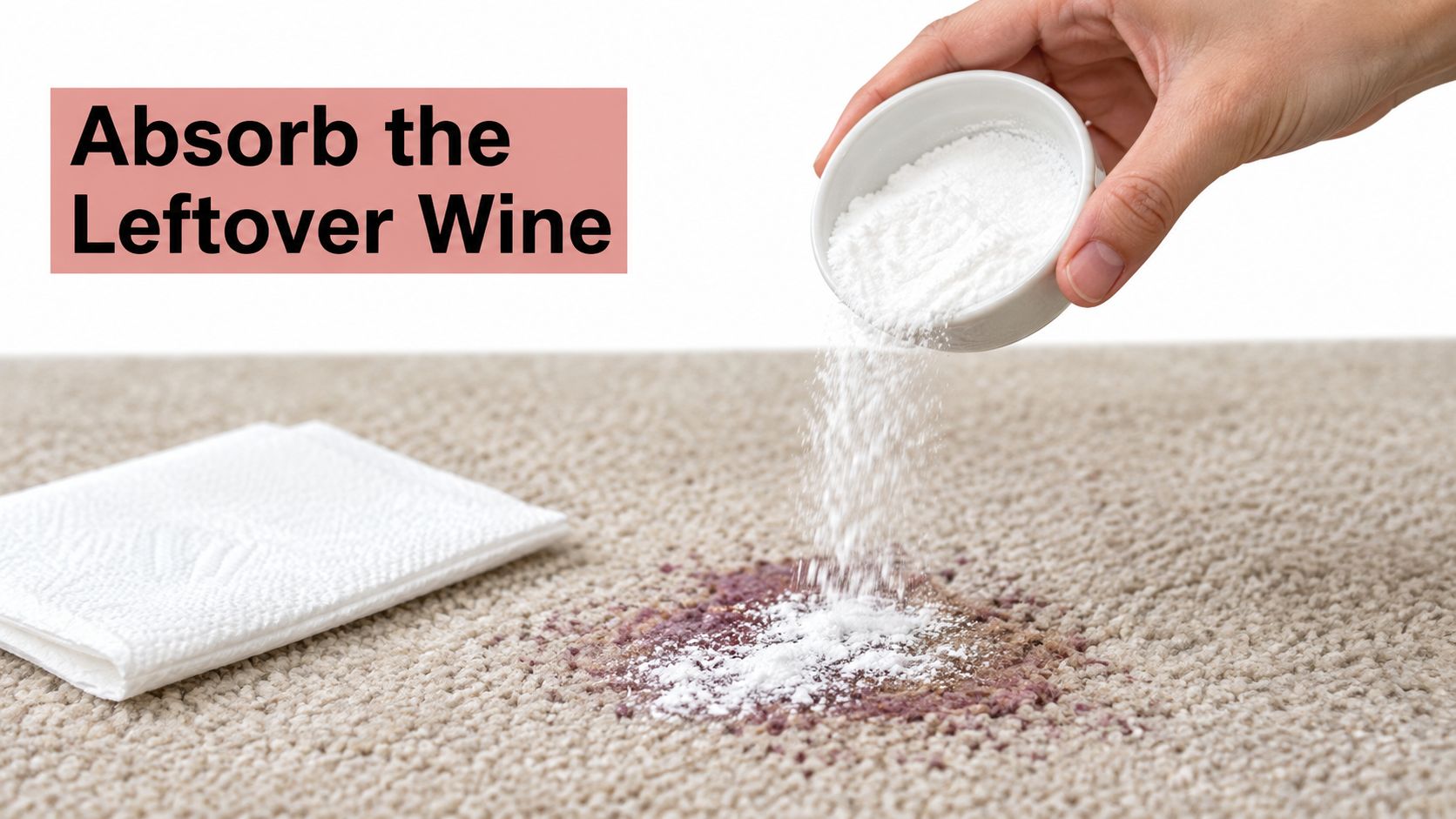
Absorbent powder is an option for remaining surface moisture, not a reason to scrub.
Work inward and remove what you apply
- Collect remaining liquid. Continue pressing with a white cloth until it stops collecting free wine. Replace saturated towels rather than pressing their contents back into the material.
- Choose an absorption approach. Iowa State University Extension advises salt or baking soda to absorb the spill, or club soda allowed to fizz and soak for at least 10 minutes, followed by blotting as dry as possible. Keep any club soda application controlled rather than flooding the area.
- Treat the remaining mark. On suitable carpet, apply the table's carpet mixture with a cloth, working from the perimeter inward. For a water-cleanable sofa, use the weaker upholstery mixture instead.
- Remove the cleaner. Sponge lightly with cold water and blot with a fresh towel. Don't leave a soapy patch behind.
- Dry and inspect. Use a fan or ventilation where conditions allow. Press a white towel firmly against the area and watch for renewed pink or yellow transfer, which can indicate remaining contamination below the surface.
Say a four-inch splash lands on synthetic living-room carpet. A small club soda application and two rounds of blotting might remove the visible wine, but that's a hypothetical workflow, not a required dose or guaranteed result. Stop adding liquid once your towel can't keep up.
For a fabric sofa, keep the cushion out of use until it's dry throughout. The Sofa Cover Crafter's step-by-step wine stain removal advice is a useful companion for checking sofa-cover treatment options.
This demonstration provides another visual reference for the process.
Judge the dry result
Success means the dry spot matches its surroundings in color and texture. A pale patch, stiff pile, or returning ring isn't a clean result.
If odor remains, use a restrained cold-water rinse and blot rather than adding detergent. Persistent odor or recurring color needs extraction assessment. For powder-based furniture care, check the guide to cleaning furniture with baking soda before treating a cushion.
Myths That Make Wine Stains Permanent
Pouring white wine onto red wine is a common mistake. At a dinner party, it can turn a small rug spot into a larger wet area without solving the pigment problem. Reach for a towel instead.
Replace these habits with controlled treatment
- White wine as a cleaner. It isn't a dependable substitute for laundering on cotton, polyester blends, or silk. If a guest offers to pour it over a stained napkin, use cold water and an appropriate pretreatment instead.
- Salt as a complete color remover. Salt can absorb liquid; it doesn't finish the job of removing bound pigment. A pink crust on a tablecloth doesn't prove the cloth underneath is clean.
- Brushing harder. A stiff brush can spread a sofa stain and roughen the fabric. Use lifting presses, not back-and-forth strokes.
- Hot water as the first response. Don't put a freshly stained shirt straight under the hot tap. Begin with cool dilution, then choose a permitted wash temperature after treatment.
- The dryer as a finishing step. A faint mark on a washed tablecloth still needs inspection. Don't use drying heat to find out whether it disappeared.
- More liquid for a stubborn carpet mark. Emptying a bowl over the spot can carry contamination beneath the visible pile. Compare carpet cleaning and steam cleaning before renting equipment or improvising extraction.
- Peroxide for every pale fabric. A cream wool rug isn't equivalent to white cotton. Leave oxidizing treatment of wool and silk to a specialist.
The difficulty isn't unusual: Cotton Incorporated's Lifestyle Monitor reports that 65% of consumers find wine stains at least somewhat difficult to remove. That's a reason to control treatment, not keep stacking remedies.
If a step adds uncontrolled moisture, heat, or friction, it's usually the wrong next step.
Decide When to Stop DIY and Call a Pro
Run through these stop rules before another application:
- Sensitive material: The item is silk, wool, antique, handmade, structurally delicate, dry-clean-only, or a natural-fiber rug.
- No useful progress: The right treatment has stopped improving the stain. I would stop after a couple of careful attempts rather than escalate the chemistry.
- Unstable dye: A hidden-area test changes color, or the cloth picks up the item's own dye rather than wine.
- Contamination below the surface: Color returns after drying, moisture keeps transferring, or the backing or cushion remains damp.
- Persistent odor: The material smells after surface cleaning and drying.
Use this checklist before deciding whether the item needs specialist handling.

Protect the material before chasing the mark
Water, acid, oxidizer, heat, and friction affect fibers and dyes differently. A method suitable for a plain cotton shirt can discolor a rug, distort upholstery, or damage an adjacent wood finish.
Don't make decisions around precise countdown claims. The Alibaba product-insights article on wine-stained clothing includes precise timing claims without an established textile-science source behind them. Material identification and the item's response are more useful than an alleged irreversible deadline.
Say a handmade wool rug develops a pink edge after you blot it. Stop there, keep people off it, and tell the specialist exactly what touched it. Don't conceal the treatment history or add another product while waiting.
For Kennesaw and North Atlanta households, Aquastar Cleaning Services offers carpet cleaning by dedicated specialists, alongside insured and bonded residential cleaning teams. Eco-friendly, biodegradable product options are available for homes with children and pets; product selection still needs to match the carpet.
Call the same day when possible, rather than spending a week experimenting. Earlier assessment gives the cleaner a better opportunity to choose an appropriate treatment, though no responsible service can guarantee every stain will disappear.
Aquastar Cleaning Services, LLC offers specialist carpet cleaning and customizable residential cleaning for Kennesaw and North Atlanta homes. For a stubborn wine mark, visit Aquastar Cleaning Services, LLC to request an assessment and explain the material, the spill, and any products you've already used.