


You wiped the shower glass clean on Saturday, and by Tuesday the white haze is back. The faucet has a rough crust at the base, the kettle leaves flakes in your tea, and scrubbing harder only makes your arm tired. That's not poor cleaning. When you're cleaning hard water deposits, the fix starts with naming the mark and checking the surface, because the wrong cleaner wastes time or leaves permanent damage.
Identify the Deposit Before You Pick a Cleaner
Put a few drops of white vinegar on a chalky crust. If it fizzes slightly, you're likely looking at limescale, and the acid is reacting with carbonate. If the film feels greasy, smears, and doesn't fizz, it's mostly soap scum, and it needs an alkaline cleaner first.
Both marks can come from the same tap. The U.S. Geological Survey hardness table classifies water with 0 to 60 mg/L CaCO3 as soft, 61 to 120 mg/L as moderately hard, 121 to 180 mg/L as hard, and more than 180 mg/L as very hard. As that water evaporates, dissolved calcium and magnesium stay behind as scale, and those same minerals react with soap to form soap curd on tubs and tile.
Match the Mark to the First Fix
| Deposit | What It Looks Like | Where It Shows Up | First Fix |
|---|---|---|---|
| Limescale | Chalky white crust, rough to the touch | Faucet spouts, aerators, showerheads | Diluted white vinegar soak |
| Soap scum | Greasy, dull film that smears when wiped | Tub, tile, shower doors | Alkaline cleaner, then rinse before any acid |
| Mineral haze | Cloudy film on glass that does not wipe off | Shower glass, oven door | Mild acid wipe, then dry and polish |
| Rust-tinged stain | Orange or brown streak | Sinks, toilet bowl | Rust remover, since it is iron rather than hardness |
Say a shower door feels slick at the bottom but rough around the handle. That door has two layers. Wash the soap film off with a bathroom cleaner and a non-scratch pad, rinse, then treat only the rough patches with acid.
Practical rule: Loose soap film comes off before acid goes on, so the acid reaches the mineral layer instead of sitting on grease.
Which Surfaces Tolerate Vinegar and Which to Avoid
Vinegar is cheap, so it's easy to assume it's harmless everywhere. It isn't. A BBC Future review of vinegar cleaning notes that acid dissolves carbonate-based limescale, yet vinegar can corrode or discolor copper, brass, and bronze, damage rubber gaskets, strip some tile or grout coatings, and etch marble, limestone, and travertine.
The natural option isn't automatically the gentlest option. An etched stone shower surround can't be wiped back to a shine, and a dulled brass finish usually stays dulled. That's why I would identify the material before I spray anything.
Do the Hidden Spot Test
Apply a small amount of diluted vinegar to a spot no one sees, such as the underside of a faucet lever or a low corner of grout. Wait about five minutes, rinse, dry, and check in good light for haze, dulling, or color change. If the test spot looks different, don't use acid on that surface.
Hardness itself is generally a nuisance rather than a health concern. Your goal is narrower. Remove the deposit without trading white crust for a damaged finish.
| Surface | Vinegar Suitable? | Safer Approach |
|---|---|---|
| Chrome and stainless steel | Yes, with a thorough rinse | Diluted vinegar with short contact time |
| Glass and shower doors | Yes | Vinegar or citric acid, then dry to avoid streaks |
| Copper, brass and bronze | No for long soaks | Mild non-acid cleaner; test first |
| Marble, limestone and travertine | No | pH-neutral stone cleaner |
| Rubber gaskets and seals | No | Soap and water only |
| Glazed tile and grout | Test first | Short contact, rinse well; check sealant condition |
| Painted or lacquered finishes | Test first | Test a hidden spot before any acid |
Take a North Atlanta bathroom with a travertine shower surround next to chrome fixtures. The chrome gets a vinegar-dampened cloth, kept off the stone. The travertine gets a pH-neutral stone cleaner and a soft cloth. The same caution applies at the kitchen sink, where our guide on how to clean a composite granite sink shows why finish matters before product choice.
Eco-Friendly Descaling Options Compared
Eco-friendly doesn't mean risk-free. Every acid below can etch or corrode the wrong surface, so pick by crust thickness and material, not by label alone.
White vinegar handles light scale on glass and chrome and costs very little. Citric acid powder has no sharp smell and works well for soaking showerheads, aerators, and kettles. For a light soak, mix about 1 tablespoon per cup of warm water, mixed fresh each time, and read our overview of citric acid cleaning before using it on plated finishes.
Lemon juice is fine for a quick faucet touch-up, but it's weaker and leaves sticky residue if it dries. Baking soda paste helps with soap scum and light abrasion, but it doesn't dissolve carbonate scale. Save a commercial acid descaler for heavy, aged crust, and use gloves, ventilation, and strict label directions.
| Option | Main Ingredient | Best For | Watch Out For |
|---|---|---|---|
| White vinegar | Acetic acid | Glass, chrome, light scale | Strong smell; avoid stone and brass |
| Citric acid powder | Citric acid | Showerheads, kettles, faucet aerators | Mix fresh; slower on heavy crust |
| Lemon juice | Citric acid | Quick spot touch-ups | Weaker; sticky residue if left to dry |
| Baking soda paste | Sodium bicarbonate | Soap scum and light abrasion | Does not dissolve carbonate scale |
| Commercial acid descaler | Phosphoric or sulfamic acid | Heavy, aged crust | Ventilate, wear gloves, never mix with bleach |
For a practical example, descale a kettle with citric acid solution, run a full boil, discard the water, then rinse twice with clean water. For a dishwasher or washing machine, use the manufacturer's descaling cycle instead of soaking gaskets in vinegar, and check the filter for loose scale afterward.
How to Remove Limescale Step by Step
Limescale is calcium carbonate left behind as water evaporates, so acid dissolves it while scrubbing alone only scratches it. The USGS groundwater quality guide classifies water above 180 mg/L as calcium carbonate equivalent as very hard, and scale forms more readily when that water is heated.
The order matters more than force. Work through the steps below, and use the flow in this infographic as a quick check at the sink.
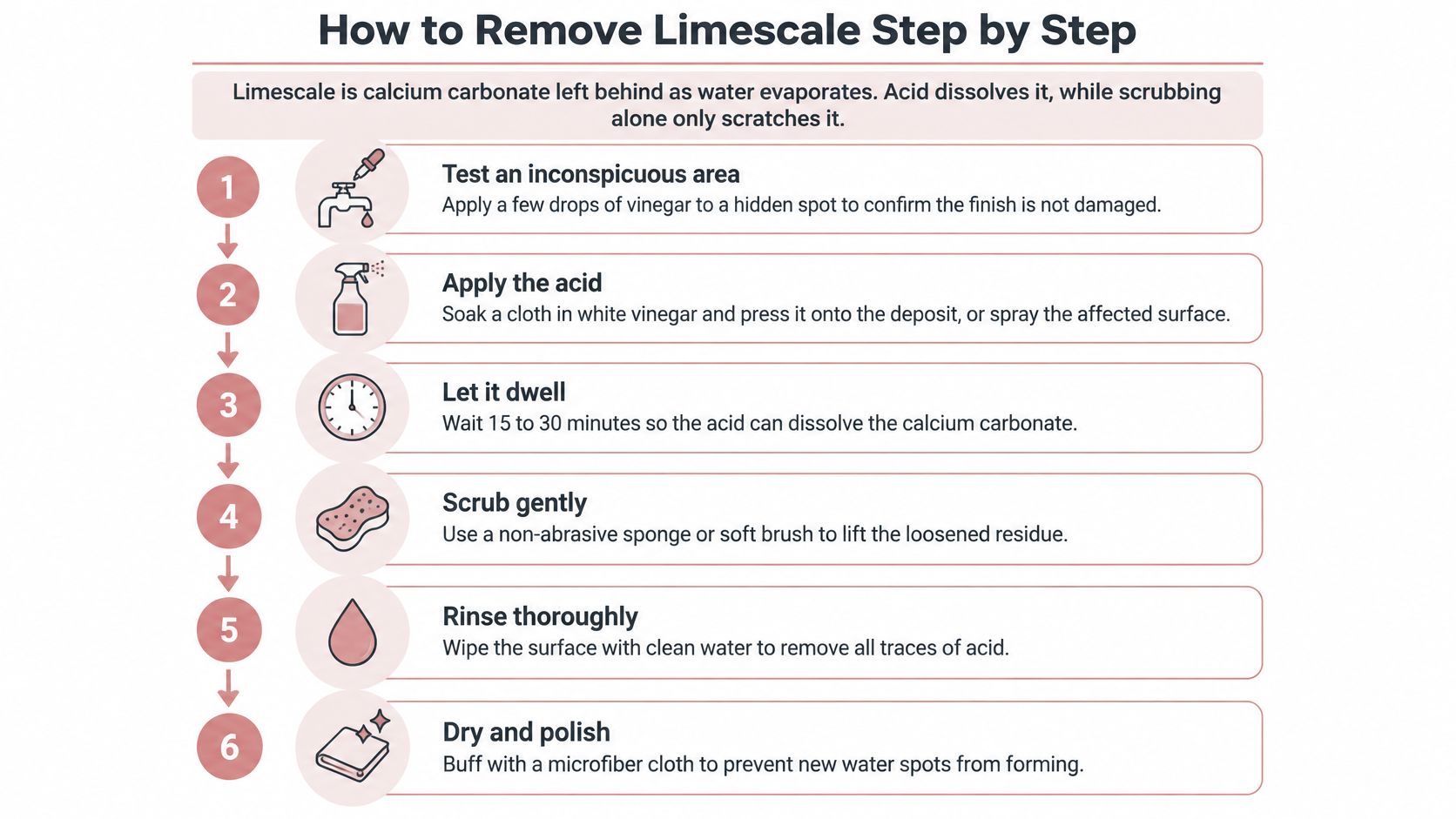
The Seven Steps
- Test a hidden spot first. Confirm the finish, grout, colored coating, or aged sealant tolerates acid. If it dulls, stop and switch to a neutral cleaner.
- Remove loose soil and wet the deposit. Brush off dust, wipe away soap film, and dampen the crust so the acid spreads evenly.
- Apply the acid with contact, not mist. Press a cloth saturated with white vinegar or a labeled mild acid onto tile and glass. Use a controlled spray on a faucet so liquid doesn't run onto stone or wood.
- Keep it wet while it dwells. Give light haze 15 to 30 minutes. For a showerhead, fill a sturdy bag with vinegar, tie it around the head so the nozzles stay submerged, and leave it for about an hour.
- Agitate gently. Use a non-scratch pad, soft brush, or old soft toothbrush around aerator threads and faucet bases. The crust should feel softer before you scrub.
- Rinse thoroughly and dry. Rinsing removes dissolved mineral and leftover acid. Buff glass and chrome dry with microfiber so fresh droplets don't restart the cycle.
- Repeat instead of going stronger. Thick scale often needs a second wet dwell. A repeat mild treatment is safer than jumping to a harsh product.
Keeping the surface continuously wet matters more than using a stronger concentration. If sprayed vinegar dries in ten minutes, the reaction stops and concentrated residue can sit on the finish. A soaked cloth solves that problem because it holds liquid against vertical shower glass.
Watch how dwell time and gentle agitation look in practice before you start on a large door.
Slips That Waste the Work
- Scrubbing too early: You scratch at hard crust instead of lifting softened residue, and chrome can show fine marks.
- Letting acid dry: You get streaks and still have mineral left, especially on warm glass.
- Mixing products: Never mix acidic cleaners with chlorine bleach or other chemicals, and keep the room ventilated.
For example, a faucet aerator with a white ring usually clears after a soaked cloth wrap, a soft brush, a rinse, and drying. If you're choosing a product for a thicker job, our explainer on what descaling solution is covers label terms worth checking. Finish by running a fingertip over the spot. It should look clear and feel smooth, not gritty.
Hardness Levels, Cleaning Rhythm and Prevention
Start by finding your number. Most U.S. utilities print hardness in the annual Consumer Confidence Report as mg/L as CaCO3. If that report isn't handy, a home test strip gives a rough reading that's still useful for setting a routine.
The USGS Hardness of Water page classifies water as soft at 0 to 60 mg/L, moderately hard at 61 to 120 mg/L, hard at 121 to 180 mg/L, and very hard above 180 mg/L. Water testing at 200 mg/L CaCO3 is very hard and will leave deposits on faucets, sinks, and shower glass far faster than water at 40 mg/L.
That gap explains why two households can use the same cleaner and get different results. A wipe removes loose residue, but it can't stop new minerals from staying behind when the next shower evaporates. In a very hard home, prevention is mostly drying. In a soft home, a monthly wipe may be enough.
| Hardness Band | mg/L as CaCO3 | Typical Deposit Pattern | Suggested Cleaning Rhythm |
|---|---|---|---|
| Soft | 0–60 | Light film, rare scale | Monthly wipe of shower glass |
| Moderately hard | 61–120 | Visible spots within several weeks | Every two weeks |
| Hard | 121–180 | Scale on faucets and glass within days | Weekly descale on faucets and glass |
| Very hard | Above 180 (example: 200) | Crust returns quickly after cleaning | Dry fixtures after each use, plus weekly descale |
Habits That Slow the Next Deposit
- Squeegee shower glass after every shower. Thirty seconds with a small squeegee removes the water that would become haze. Keep it hanging inside the shower so no one has to hunt for it.
- Wipe chrome dry. A dry microfiber cloth on faucets and handles stops droplets from drying into rings. Keep one cloth for glass and chrome only, so it doesn't pick up gritty cleaner from other jobs.
- Clean aerators and showerheads every few months. Flow loss shows up there first. Unscrew an aerator, soak it in citric acid solution if the finish allows, brush the screen, rinse, and reinstall it.
- Check faucet spouts monthly. The first white ring is thin and quick to dissolve. Left alone, it bonds into a crust that needs repeated dwells.
Match your rhythm to the worst fixture in the house, which is usually shower glass because it gets hot water daily and dries slowly.
Say a family in a very hard home squeegees after each use and dries the faucet handles at night. Their weekly descale can shrink to a quick spot check, because thin film never gets a chance to become crust. Without those habits, they'd be soaking the same door every weekend.
When cleaning can't keep up, a whole-house softener is the long-term fix to price out, especially if scale also shows up in the kettle and dishwasher. Water heaters also need draining or service on the manufacturer's schedule, since hot water drives scale formation. Our roundup of hard water solutions can help you compare those next steps with simple habit changes.
Don't chase a perfect schedule from a chart if your worst fixture tells a different story. If haze returns in four days, dry after each use and descale weekly until the pattern slows. If glass stays clear for a month, keep the lighter rhythm and spend your time elsewhere.
When Scale Points to Plumbing or Appliances
Some scale is only a surface job. Other scale is a warning that hot water is building deposits where you can't see them.
Watch for these signs:
- Hot-side pattern: Deposits return mainly on hot-water fixtures while cold taps stay fairly clean.
- Flow loss: A showerhead sprays sideways or an aerator slows to a weak stream after cleaning.
- Water heater strain: The unit rumbles, pops, or recovers slowly between showers.
- Pitted finish: The surface still feels rough after two careful treatments, which points to damage rather than removable film.
Cleaning removes the visible mark, but it can't remove mineral building inside equipment. The Health Canada drinking water operational parameters state that hardness minerals precipitate inside hot-water pipes and appliances, scale can clog household plumbing, and deposits in water heaters impede heat transfer, reducing efficiency and potentially shortening service life.
Use one escalation rule. If two careful treatments on the same fixture fail, or any sign above appears, call a plumber or water-treatment professional. Write down where deposits recur, note whether flow changed, and keep your hardness number from the utility report with those notes.
For tankless units, routine residential tankless water heater flushing from JMJ Plumbing is a useful resource for understanding how internal scale is cleared on schedule. A similar logic applies in the kitchen, where our guide to white residue in a dishwasher helps separate film from appliance buildup. Start with one concrete next step today. Check the water heater service date and confirm your hardness number.
If hard water keeps undoing your bathroom and kitchen work, Aquastar Cleaning Services, LLC offers recurring, deep, and move-in or move-out cleaning in Kennesaw and North Atlanta with eco-friendly options for homes with children and pets. Visit the site to request a quote and build a cleaning rhythm that keeps glass, chrome, and tile clear between visits.