


You're preheating the oven for dinner and it starts to smoke before the food even goes in. There's a burnt smell, a cloudy door, and grease baked onto the floor from last month's roast. You want it clean, but you don't know if a spray, a paste, or that Self Clean button is safe for your oven.
That's the right question to ask first. Deep cleaning oven interiors isn't one method. Match the method to the oven technology, then choose the lowest-risk method that fits your household.
Which Deep Clean Method Fits Your Oven
Say you're a renter with a 2015 range and you find a Self Clean label on the control panel. Don't press it yet. Check the manual or the label inside the door for words like conventional, steam-clean, self-clean, pyrolytic, or catalytic. That wording decides whether high heat, steam, or a product is allowed at all.
The Texas Workforce Commission equipment cleaning manual starts the same way, with identifying whether the oven is conventional, steam-clean, or self-cleaning, disconnecting power where appropriate, and removing racks, trays, thermometers, and loose debris before anything else.
Deep Clean Method by Oven Type
| Oven type | How to identify it | Safe deep-clean method | Avoid |
|---|---|---|---|
| Conventional enamel | No self-clean label; smooth enamel walls | Baking soda paste or approved degreaser on a cool oven | High-heat cycles and steel wool on enamel |
| Steam-clean | Steam or Steam Clean option on the panel | Manufacturer steam cycle, then wipe dry | Chemical sprays unless the manual approves them |
| Pyrolytic self-clean | Self Clean setting; door locks during the cycle | Built-in high-heat cycle after removing racks and loose soil | Running the cycle over heavy spills or leaving foil or pans inside |
| Catalytic liner | Textured dark liners on back and side walls | Hand-wipe door and racks; liner with water only if the manual permits | Any cleaning product on the liner or scrubbing it |
A landlord with a catalytic model, for example, needs to leave the back liner alone and clean only the door, floor, and racks by hand. Dark marks on that liner are normal. A steam-clean model, by contrast, should run the manufacturer's steam cycle with the cavity empty, then get wiped dry with a clean cloth. Add no spray unless the manual names an approved product.
The same identification step applies to smaller appliances too, which is why this guide to cleaning inside a toaster oven is useful if you're tackling both.
Firm rule: If you can't confirm the oven type, default to manual cleaning and check with the manufacturer or landlord before using heat.
Eco-Friendly and Store-Bought Cleaners Compared
Pick your cleaner by grease level and by how much chemical handling you're willing to do. Start with this comparison, then follow the safety rules below it with every product.
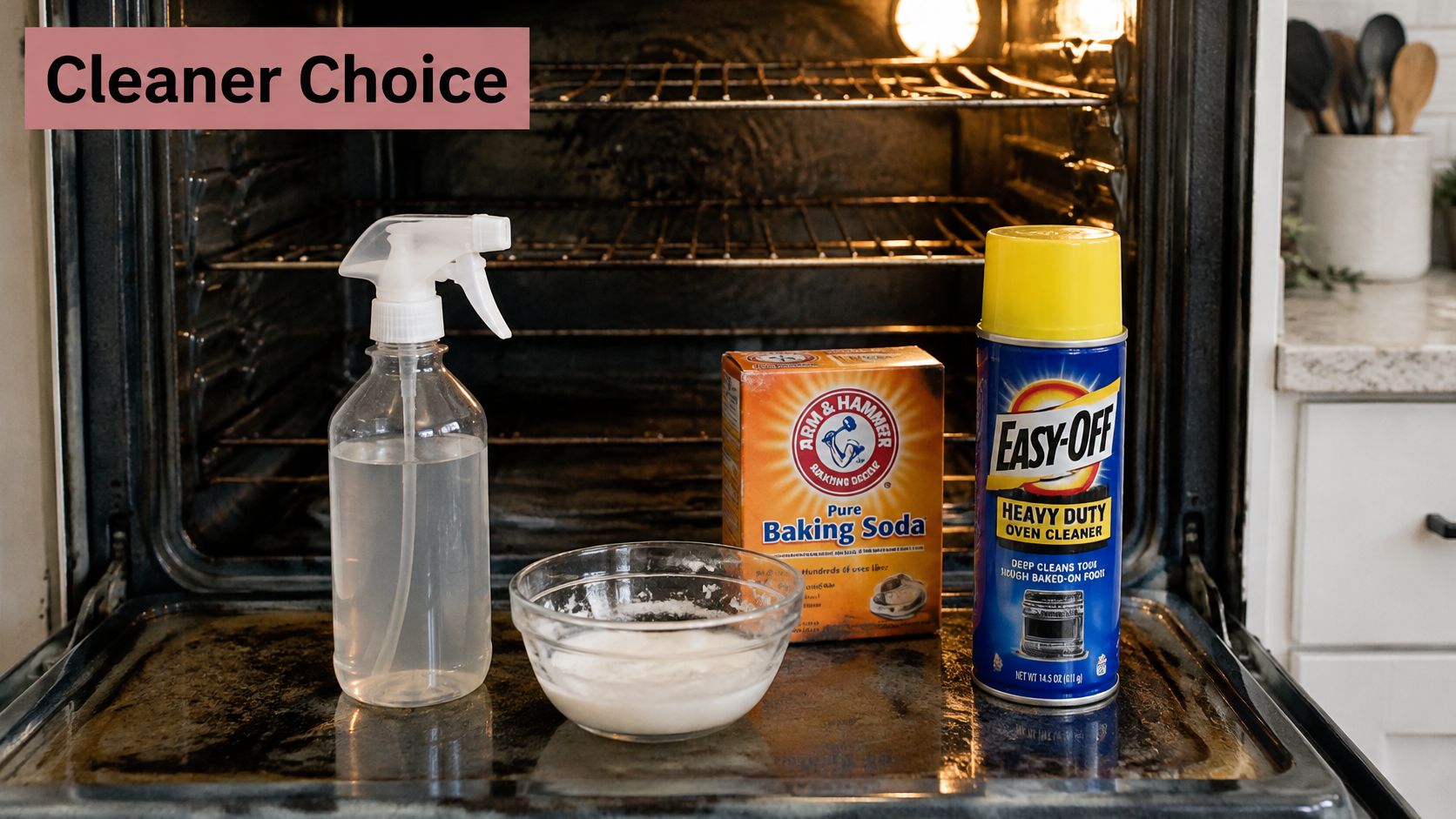
Oven Cleaners by Grease Level and Use
| Cleaner | Best for | Watch out for | Setup |
|---|---|---|---|
| Baking soda paste | Light to moderate grease; eco-friendly homes | Slow; needs dwell time | Mix with water; leave five minutes to overnight |
| Vinegar spray | Film and odor on a cool surface | Weak on baked-on grease; never mix with bleach | Spray lightly, wait briefly, wipe |
| Plant-based degreaser | Routine grease; households with children or pets | Confirm it is safe for enamel | Follow label dilution |
| Commercial alkaline oven cleaner | Heavy carbonized grease | Fumes; never above 200°F; keep off heating elements | Cold oven, gloves, eye protection, ventilation |
The Garrett County household hazardous waste alternatives guide recommends baking soda for heavy deposits and a nonmetallic bristle brush for charred spills, because dwell time and controlled scrubbing are safer than aggressive scraping. If you want lower-impact options for the whole kitchen, these eco-friendly cleaning agents cover what to look for on a label.
- Keep spray off sensitive parts: Never spray near heating elements, pilot lights, or electrical parts.
- Respect the temperature limit: Never spray a commercial cleaner when the oven exceeds 200°F, because heat makes it more caustic.
- Never mix products: Bleach combined with ammonia, acids, or other cleaners can form toxic gas and injure your lungs.
Practical example. A family with a toddler and moderate grease uses the paste first and saves the alkaline cleaner for a one-time burnt spill, with the toddler out of the kitchen.
How to Deep Clean a Conventional Oven Step by Step
This method is for a conventional enamel oven only. Work on a cold oven, give the paste time to do the work, and rinse properly at the end.
The first three steps are shown here so you can see the sequence before you start mixing anything.
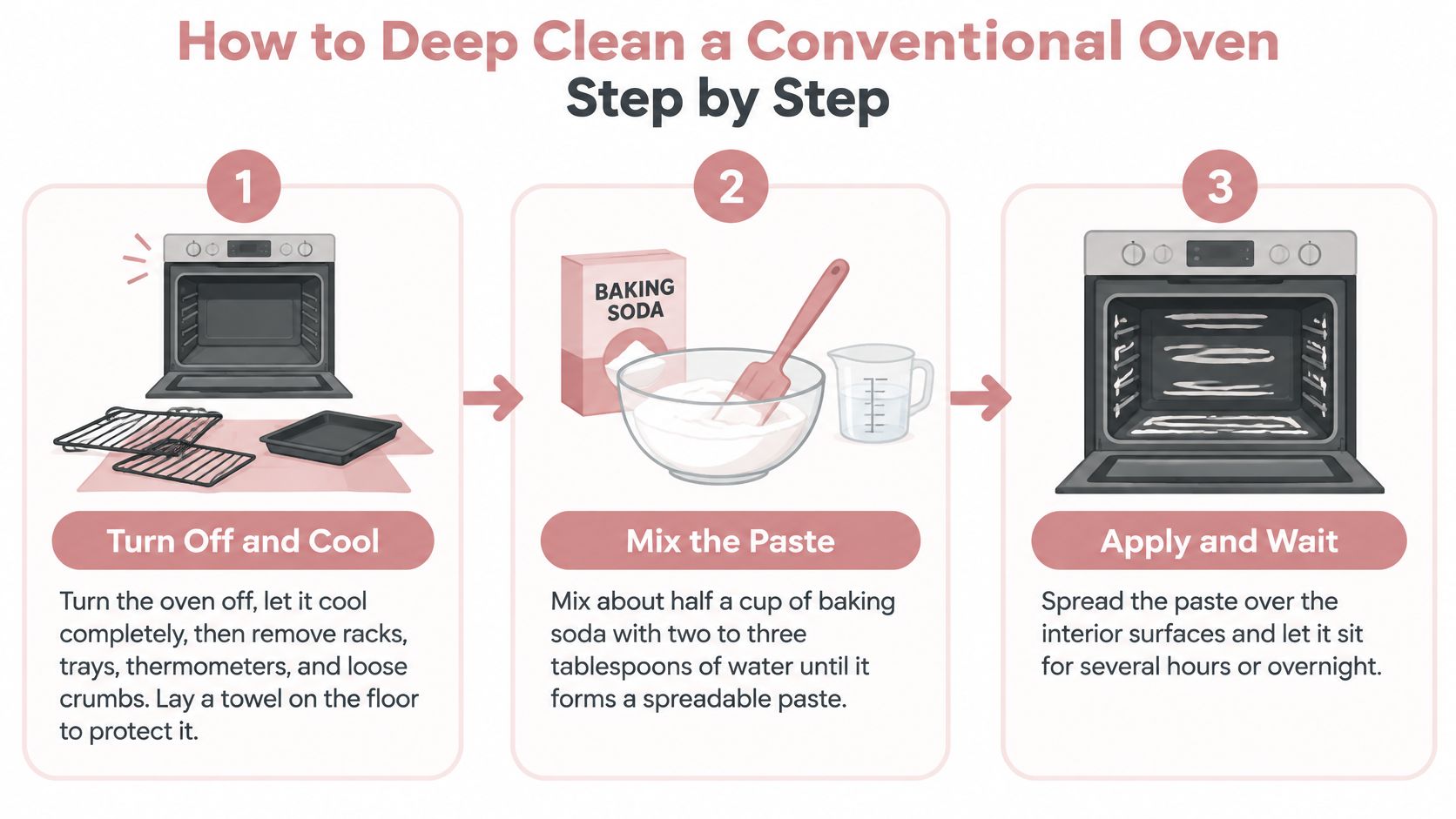
The Eight Steps
Turn it off and let it cool completely. Remove racks, trays, thermometers, and loose crumbs, then lay a towel on the floor. A cool oven protects you and stops cold water from cracking hot enamel later.
Mix the paste. Stir about half a cup of baking soda with two to three tablespoons of water until it spreads like thick frosting. Too runny and it slides off the walls. Too dry and it won't coat evenly.
Coat the greasy areas. Spread paste over the walls, floor, and inside of the door. Keep it off the heating elements, light bulb, electrical parts, and door gasket, where residue can cause damage or odor.
Let it sit. Give light grease five to ten minutes. Leave heavy, carbonized spills overnight. Dwell time loosens the bond so you don't need to scrape hard enough to scratch enamel.
Scrub with a nonmetallic brush. Work along the rack channels and door edges, where grease hides and later smokes. Use a plastic scraper gently on stubborn spots.
Wipe and rinse. Wipe with a damp cloth, then rinse with clean water until there's no foam or film. Skipping this rinse is the most common slip. Leftover residue smells when the oven heats again.
Reheat the empty oven for about ten minutes. This clears moisture and residual odor. Then switch it off and let it cool before you put racks back.
Inspect under bright angled light. Check the gasket perimeter, corners, and glass. If your hand picks up greasy transfer, rinse that spot again.
Watch the process once before you try it on a heavily soiled oven.
Practical example. A 30-inch oven with burnt cheese on the floor gets coated at 8 p.m., sits overnight, then gets scrubbed at 8 a.m. and rinsed in about twenty minutes. While the racks soak in warm soapy water, you can also tackle the cooktop using this guide to cleaning a glass top cooktop.
Don't rush step 4 to save time. Two extra hours of dwell time usually saves you twenty minutes of hard scrubbing.
Self-Clean Prep and Problem Fixes
A self-clean cycle can smoke heavily if thick grease and spills remain inside. Before choosing this method, check the oven manual: cycle temperatures, timing, and which racks can stay in vary by model. GE Appliances' self-cleaning oven guidance says some self-cleaning ovens use heat up to 885°F to turn baked-on food and grease into ash.
Use this checklist before starting the cycle.
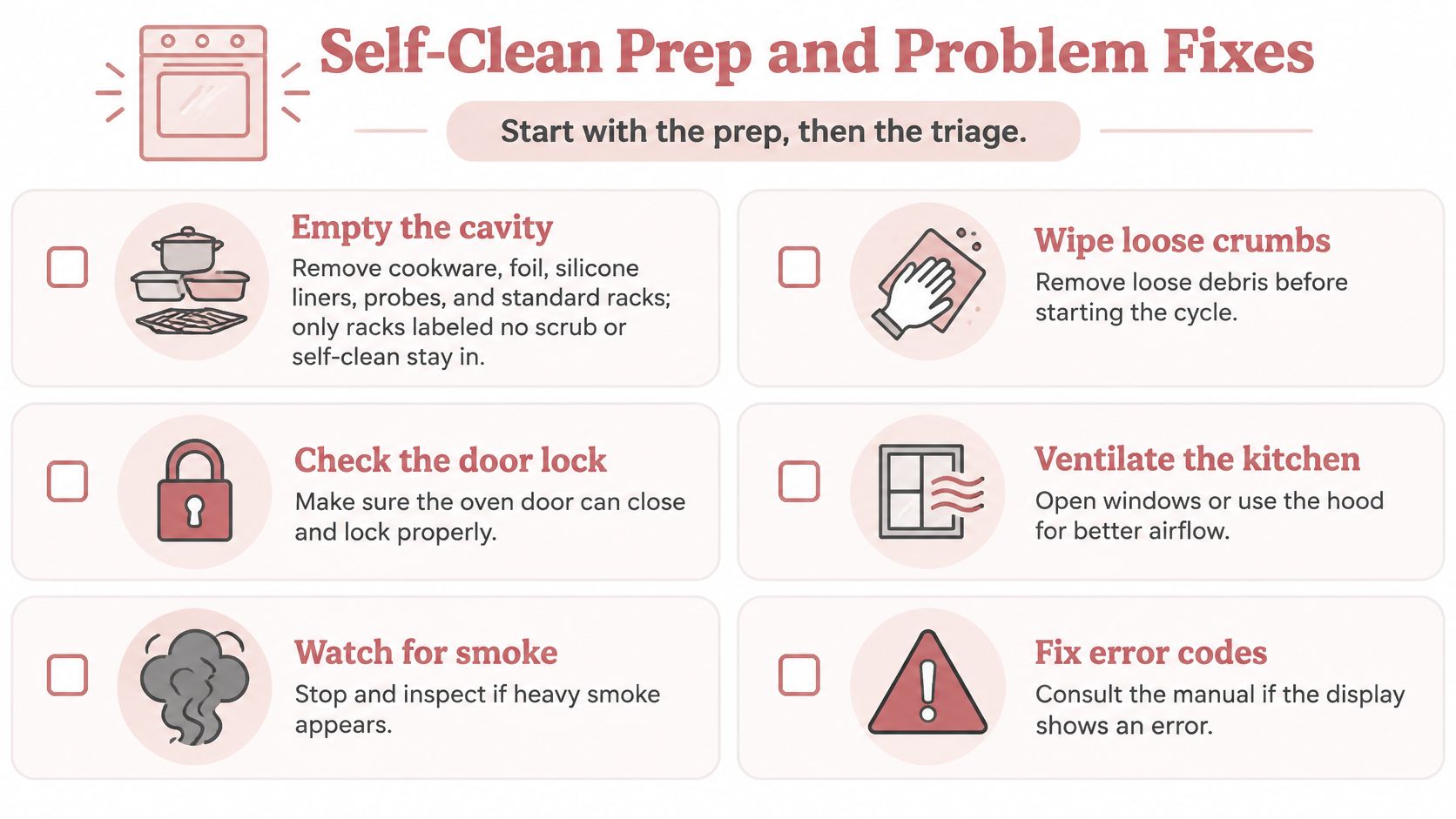
Prep Before You Start
Empty the oven. Remove cookware, pans, foil, silicone liners, probes, and standard racks. Leave racks inside only if the manual says they are safe for self-cleaning; the cycle can damage ordinary racks.
Wipe away loose crumbs and thick grease. With the oven cool, use paper towels to remove debris and heavy spills. Leftover grease can smoke during the cycle.
Ventilate and clear the area. Open a nearby window and switch on the range hood. Consumer NZ's oven-cleaning guidance notes that pyrolytic ovens can reach about 500°C, produce smoke and odors, and make the exterior hotter than usual. Keep children, pets, and towels away from the oven.
Allow time for the full cycle and cool-down. A GE self-cleaning oven manual gives approximately 4 hours and 20 minutes for a normal cycle on some models. The door stays locked until the oven cools. For example, a family starting at 1:00 p.m. should expect that cycle to end near 5:20 p.m., then wait for the door to release before wiping away ash.
When Something Goes Wrong
If flames appear, keep the door closed and switch the oven off. Use a multipurpose dry-chemical or foam extinguisher if needed. Never pour water into a grease fire. If smoke becomes heavy, switch the oven off promptly, ventilate the room, and keep people away until the air clears.
For example, if a heavily greased oven starts smoking twenty minutes into the cycle, switch it off and let it cool before opening the door. Ventilate, then remove the spills by hand. Use manual cleaning instead of restarting the high-heat cycle until the heavy grease is gone.
Self-Clean Problems, Causes and Fixes
| Symptom | Likely cause | Fix |
|---|---|---|
| Heavy smoke or burnt smell during self-clean | Grease or spills left before the cycle | Switch the oven off as soon as smoke becomes heavy, ventilate, let it cool, then wipe spills first next time |
| Discolored or stuck racks | Standard racks left in a self-clean cycle | Remove racks; soak in warm soapy water |
| Film or streaks after cleaning | Residue not rinsed fully | Rinse with clean water until no foam; reheat empty oven 10 minutes |
| White or grey powder after cycle | Normal ash from pyrolysis | Wipe with a damp cloth after cool-down |
| Dark marks on catalytic liner | Normal wear on the liner | Leave it alone; check the manufacturer if it flakes or lifts |
Most problems can be addressed after the oven cools. A liner that flakes or lifts needs a manufacturer check; cleaning alone may not resolve the issue.
How Often to Deep Clean Your Oven
Frequency depends on how much you cook and who lives with the oven, not on a fixed calendar date for everyone.
Deep Clean Interval by Oven Use
| Oven use | Deep clean interval | Method | Note |
|---|---|---|---|
| Cooking 4+ meals a week | Every 3 months | Baking soda paste | Wipe spills after each use |
| Occasional baking, 1-2 meals a week | Every 6 months | Paste or manufacturer steam cycle | Check the door gasket at each clean |
| Homes with pets or young children | Every 3 months | Low-heat manual method | Avoid high-heat cycles while children are nearby |
| Self-clean ovens under regular use | Every 2-3 months when the manual allows | Built-in self-clean cycle | Wipe ash after cool-down |
| Rental or sale | Before move-in and move-out | Full manual clean plus approved cycle | Follow the lease or listing |
Practical example. A couple who bakes sourdough every weekend and cooks dinner most nights deep cleans every three months and wipes the door monthly. That rhythm fits well alongside a broader deep cleaning checklist so the oven doesn't get skipped.
Clean it now, regardless of schedule, if you notice these signs.
- Smoke when preheating: Grease is burning off the walls or floor.
- Burnt smell at normal temperature: Old spills are reheating with every use.
- Grease on the oven floor: The next spill will bake on harder.
- Cloudy door glass: You can't monitor food without opening the door and losing heat.
Decide Whether to DIY or Book a Professional Clean
DIY makes sense when the oven is conventional, grease is light to moderate, you have a few hours for dwell time, and the kitchen ventilates well. I'd book help instead when the oven is self-clean or catalytic and you can't confirm the manual, when grease has carbonized over years, when someone at home has respiratory sensitivity, or when a rental deadline is close.
Aquastar Cleaning Services offers oven interior cleaning as an add-on to its deep-cleaning service, alongside refrigerator interior, window, garage, and basement cleaning. The cleaning team is professional, trained, and insured, and Aquastar offers a free cleaning estimate for deep cleaning, so you can compare a quote against your own time and effort. If you're planning the whole kitchen at once, this overview of a kitchen deep cleaning service shows what a full scope can include.
Use these next steps either way.
- Confirm the oven type from the manual or the label inside the door.
- Pick one method that matches that oven type.
- Set the cleaning date on the calendar, including cool-down time.
- Request a quote if any warning sign above applies.
When you call to book, some home service companies now route after-hours questions through tools like AI voice agents for home services, so you can describe your oven type and get a callback even outside office hours. Practical example. A family with a pyrolytic oven and two young children compares the DIY steps with an Aquastar quote and books the professional clean for a day when everyone is out of the house.
If your oven needs more than a paste and an overnight wait, Aquastar Cleaning Services, LLC offers oven interior cleaning as an add-on to a full deep clean for homes in Kennesaw and North Atlanta. Get a free estimate, tell us your oven type, and we'll match the method to your appliance and your household. Visit Aquastar Cleaning Services, LLC to book your clean.