



You're wiping a toilet that looked fine yesterday and already shows a pale ring. Four people used it, the seat feels tacky, and the bottle under the sink smells stronger than the bathroom. Pouring more cleaner and flushing harder feels like the fix. It usually isn't.
Eco friendly toilet cleaning works when you hold three goals at once: a low chemical load, real sanitation, and protection for water and drains. Those goals conflict. A harsh pour can lift a stain and still dump extra chemicals into the pipe. A tiny measured dose, used on a schedule, keeps the bowl clean without treating every flush like a chemical event.
Weekly Eco Toilet Routine at a Glance
A family of four shares one toilet. Within a week of a full clean, a chalky line returns at the waterline and fingerprints cover the seat. That pattern is ordinary wear, not a failed Saturday. The toilet needs a short rhythm, not a bigger bottle.
| Task | Frequency | Eco method | Amount |
|---|---|---|---|
| Quick wipe of seat, lid and outside | Every 2 days | Damp reusable microfiber cloth | Water only |
| Full bowl and under-rim scrub | Weekly | Plant-based, phosphate-free cleaner with brush | Small squeeze as the label directs |
| Descaling for mineral rings | Monthly | Citric acid or white vinegar | Label amount, left for the label time |
| Disinfecting after illness | As needed | EPA-registered disinfectant | Label concentration and contact time |
Treat that table as the default. Illness and a stubborn mineral ring are the exceptions, and they get their own steps later.
Why each amount stays small
A damp microfiber cloth with water only lifts skin oils from the seat, lid, and outside. No extra residue sits where hands land. Once a week, a plant-based, phosphate-free cleaner goes on as a small squeeze, the amount the label directs. The brush does the work under the rim and along the waterline. Once a month, citric acid or white vinegar in the label amount sits for the label time so hard-water minerals can loosen. Disinfecting waits for illness or a mess, so the drain isn't dosed on an ordinary Tuesday.
Practical rule: If the bottle is still half full after a month of weekly scrubs, you're probably using the right amount.
The routine is working when the bowl looks clean without a strong smell, no new ring forms within a week, and the cloth stays free of visible residue. If a ring shows up in a few days, move the monthly descale earlier instead of doubling the weekly squeeze.
Which Ingredients Work and Which to Avoid
Low-impact ingredients aren't interchangeable. Each one does one job well and fails at another.
| Ingredient | Best for | Main limit |
|---|---|---|
| White vinegar | Mineral scale and urine odor | Never mix with bleach; rinse well |
| Citric acid | Scale and rust-colored stains | Never mix with chlorine bleach; use label amount |
| Baking soda | Gentle scrubbing and odor | Mildly abrasive; avoid hard scrubbing on glossy glaze |
| Plant-based soap or detergent | Routine soil and grease | Works less well in hard water unless labeled for it |
| 3% hydrogen peroxide | Light staining on white surfaces | Test first; can lighten some finishes |
| Sodium hypochlorite (bleach) | Disinfecting only | Never mix with ammonia, acids or other cleaners |
White vinegar cuts mineral scale and urine odor, then needs a thorough rinse so the acid smell doesn't linger. Citric acid handles scale and rust-colored stains when you use the label amount and never combine it with chlorine bleach. Baking soda scrubs gently and knocks down odor, but hard pressure can dull a glossy glaze. A plant-based soap lifts routine soil. In hard water it performs less well unless the label says it's formulated for that water. A 3% hydrogen peroxide solution can fade light staining on white surfaces. Test a hidden spot first, because it can lighten some finishes. Bleach is for disinfecting only, never mixed with ammonia, acids, or another cleaner.
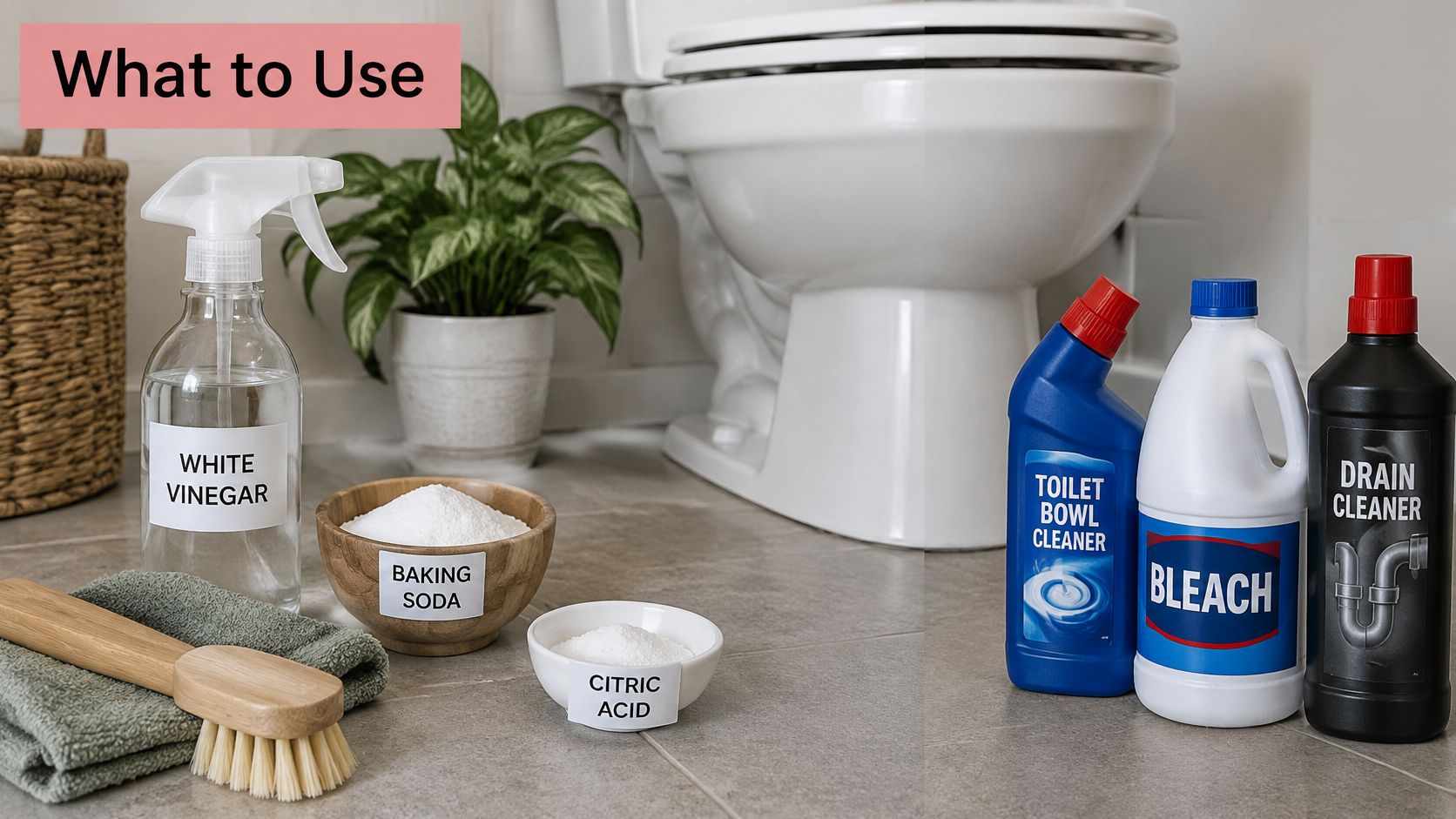
Natural words versus a verified label
"Natural" and "biodegradable" are marketing words. They don't prove the formula was screened or that it removes soil. The EPA Safer Choice and Design for the Environment standard requires toilet-bowl and urinal cleaners to show at least 75% soil removal under an accepted method, and to work across diverse water-hardness conditions. Calcium and magnesium in hard water weaken surfactants and build mineral rings, so a product should be judged where you'll use it.
Say you're in the aisle with two bottles. One says natural and lists no test. The other carries a verified environmental label. For a hard-water home, take the verified bottle. Apply it evenly under the rim, wait the label time, brush, and flush. If you want to mix a simple spray at home, The Green Living Guy cleaning recipes walk through personalized green mixes you can scale to a small bathroom bottle. For the rest of the room, these eco friendly bathroom cleaning products show how the same label habit carries past the toilet.
How to Clean a Toilet the Low-Impact Way
Set aside about ten minutes on a Saturday. Gloves, a window or the exhaust fan, a plant-based cleaner, a dedicated brush, and one damp microfiber cloth are enough.
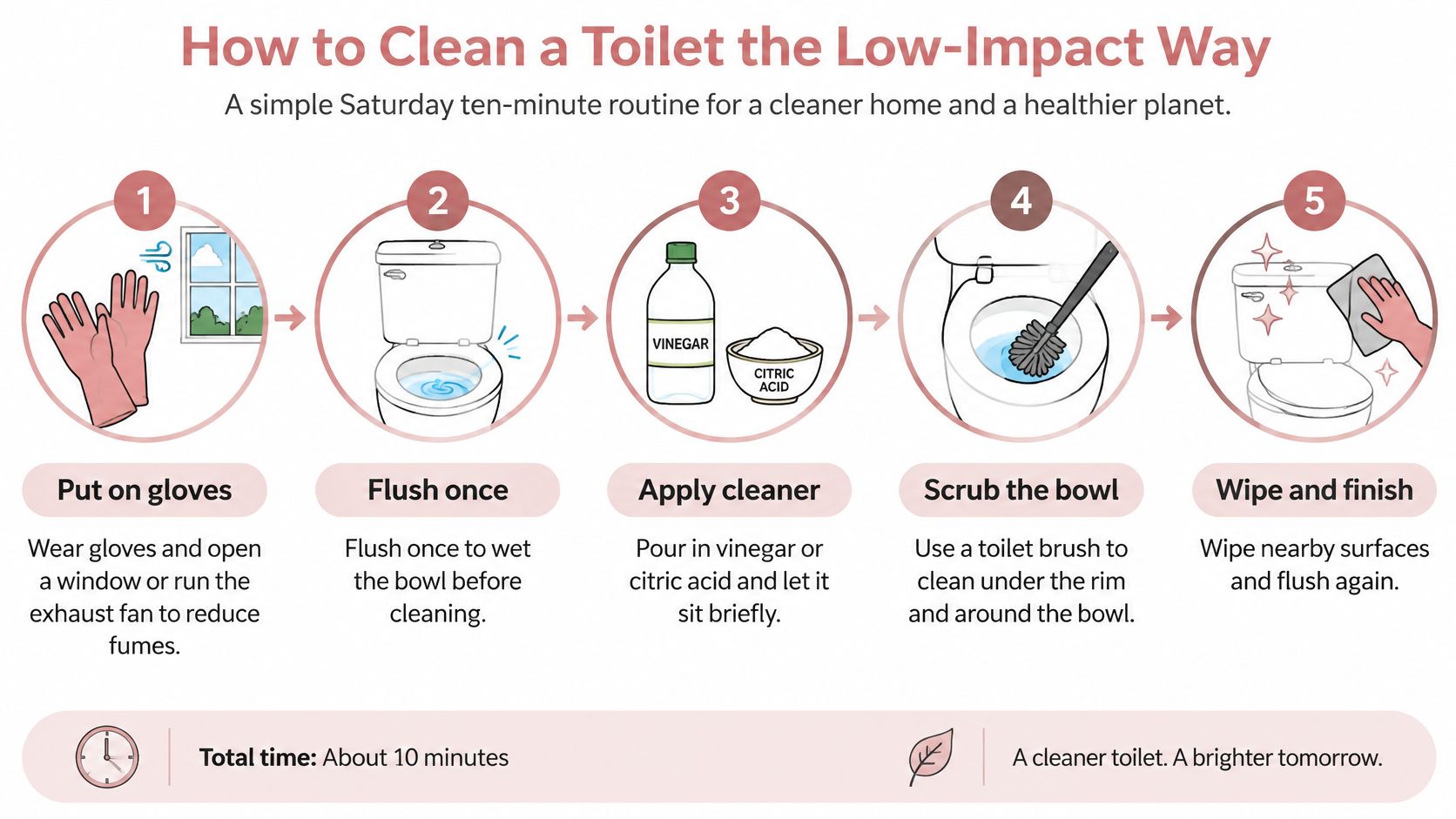
- Put on gloves and ventilate. Open a window or run the exhaust fan before you open any bottle. Moving air keeps fumes from hanging in a small room.
- Flush once. A wet bowl lets a small dose spread instead of sitting in a dry patch.
- Apply a measured amount under the rim. Product poured on the water surface runs away and is wasted. A small squeeze under the rim rides down the porcelain.
- Wait the label time. A few minutes lets soil loosen. Skipping the wait is the most common slip, and people answer it by adding more product.
- Brush the bowl, under the rim, and the waterline. Use a brush that stays with this toilet. Mechanical scrubbing removes film that chemistry alone leaves behind.
- Wipe from clean to dirty. Seat, lid, handle, then base, with the damp cloth. Starting at the dirtiest spot drags soil onto surfaces you just cleaned.
- Flush, rinse the brush, and let it dry. A wet brush left in the holder grows the smell you just removed.
A couple with one bathroom can finish this on a Saturday by running the fan, flushing once, placing that small measured dose under the rim, and brushing after the wait. They check that the bowl looks uniform and odor-free before the brush goes away to dry.
The slips that undo the routine
Using a full cap when the label asks for a squeeze doesn't clean better. It leaves film and sends leftover chemistry down the drain. Mixing two bottles because one "isn't working yet" is the other slip, and it can release hazardous gas when an acid meets bleach. One product, one wait, one brush.
A clean toilet after this routine has an even bowl, no odor, and no streaks on the cloth.
This short walk-through shows the same order in motion if you want to watch the sequence once before you try it.
Fixing Stains, Odors and Scale Without Harsh Chemicals
Most toilet complaints are minerals, iron, trapped residue, or moisture, not a need for a stronger chemical.
| Symptom | Likely cause | Gentle fix |
|---|---|---|
| White or chalky ring at the waterline | Hard-water minerals | Citric acid or vinegar soak about 30 minutes, then brush |
| Rust-colored ring | Iron in the water | Citric acid with a longer dwell time, then rinse |
| Odor that returns after cleaning | Residue under the rim or dry trap | Brush under the rim and run water in rarely used bathrooms |
| Dark spots on the bowl or seat | Mold or mildew | Scrub and dry thoroughly; avoid stronger chemicals |
| Stain that will not lift | Deep staining or surface damage | Stop after two rounds and seek advice |
Match the fix to the mark
A white or chalky ring at the waterline is usually hard-water minerals. Acid dissolves that scale. Brushing then lifts what the acid loosened, and a rinse carries it away. A household on a hard-water supply can pour citric acid under the rim, leave it about 30 minutes, brush, and rinse. The ring often clears in one round.
A rust-colored ring in that same home comes from iron in the water. It needs a longer dwell and a second brush pass before it lifts. If marks like these keep returning, this guide to cleaning hard water deposits covers the same mineral film on nearby fixtures.
An odor that returns after a good scrub usually means residue still sitting under the rim, or a dry trap in a bathroom nobody uses. Brush under the rim, then run water in that floor drain so the trap refills. Dark spots are usually mold or mildew. Scrub them and dry the area. Moisture, not a missing chemical, is what lets them return.
Stop after two rounds. If the stain stays, or the odor tracks to a leak, you need a plumber, not a stronger cleaner.
When Cleaning Is Enough and When to Disinfect
Someone in the house had a stomach bug overnight. The weekly scrub suddenly feels too light. Ask one question first. Is there visible soil, vomit, or diarrhea, or are you only nervous?
The CDC guidance on cleaning and disinfecting says to use detergent or soap and water on dirty, hard, non-porous surfaces before a disinfectant. Soil blocks the product from reaching germs. Scrub the bowl, seat, lid, handle, and nearby floor with a detergent-based cleaner. Only then disinfect the high-touch spots.
If bleach is the product you choose
The CDC specifies a solution of at least 1,000 ppm sodium hypochlorite, commonly 5 tablespoons (one-third cup) of 5%–6% household bleach per gallon of room-temperature water, or 4 teaspoons per quart. Keep the surface visibly wet for at least 1 minute. Ventilate during and after use. Discard the mix after 24 hours. Never mix bleach with ammonia, acids, or another cleaner, because dangerous fumes can form.
A natural cleaner cannot carry a validated kill claim. That claim belongs to an EPA-registered disinfectant used at the label concentration and contact time. For how those words differ, see the difference between sanitizers and disinfectants.
| Situation | Cleaning alone is enough | Disinfect with a registered product |
|---|---|---|
| Routine weekly scrub | Yes | No |
| Visible mold or mildew line | Yes, scrub and dry | No, disinfectant is not needed |
| Household member with vomiting or diarrhea | No | Yes, high-touch areas and floor |
| Shared bathroom with a sick guest | No | Yes, after cleaning visible soil |
A routine week stays on the mild cleaner and the brush. Vomiting, diarrhea, or a sick guest in a shared bathroom moves you to the registered product after the soil is gone. A mold line still wants scrubbing and drying, not a disinfectant standing in for a dry surface.
Save Water and Keep Chemicals Out of Drains
An older toilet can use far more water than any bottle of cleaner ever will. Picture a home flushing five times a day. The EPA WaterSense toilets page reports that older toilets can use as much as 6 gallons per flush, which is up to 30 gallons a day from flushing alone in that example. A WaterSense toilet uses no more than 1.28 gallons per flush, 20% less than the federal standard of 1.6 gallons.
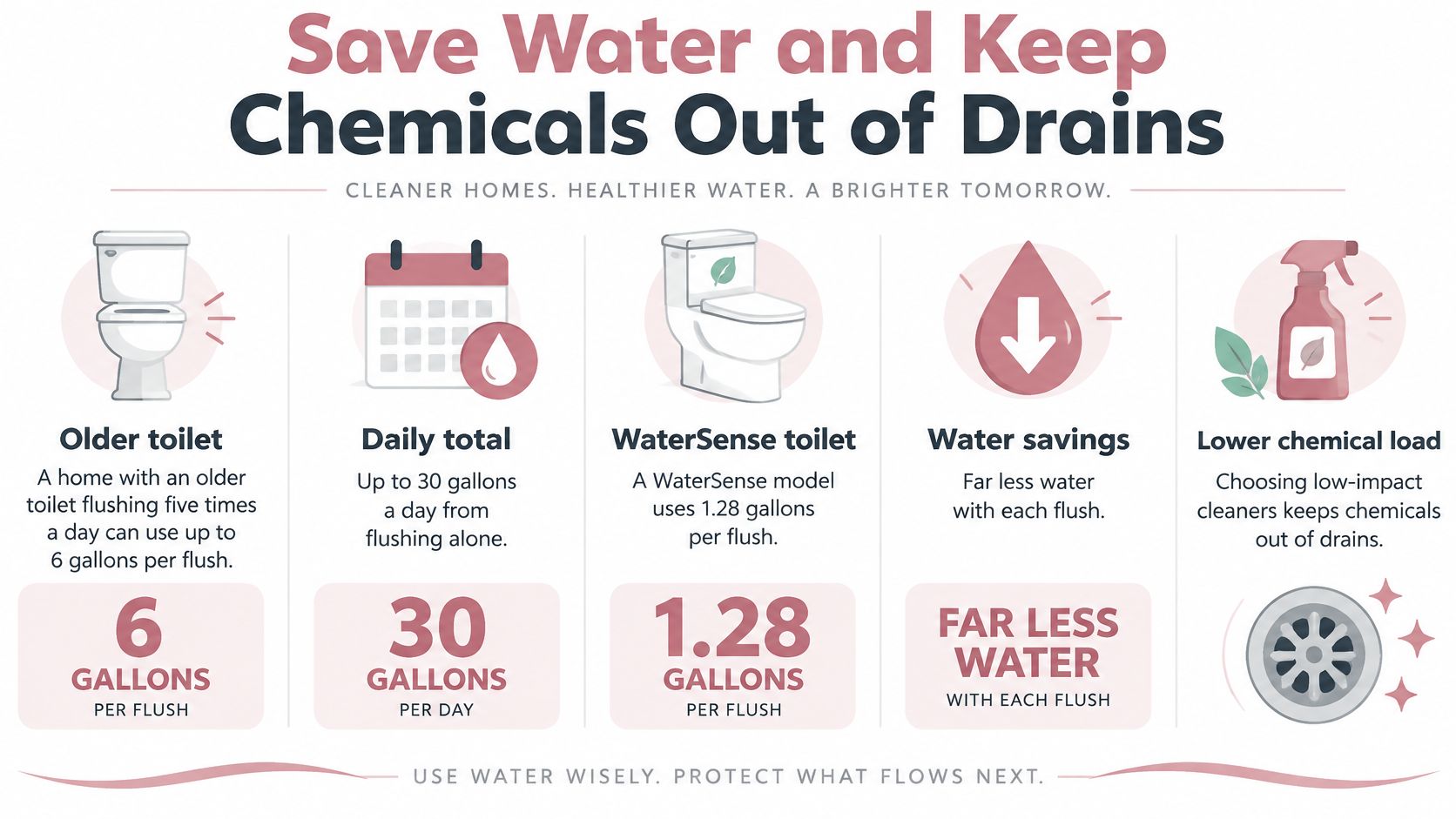
That federal maximum comes from the Energy Policy Act of 1992 and applied to toilets sold in the United States after January 1, 1997. The EPA estimates that replacing all old, inefficient residential toilets with WaterSense models could save approximately 520 billion gallons of water annually.
What you control this week
- Listen for a running tank. A trickle after the flush means water is leaving all day, cleaning or not.
- Use measured rinse water. One flush to wet the bowl and one flush to finish is enough for a normal scrub.
- Find leaks. Dye in the tank that shows up in the bowl points to a flapper, not a dirtier toilet.
Don't pour leftover concentrated cleaner into the toilet or sink. Don't flush disposable wipes, paper towels, or an expired bottle. Use only the label quantity. On a septic system, flush only human waste and toilet paper, and keep cleaning tablets out of the tank unless the manufacturer approves that use. Take unwanted chemicals to the local household hazardous waste program. Pouring bleach down the drain is a separate problem from a clean bowl, and it doesn't belong in the weekly habit.
Before you put the supplies away, run four checks. The tank isn't running. You used the measured amount. Leftovers go to a collection site, not the bowl. Tablets stay out of the tank.
Choose Your Routine or Hire Eco Cleaning Help
You can keep this work, or hand the bathrooms to someone else. Self-cleaning fits a household with time and one or two bathrooms. The weekly scrub, the monthly descale, and a label-verified product are enough if you can protect that Saturday slot. Hiring help fits when time is short or the home has several bathrooms that all need the same standard.
A family with two children and a pet can book a deep clean first, then keep the monthly descale themselves. Aquastar Cleaning Services, LLC is a family-owned residential cleaner serving Kennesaw and North Atlanta. Our deep cleaning may include tubs, showers, sinks, and toilets, using gentle, biodegradable cleaning solutions. Plans can be customized to the home and schedule, and you don't need to be home during service. A green maid service is one way to see how that visit is scoped before you decide.
Pick the routine that fits your time. Check the labels on the products you already own. Set a reminder for the monthly descale so the ring doesn't get a head start.
Aquastar Cleaning Services, LLC cleans bathrooms as part of whole-home housekeeping, including toilets, tubs, showers, and sinks, with gentle, biodegradable solutions when you want a lower-impact visit. Recurring or one-time deep cleaning can cover the scrub while you keep the simple habits between visits. Visit Aquastar Cleaning Services, LLC to request a free estimate and match a plan to your home and schedule.