


You've scrubbed the shower, but the glass still looks cloudy. The grout stays dark, the room smells damp after bathing, and you're wondering whether booking a deep cleaning bathroom service will solve the problem. A good service separates removable buildup from damaged materials, then considers how moisture and cleaning products affect the air you breathe.
The useful question isn't just whether someone will scrub harder. It's which surfaces they'll clean, which products those surfaces can tolerate, and what needs repair rather than another application of cleaner.
What a Bathroom Deep Clean Covers, Room by Room
Say you book a deep clean expecting the shower to look new. The glass improves, but peeling caulk remains around the tray. That doesn't necessarily mean the cleaning failed. Cleaning removes deposits; it doesn't rebuild a failed joint.
A bathroom deep clean should be a detailed pass over the agreed accessible surfaces, not a quicker version of routine maintenance. At Aquastar Cleaning Services, LLC, our deep cleaning may include detailed cleaning of tubs, showers, sinks and toilets, along with doors, door frames, baseboards and trim. The written scope should identify what your particular visit includes.
Match the Work to Each Area
In the shower, the work means scrubbing walls, doors, glass, tracks and grout lines rather than wiping the obvious splashes. A shower that gets a weekly spray can still need periodic attention to corners and door channels.
At the sink, look beyond the basin. Soap collects around the rim, beneath faucet edges and around the drain opening. A narrow nylon detail brush reaches these areas better than a broad sponge.
The toilet needs attention inside the bowl, around the seat hinges, along the base and on the floor behind it. Use separate cloths for the toilet and vanity so the same cloth doesn't travel between them.
Bathroom deep clean scope by area
| Area | Included in a deep clean | Check or handle separately |
|---|---|---|
| Tub and shower | Walls, doors, glass, tracks and grout lines scrubbed | Peeling caulk needs a re-caulk quote |
| Sink and faucet | Basin, drain area, faucet and handles cleaned | Leaking drains need a plumber |
| Toilet | Bowl, seat, hinges, base and floor behind the bowl | Cracked seals need a repair |
| Floors and baseboards | Hard floors swept and mopped, baseboards and trim wiped | Warped or damaged flooring needs replacement |
| Doors and switches | Door frames, handles and light switches wiped | Loose fixtures need an electrician |
| Mirrors and corners | Mirrors wiped, cobwebs removed from corners and vents | Mold behind mirrors needs remediation |
Check Access and Exclusions Before Booking
Floors need loose debris removed before mopping. Baseboards and door frames need a damp wipe, while switches require controlled wiping rather than direct spraying. Accessible vent covers can be dusted, but cleaning a cover isn't the same as servicing an exhaust duct.
For example, a house with peeling shower caulk needs a separate re-caulking decision, not more scrubbing around the damaged edge.
Before booking, check these points:
- Coverage: Are tracks, hinges, trim and the floor behind the toilet included?
- Access: Can the cleaner reach surfaces without moving heavy fixtures?
- Condition: Have you identified loose caulk, leaks or damaged finishes?
- Expectations: Does the quote distinguish cleaning from repairs and hidden mold work?
How Pros Restore Tile, Grout and Hard-Water Scale
Detergent removes soap residue and body oil; mineral scale generally needs a compatible acidic descaler. The catch is surface compatibility. A product that clears deposits from suitable glass may damage nearby natural stone, cement grout or a decorative metal finish.
Choose by material first, then by the deposit. Don't treat the whole shower as though every surface were glazed tile.
Cleaner and dwell time by bathroom surface
| Surface | Cleaner to use | Dwell time |
|---|---|---|
| Glazed tile and tub | Detergent first, then an EPA-registered disinfectant only if needed | Full labeled wet time; a bathroom disinfectant example appears below |
| Mineral scale on glass and faucets | Acidic descaler, tested on a small area first | Label-specified time; inspect before scrubbing |
| Natural stone and cement grout | Mild pH-neutral cleaner, no acids | Product-specified time; no universal dwell period |
| Metal fixtures | Non-acidic cleaner and a non-scratching tool | Product-specified time; test a hidden spot first |
The surface check comes before the chemical application.
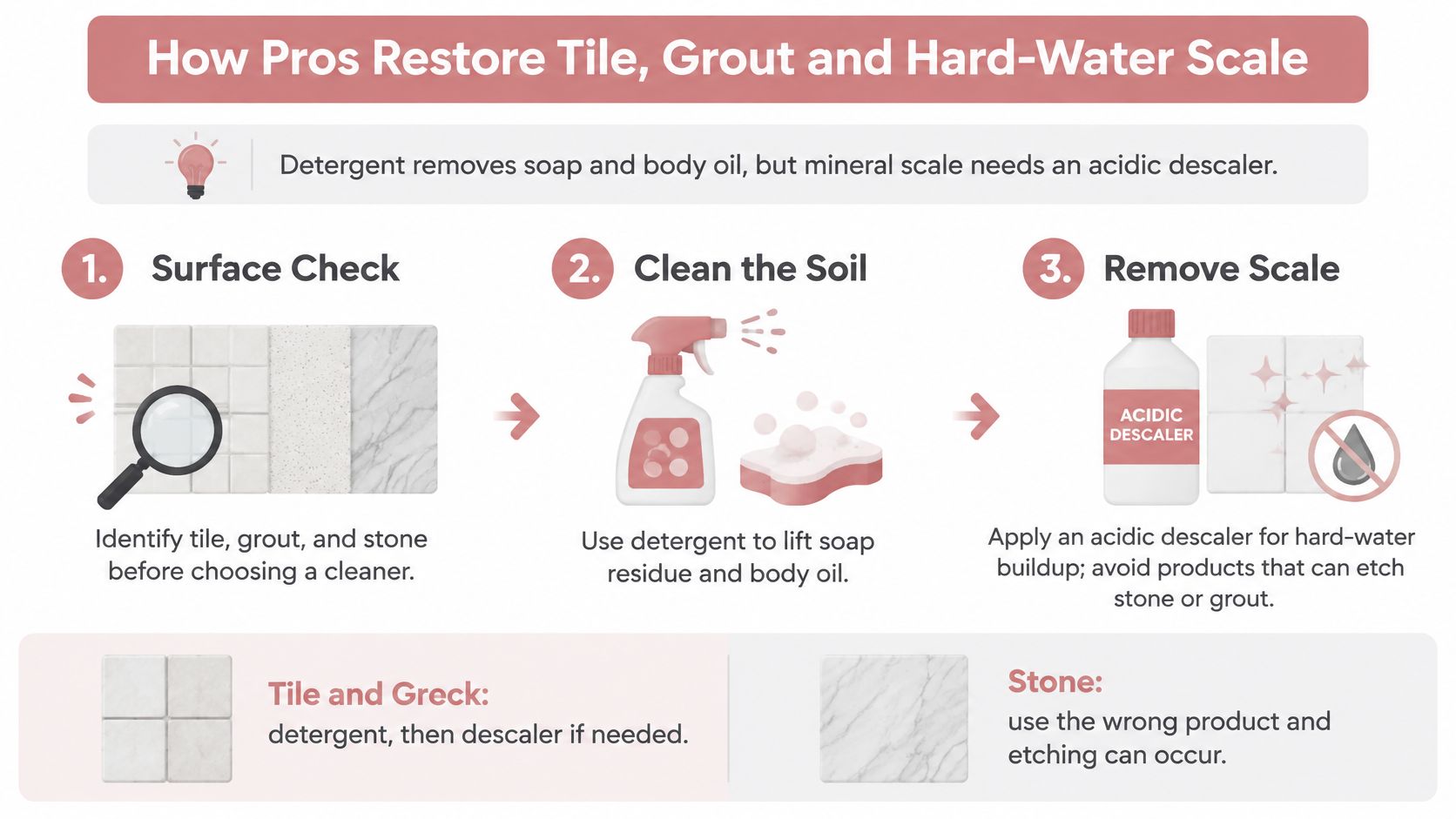
Use a Detergent-First Working Order
- Remove loose debris dry. Vacuum or collect hair and grit so you don't drag particles across the finish.
- Wash with detergent to lift the soap and body-oil layer. Rinse away the loosened residue.
- Test the descaler. Choose an inconspicuous patch and inspect for dulling, discoloration or finish changes.
- Apply the compatible product and allow its specified dwell time. Don't let it dry unless the directions explicitly permit that.
- Agitate gently. Use a nylon brush or non-scratching pad, paying attention to tracks and fixture edges.
- Rinse thoroughly with clean water. Remove residues before using another product.
- Dry the surface. A clean microfiber cloth helps prevent fresh spotting and reveals deposits that remain.
Consider a showerhead with white crust over a greasy soap film. Applying descaler straight onto that film can leave a messy slurry without reaching the deposit effectively. Detergent first gives the scale remover access to the mineral layer.
Practical rule: Never mix chlorine bleach with acids or ammonia. Keep bottles and used tools separated, and rinse between different cleaning stages.
The CDC's home-cleaning guidance emphasizes correct product use, surface restrictions and the danger of mixing cleaning chemicals. For a closer look at stubborn deposits, our guide to cleaning hard-water deposits addresses that specific problem.
Know When Restoration Stops
A cleaner can remove a mineral layer but can't polish away every etched patch or restore a worn coating. If glass stays cloudy after deposits are gone, continued aggressive scrubbing may make matters worse.
Finish with a grout water check. Beading suggests water repellency; rapid absorption suggests the grout may need resealing after cleaning and drying. Treat that as a screening check, not proof: grout type and existing treatments matter, and some grout systems don't require a sealer.
What Cleaning Can and Cannot Do About Mold
Bleach doesn't fix a leak, dry a cabinet or remove mold embedded in porous backing. Mold is a moisture problem before it's a stain problem. Cleaning can address suitable exposed surfaces, but recurring growth calls for investigation.
Surface scrubbing is only part of the job.
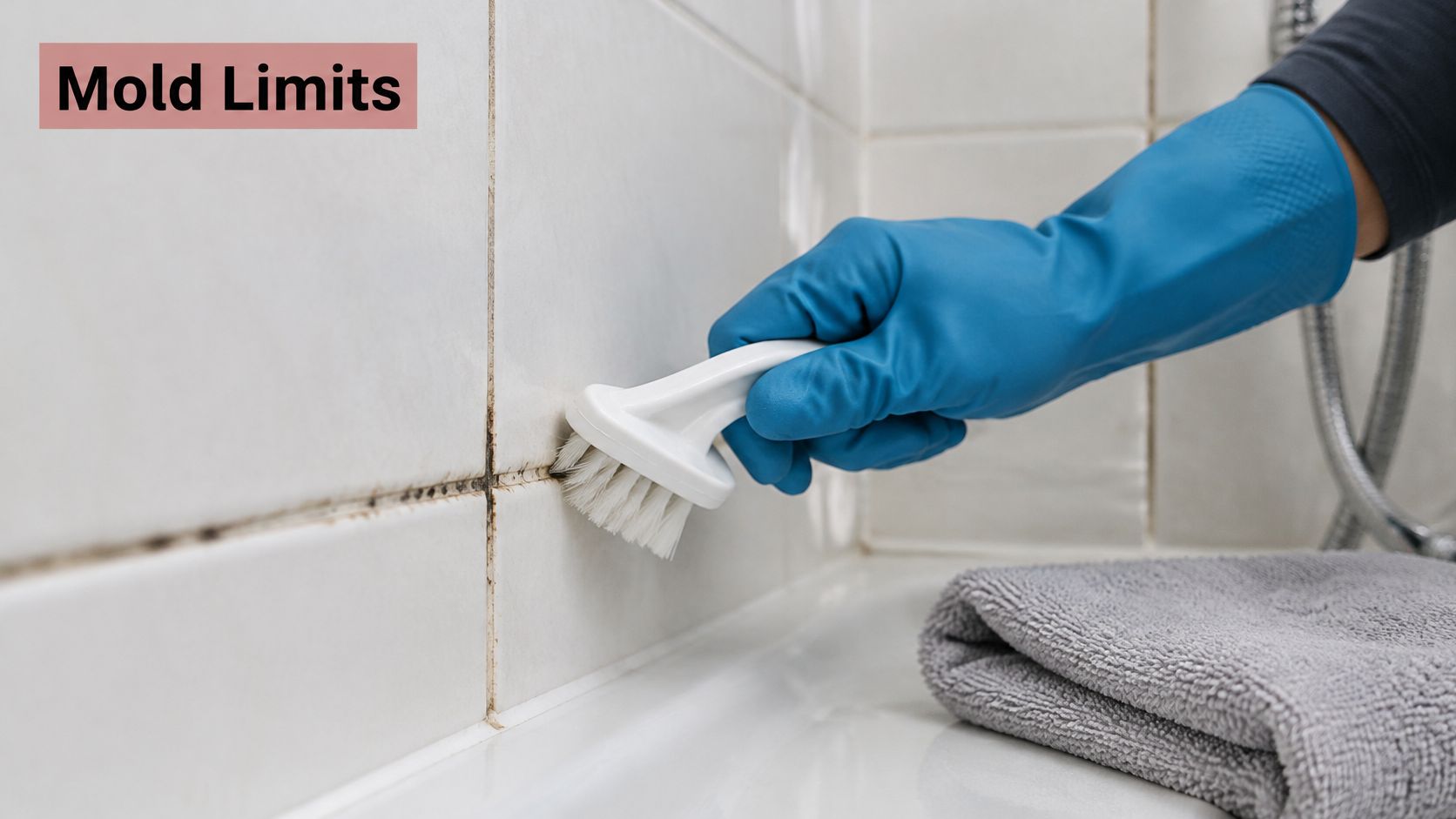
The EPA's mold and moisture guide recommends drying water-damaged materials within 24–48 hours, scrubbing mold from hard surfaces with detergent and water, and drying them completely. Porous materials such as affected drywall or soaked cabinet backing may need removal rather than surface treatment.
Fix the Water Source First
Suppose a drain leak wets the cabinet floor beneath your sink. A plumber should stop the leak, and drying should begin promptly. Don't postpone drying while waiting for the cabinet to look clean.
Once the source is controlled, suitable hard surfaces can be cleaned and dried. Swollen particleboard, deteriorated backing or hidden damage needs a separate assessment. A clean tile face doesn't establish that the wall behind it is sound.
For humidity control, the EPA's mold-prevention guidance recommends indoor relative humidity below 60%, ideally 30–50%, and using bathroom exhaust fans or opening windows during bathing. A practical starting habit is to keep the fan running for about twenty minutes afterward, then check whether surfaces are drying rather than treating the timer as a guarantee.
This video offers another visual reference for the bathroom mold problem.
Keep a Post-Service Moisture Checklist
- Run the fan: Use ventilation while bathing and afterward until moisture clears.
- Remove standing water: Squeegee walls and glass, and clear water from tracks.
- Check humidity: Use a humidity meter instead of judging the room only by smell.
- Report leaks: Photograph damp patches, damaged caulk and swollen materials promptly.
Persistent odor, recurring growth within weeks or suspected damage behind walls warrants a moisture or remediation assessment. Renters should document those conditions for the property manager; landlords should distinguish routine cleaning from building maintenance.
Our guide to cleaning bathtub mold focuses on accessible bathroom surfaces. It isn't a substitute for correcting concealed water damage.
How to Disinfect Safely Around Kids and Pets
Use a clean-first, disinfect-second process. Remove visible soil with soap or detergent and water, then use a suitable disinfectant on compatible hard, nonporous surfaces when there's a reason to disinfect.
Glazed tile, sealed counters, toilet exteriors and compatible handles are possible targets. Don't assume a product approved for one hard surface is suitable for unfinished wood, natural stone or every faucet coating.
Routine home disinfection is generally unnecessary unless someone is sick, someone at higher risk lives there or a recently sick person has visited. For a household managing illness, concentrate on relevant touchpoints rather than treating every wall as an equal priority.
Contact Time Means Staying Wet
One EPA-registered bathroom disinfectant label directs users to remove visible soil, spray hard nonporous surfaces from 6–8 inches away, and keep them wet for at least 10 minutes before wiping. That same label requires potable-water rinsing of food-contact surfaces and excludes utensils, dishes and glasses.
Say the worker is treating a toilet exterior with that product. A quick spray followed by immediate drying doesn't satisfy the directions. The coating must remain wet throughout the required period, with reapplication if necessary and permitted.
The EPA disinfectant guidance explains that contact time is the period a treated surface must remain wet. It's the time the surface must stay wet, not the time between opening the bottle and leaving the room.
A product's wet contact time is not automatically the time when children or pets may return.
Control Access and Product Handling
Follow a short safety sequence:
- Ventilate: Open a suitable window or run effective exhaust ventilation.
- Separate people and animals: Keep children, pets, toys and bowls away from the work area.
- Protect the worker: Use gloves and any additional protection the label requires.
- Finish properly: Complete required rinsing and follow the product's drying and re-entry instructions.
The CDC's facility-disinfection guidance supports ventilation, safe storage and keeping disinfectants off skin and animals. Never mix bleach with vinegar or ammonia.
If using appropriate household bleach and dilution directions aren't available, the CDC's bleach guidance gives 4 teaspoons per quart of room-temperature water, a wet contact time of at least one minute, and preparation of fresh solution daily. Check that the bleach itself is suitable; this isn't a recipe for every bleach-containing product.
Our explanation of the difference between sanitizers and disinfectants helps clarify product claims. Before choosing a treatment, identify which surfaces receive the most hands and whether anyone at home has a higher risk.
Eco-Friendly Products Compared by Emissions
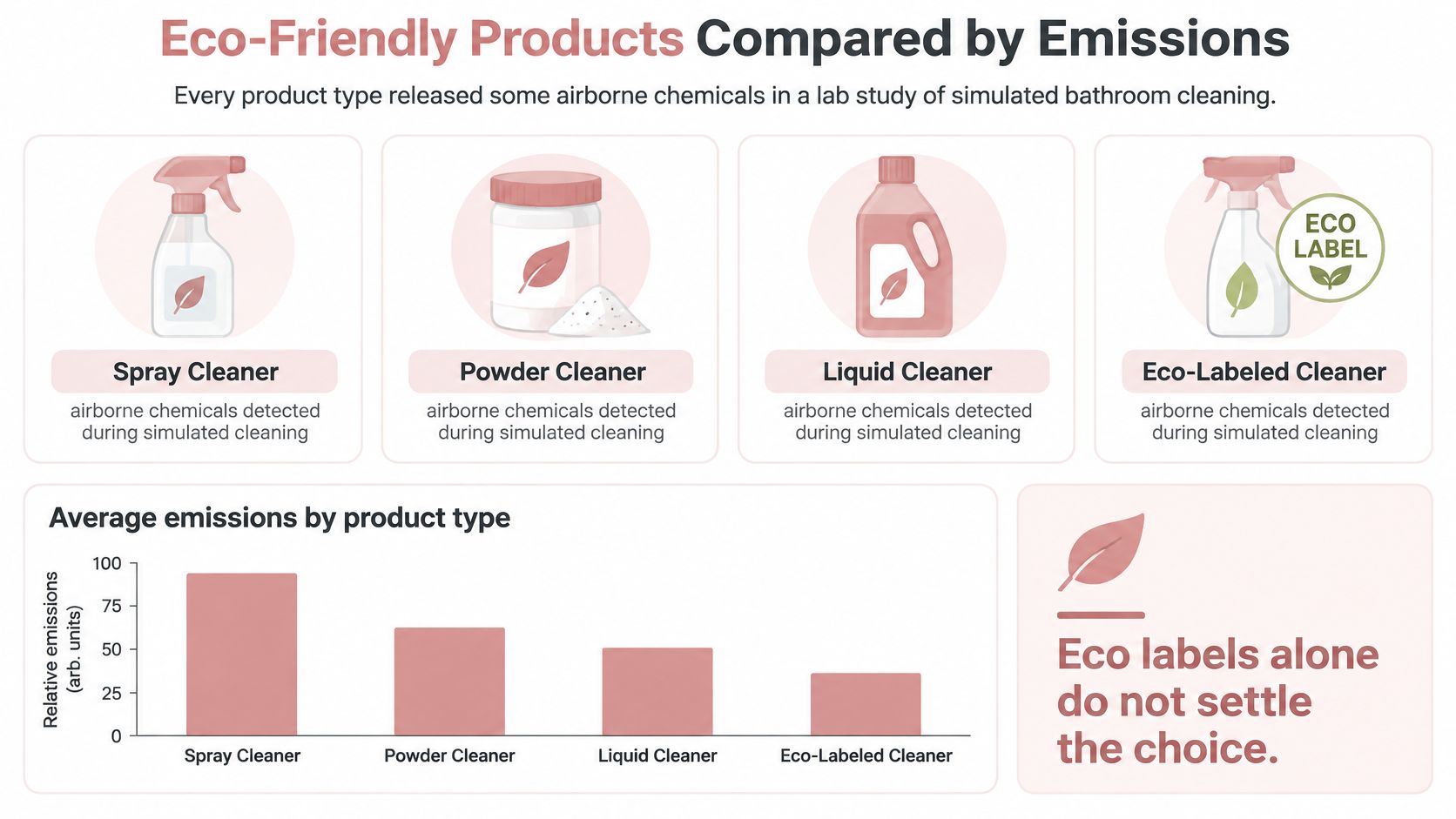
An eco label doesn't mean emission-free. In a CDC-supported study of simulated residential-bathroom cleaning, every tested product category generated volatile organic compounds, or VOCs. Mean total concentrations were 1,210 ppb for quaternary-ammonium products, 593 ppb for bleach-based products and 498 ppb for green products. These measurements compare the categories tested, not every cleaner on the market.
Average airborne VOC levels by product type
| Product type | Mean total VOC (ppb) | Best use | Caveat |
|---|---|---|---|
| Quaternary-ammonium | 1,210 | Disinfecting when its registered claims fit the task | Highest measured VOC level among these categories |
| Bleach-based | 593 | Compatible stain treatment, mold-prone grout and justified disinfection | Chlorine exposure exceeded the OSHA ceiling for some aides |
| Green products | 498 | Routine soap residue and upkeep | Not automatically a disinfectant |
The comparison is by chemical category, not by powder versus liquid format. The chart shows average airborne chemical emissions for product types, including sprays and liquids.
Application Changes Exposure
The study found the highest VOC exposure during spraying and the lowest during wiping. For routine cleaning, applying product to a cloth can reduce airborne spread when the label allows it. If the instructions require spraying, aim at the surface rather than misting the room. Keep a disinfectant's prescribed method unchanged.
A household might use a lower-emission cleaner for routine soil and reserve an appropriate disinfectant for relevant touchpoints when someone is ill. The trade-off is task-specific: a product suited to routine wiping may not meet a disinfection need. Ventilation still matters, and children should stay outside the work area.
Strong fragrance isn't evidence that a bathroom is cleaner.
The eco-friendly bathroom product guide can help compare options. Aquastar Cleaning Services can tailor deep cleaning to the home's needs; product suitability depends on the surface and task.
Before booking, ask:
- Product identity: Which products are proposed for the room?
- Lower-emission choice: Is there a suitable option for routine soil?
- Air management: How will the room be ventilated during and after cleaning?
What Drives the Price of a Deep Clean
Bathroom count, condition, access and the agreed work drive the quote. Similar floor plans don't necessarily require similar labor. A compact shower covered in mineral crust can demand more attention than a larger bathroom that receives consistent upkeep.
There isn't a defensible universal price to attach to an unseen bathroom. A useful estimate describes what the cleaner will tackle, not just the total at the bottom.
Compare the Same Bathroom Priced Two Ways
Consider a bathroom with cloudy shower glass, packed tracks and cluttered counters. A lower quote might cover the toilet, vanity, mirror and a basic shower wash. A more extensive quote might also include careful descaling, track detailing and trim cleaning.
Those aren't equivalent services. Neither number tells you enough without the scope.
Likewise, a hypothetical home with several heavily scaled showers and an older tub may require more work than a similarly sized home with fewer bathrooms and regular upkeep. The age of the tub alone isn't the issue; its condition and finish determine what can safely be cleaned.
| Price driver | What changes the work |
|---|---|
| Home size and bathroom count | More fixtures and surfaces to cover |
| Heavy buildup | Extra product stages, agitation and rinsing |
| Pets and shedding | More hair removal before wet cleaning |
| Clutter | Additional handling before surfaces are accessible |
| Product preferences | Need to match suitable products to materials |
| Add-ons | Separate work beyond the bathroom scope |
Get a Quote You Can Actually Compare
We customize deep cleaning to the home's specific needs and condition and offer a free cleaning estimate. Additional services can include refrigerator and oven interiors, windows, garages and basements; don't assume they're automatically part of a bathroom visit.
For a useful comparison, request:
- An itemized scope: Identify the rooms, fixtures and detail work.
- The product plan: Clarify preferences and whether disinfection is included.
- Written exclusions: Separate cleaning from remediation, plumbing and caulk repair.
Also establish whether the quote is per bathroom, per room or a flat total, and whether photos or a walkthrough are needed to assess the condition. These are pricing questions, not reasons to assume a particular company's billing method.
Our guide to what deep cleaning costs helps you think through the scope. Compare each proposal against the room-by-room checklist, especially the easy-to-miss areas behind fixtures and inside shower tracks.
Choose a Pro or DIY and Book Your Next Step
A renter facing a short move-out deadline and heavily scaled shower glass has a good reason to book professional cleaning. A homeowner with light soap residue, suitable supplies and an unhurried Saturday morning may be better off using detergent, a soft brush and a squeegee.
Choose according to the task and the risk, not embarrassment about the bathroom. Hiring help makes sense when the work exceeds your time, physical capacity or confidence with the materials.
Decide Which Kind of Help You Need
- Book cleaning: Heavy removable scale, neglected detail work or a tight sale or move-out deadline makes a professional visit useful.
- Arrange repairs first: An active leak needs a plumber, even if cleaning is also overdue.
- Seek mold assessment: Extensive or recurring growth needs the right specialist, not a promise of harder scrubbing.
- Consider household needs: Illness or higher-risk residents may make a planned professional clean worthwhile when time is short.
- Choose DIY: Light grime and sound surfaces are manageable when you can work carefully.
For the DIY route, use the numbered tile-and-scale sequence. A light soap-scum job generally needs only the detergent stage, gentle agitation, rinsing and drying. Don't add a descaler merely because it's in the cupboard.
Choose the Right Quote Category
Our online quote form includes Deep Cleaning, One-Time, Move-In/Out and Post-Construction cleaning. Select the option that matches the situation, then describe the bathroom's condition rather than assuming the category explains everything.
Request a free estimate and offer clear photos of the shower, sink and toilet. Include close-ups of scale, damaged caulk or unusual finishes, and check the proposed work against the room-by-room list before agreeing to the visit.
Aquastar Cleaning Services, LLC offers customized deep cleaning for homes that need more attention than routine maintenance, including detailed bathroom work within the agreed scope. Visit Aquastar Cleaning Services, LLC to book your free estimate this week, and include your bathroom priorities so the proposed clean addresses the buildup you need removed.