



The mug tips off the arm of the sofa and lands upside down on the carpet. By the time you set your own cup down and get there, the coffee has spread into a saucer-sized dark ring, the middle has gone matte, and your first instinct is to grab a rag and scrub hard. That instinct is what turns a five-minute spill into a permanent shadow.
Cleaning spilled coffee on carpet is not really a chemistry problem. It's a moisture problem. The coffee itself is stubborn, since roast compounds behave like dye on fiber, but most of the stains that survive are made worse by the person cleaning them: too much water pushed into the pile, soap left behind, and drying that stops while the backing is still damp. Get the moisture right and the coffee usually comes with it.
What follows is the sequence I'd use in my own living room, and the order of the steps matters more than the products you buy.
Blot Up a Fresh Coffee Spill in Minutes
Say a mug of black coffee goes over on a beige living-room carpet, still wet, still spreading. The first few minutes decide most of the outcome, because coffee travels down the pile quickly and starts working into the backing while you're still hunting for a cloth. What you do in that window is almost entirely about removing liquid, not about cleaning.
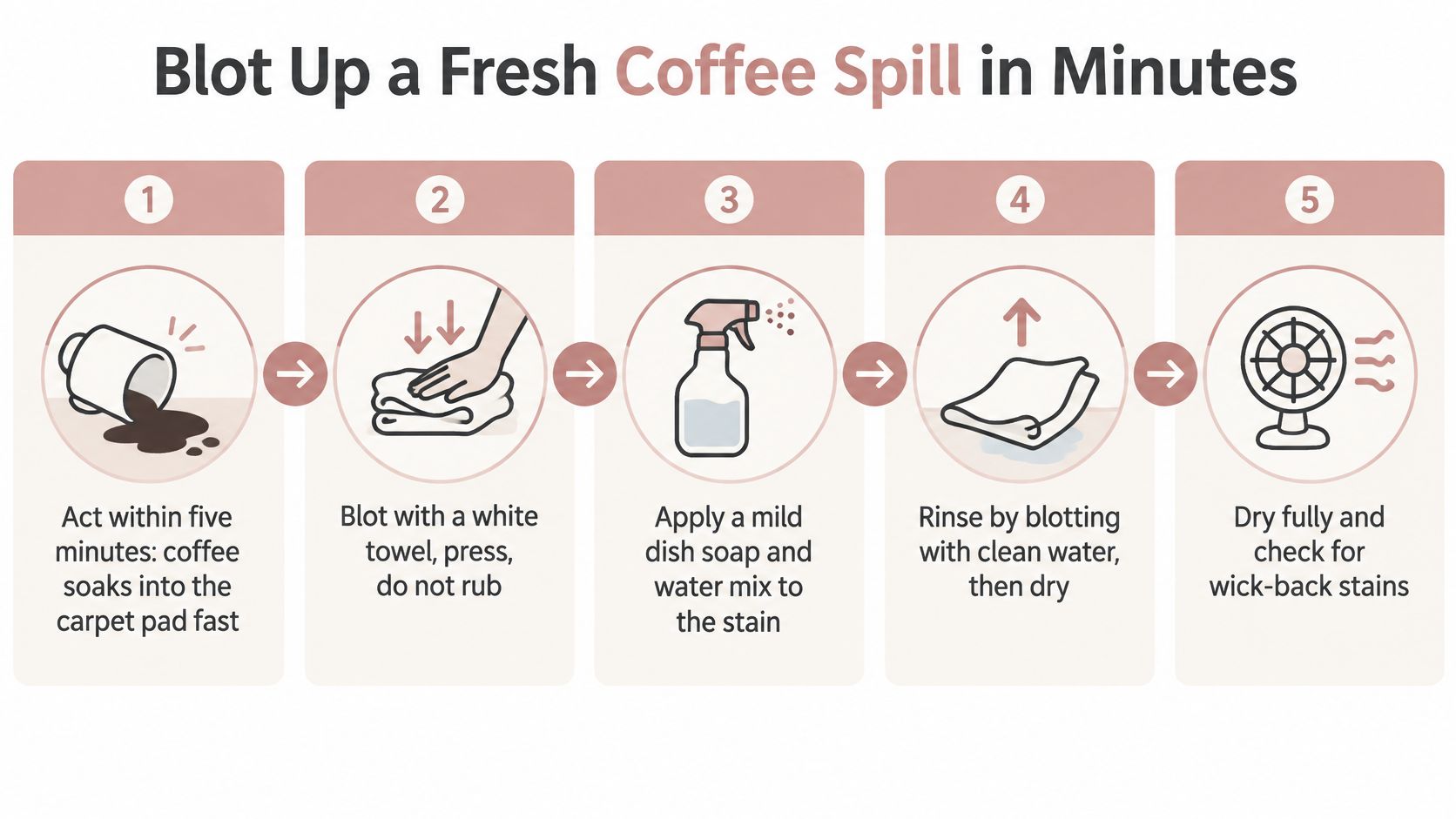
Blot in this order
- Reach for white, not colored. A clean white cloth or a stack of white paper towels. A colored dish towel can transfer dye onto a light carpet, and a printed paper towel can leave ink behind.
- Press straight down, then lift. Firm vertical pressure, no sideways motion. Rubbing spreads the liquid across a wider patch and forces the colored coffee compounds deeper into the pile, which is exactly what you don't want on a fiber you can't turn inside out.
- Rotate to a dry section every time the cloth browns. A saturated cloth just re-wets the carpet and pushes moisture around. Fold, swap, repeat.
- Work from the outside edge toward the center. Starting at the rim keeps coffee from migrating outward into clean fiber, where it creates a halo ring you'll be chasing for weeks.
- Add cold water only after the cloth stops lifting color. A small amount, sprayed or dabbed on with a damp cloth, never poured. Pouring is the most common mistake at this stage: it floods the pile, drives coffee into the backing, and turns a surface spill into a pad problem. Cold, not hot, because heat pushes a coffee stain toward setting.
- Blot dry again until nothing else comes up. Finish by extracting moisture rather than leaving the spot damp.
The Carpet and Rug Institute's coffee spot guidance reduces this to three moves: remove the spill, rinse the area with cold water, and blot until the carpet is dry. The institute deliberately avoids oversaturation, for the same reason you should, since moisture pushed into the backing is what makes a spill come back later.
One detail worth knowing about how coffee stains are tested: the CRI's spot-cleaning protocol uses hot coffee at 60 ± 3°C, or roughly 140 ± 5°F, as a standardized staining agent. That's a controlled lab variable for comparing products, not a suggestion to pour hot water on your carpet.
The same moisture discipline applies to other wet accidents around the house. If you've ever handled a sick child at 2 a.m., the method for getting vomit smell out of carpet runs on the identical principle: lift what's there, rinse sparingly, then dry hard.
Practical rule: Coffee stains rarely fail because the product was too weak. They fail because there was too much water and not enough blotting.
The check that tells you to stop
Press a fresh dry white cloth onto the spot and hold it for a few seconds, then look at the cloth, not the carpet. If it comes up clean, the liquid is out and you can move on to drying. If it comes up brown, keep blotting with plain water rather than reaching for a stronger bottle. Wet carpet lies to you. A stain can look gone while damp and reappear as a brown outline once the fibers dry, which is why the decision gets made on the cloth.
Test Your Cleaner in a Hidden Spot First
Before any detergent or vinegar touches the visible stain, spend two minutes on a spot nobody looks at: under the sofa, behind a door, inside a closet. This is the step people skip, and it's the one that prevents a coffee stain from becoming a color change you can't undo.
- Dampen a white cloth with the exact diluted solution you plan to use on the spill.
- Press it onto the hidden carpet for about a minute, following the test procedure recommended for common carpet stains.
- Blot with a dry white cloth and check whether any color transferred onto it. Dye on the cloth is a red flag.
- Let the test spot dry completely, waiting at least 20 minutes before judging, then compare its color and texture with the surrounding carpet.
The drying wait is the part that matters. A test patch can look perfectly fine while wet and still fade, stiffen, or dull once dry, because the fiber's reaction shows up after the moisture leaves. Judge it dry or don't judge it at all.
Wool, silk, specialty dyes, and any carpet with manufacturer care restrictions deserve extra caution here, since those fibers hold color differently from solution-dyed synthetics.
If the test spot changes color or texture, stop. Don't put that solution on the visible stain, and don't go looking for a stronger one. That's the point where a professional assessment is cheaper than a repair.
This test gates everything that follows, both the neutral detergent and the vinegar step, so run it once and you're covered for the whole spill.
Cleaning Solutions and When to Use Each
You need one solution at a time, applied after blotting, and stronger is never better. A coffee stain that's been sitting on a rug for a week starts with the neutral detergent, then moves on only if color remains.
| Solution | Mix | When to use | Avoid |
|---|---|---|---|
| Plain cold water | Clean water only | Rinse after most of the liquid is blotted up | Hot water, which pushes the stain toward setting |
| Neutral detergent | 1 teaspoon per 1 cup of lukewarm water | First chemical step on a visible stain | Alkaline cleaners and bleach |
| White vinegar | 1/3 cup white vinegar with 2/3 cup water | Second step if discoloration remains after the detergent round | Mixing with other cleaners, or using on wool or silk without a test |
| Dry white towel | No mix needed | Every blotting round | Colored towels that can transfer dye onto the carpet |
The University of Georgia textiles guidance on coffee and tea stains sets the working rule for the detergent round: a neutral detergent with no alkalies or bleach, mixed at that 1 teaspoon to 1 cup ratio, applied in small amounts into the pile, blotted, flushed lightly with clean water, and blotted again. Vinegar is a genuine second step, not a substitute, and only when discoloration survives the first round. Never mix it with detergent or bleach, and use it sparingly.
Misting beats pouring every time. Solution poured onto the spot until it soaks through is the mistake that produces wick-back, and it's also how detergent ends up left in the fibers, where it attracts soil and makes the area look dirty again within a month. Apply to the cloth, then to the pile.
Rinsing deserves its own mention. Weak rinsing leaves residue, and residue is why some spots feel crunchy or grab at your socks a week later. Flush lightly with clean water and blot it out.
Stop rule: after two rounds with no visible improvement, stop and reassess. Two rounds of detergent and one of vinegar is the ceiling for household treatment. Escalating strength rarely fixes what moisture technique got wrong, and it does risk fiber damage.
If you want a second opinion on technique before you start, Flacks Flooring's carpet stain removal guidance covers the fiber and pile side of the question well. Baking soda is a different tool entirely, best saved for pulling moisture out during drying rather than cleaning, and this baking soda stain removal guide shows where it fits.
For context on how much product choice matters, in 2025 Real Simple tested 40 carpet stain removers on coffee and other stains, and one product removed 100% of both fresh and dried coffee stains in its test. The spread across 40 products tells you the bottle isn't the main variable.
Treat a Coffee Stain That Has Already Dried
This is the version you find on Wednesday morning: a mug knocked over Tuesday night, unnoticed until the carpet is stiff and brown with a hard outline where the liquid stopped. Fresh spills are a liquid problem. Dried ones are a rehydration problem, and they take more rounds.
- Vacuum or brush the dry residue first. Loose grounds and crusted coffee should come off the surface before any liquid touches them, or you'll turn them into mud and work them into the pile. Use the brush attachment, no scrubbing.
- Dampen lightly with cold water. A spray bottle set to a fine mist, or a damp white cloth pressed on. Not a pour. Saturation drives the stain deeper and into the backing, which is the one thing you can't undo.
- Press a dry white cloth over the spot and lift. Move to a dry section as it discolors, working from the outer edge inward, the same direction logic that a household coffee-stain routine applies to larger spills where the dilute-and-blot cycle is repeated at least twice.
- Apply the neutral detergent solution from the previous section, but only after the hidden-spot test has dried without a color change.
- Rinse lightly with clean water and blot again. This is the round that decides whether you get a clean result or a residue patch that grabs dirt.
Count your cycles out loud if you have to. Dried stains usually need two or three full blot, rinse, blot rotations, versus one for a fresh spill, and each complete cycle should lift noticeably more color than the last. If cycle two looks identical to cycle one, you're not making progress and more rounds won't help.
Dried coffee is half pigment and half sugar and milk solids. The pigment responds to water and detergent. The sugar and dairy respond to thorough rinsing. Skip the rinse and the spot stays sticky no matter how well you cleaned it.
The same rehydrate-then-blot approach works on other tannin-heavy spills, and this wine stain removal walkthrough shows the deeper-set version of the same logic.
When a dried stain resists two full rounds, don't add more chemistry. Move to drying and troubleshooting, because a stain that keeps returning is usually a moisture problem wearing a stain's clothing. Star Cleaner Australia's carpet stain guide is a useful cross-check if you're dealing with an unusual fiber or an old mark.
Dry Fully and Fix Wick-Back Stains
A full carafe hits a 6 by 8 foot patch beside the kitchen island on Saturday morning. By Sunday the pile can look dry while the pad underneath is still cool and damp. That coffee is still moving. Most carpet and pad need one to two days to dry fully, and a surface that only feels dry on top is not finished.
For a heavy soak, pull bulk water with a wet vacuum, then run a fan across the pile and a dehumidifier if the room stays humid. A wet vacuum removes standing water. It does not dry the carpet. The pad and backing hold the moisture that later smells musty and sends the brown mark back up the fiber.
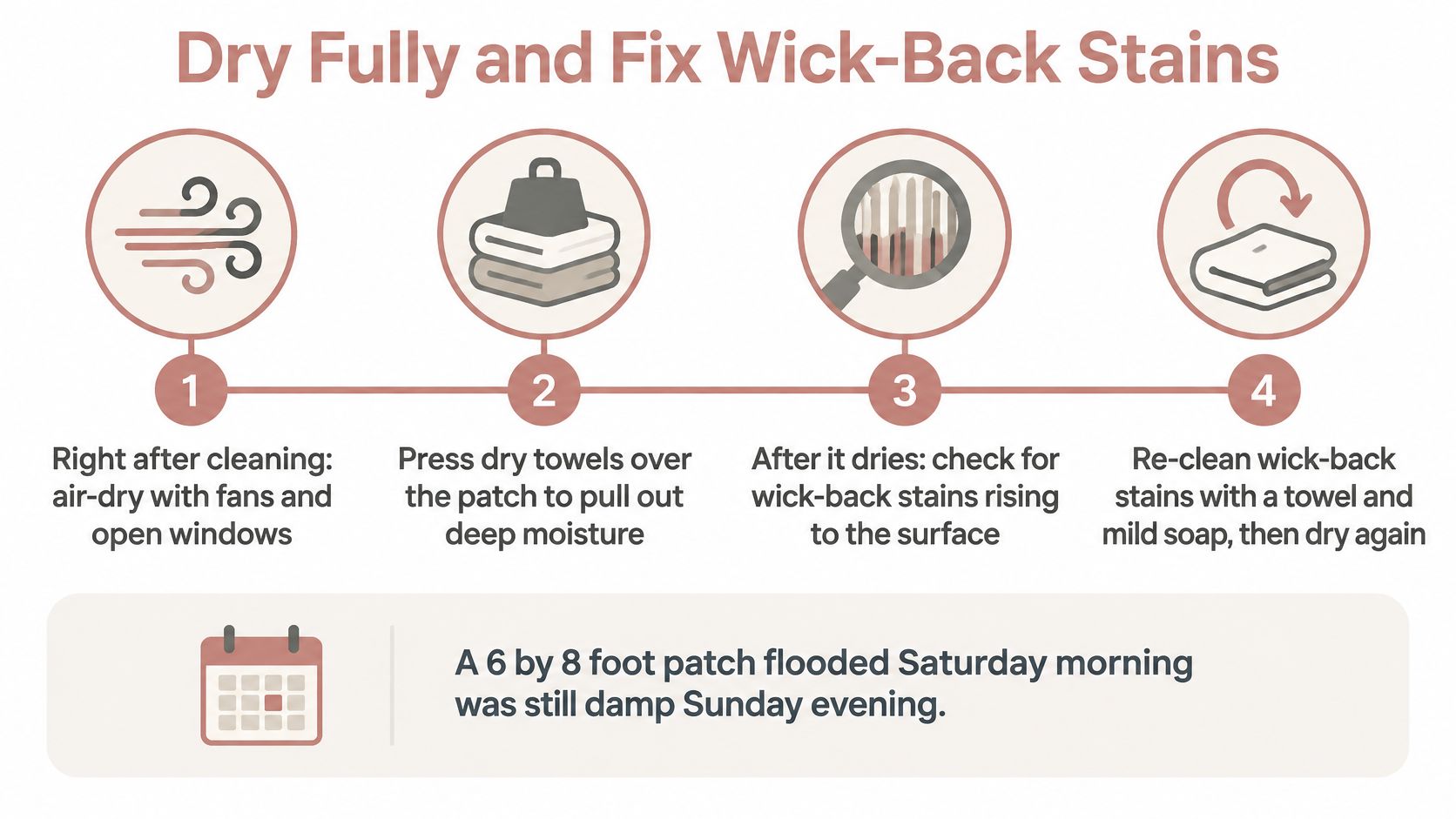
The drying stages
| Stage | What to do | Target |
|---|---|---|
| Right after treatment | Press dry white towels on the spot and replace them as they get damp | Towels stop picking up moisture |
| First 2 hours | Run a fan across the area and open a window if the air is still | Surface feels dry to the touch |
| Over the next one to two days | Run a dehumidifier in a humid room and check the pad underneath | Carpet and pad dry fully, not just the pile |
Cover the spot with a thick layer of dry absorbent material, enough to take up moisture without turning saturated, then weight it down. Swap the layer as soon as it feels damp. A thin towel that soaks through in minutes just parks water on the fiber.
Why the brown ring comes back
Wick-back is the brown outline that shows up hours after the spot looked clean. Moisture left in the pad or backing travels upward as the surface dries, carrying dissolved coffee and dropping it at the top of the fiber. A stain that returns is almost always leftover water, not a sign you cleaned too little.
Residue makes the same ring from the other direction. Detergent left in the yarn grabs soil, and leftover coffee keeps migrating upward. Use only a small amount of carpet-safe solution, work from the outside toward the center, and blot until the towel comes up nearly clean. The CRI's formal spot-testing method applies 2.5 ± 0.5 milliliters of full-strength hot coffee per test, a useful check on how little liquid a controlled test uses compared with a kitchen spill.
Watch this walkthrough if you want to see the drying and extraction stage in motion:
Two things not to do. Don't run a wet vacuum over carpet that is already surface-dry just to chase a faint mark. You put water back into fibers that were finally losing it. And don't keep pouring solution onto a patch that has already soaked through to the pad. Lift that section or have it extracted. If a musty smell or a damp patch persists, this guide on when to call professionals about mold explains what you're looking at.
A one-time spill still sits inside a larger wear pattern. Traffic, grit, and repeat damp spots are why how often carpets should be cleaned matters once this patch is dry.
Decide Whether a Carpet Pro Is Worth Calling
Hand it over when any one of these is true.
- The coffee reached the pad or backing. The spot feels squishy rather than just cool, or you can press nearby and feel dampness spreading under the pile.
- The carpet is wool, silk, or a specialty fiber. These hold color differently, and a failed experiment is permanent.
- A musty smell appears after 48 hours. That's a moisture problem now, not a stain problem.
- The stain survives two complete rounds. More chemistry at that point risks color change or fiber damage with little upside.
- The spill covers a large area. A full carafe across a rental unit's carpet is an extraction job, not a towel job.
Repeated spraying isn't the answer to a stubborn spot. Guidance on healthy-home carpet care is blunt that the usual failure mode is overwetting, residue, or wick-back rather than insufficient cleaning, which is why adding more passes to a damp patch tends to make the outline worse. If you're working in a rental and the pad is soaked, the practical concern isn't the visible mark. It's the backing and the subfloor underneath it.
A professional can lift and replace a damaged section of carpet or pad. Compared with replacing a whole room's flooring, that's often the cheaper path, and it's the reason I'd stop early rather than fight a stain that has clearly gone deep.
We offer carpet cleaning as part of our services here at Aquastar Cleaning Services, with trained and insured teams, and if an area doesn't come up to standard we return to re-clean it at no additional cost. Confirm current service terms and availability directly with us before booking. If you're weighing methods, this comparison of carpet cleaning versus steam cleaning explains which suits which carpet type.
Keep the sequence for next time, whatever you decide today: blot first, test the cleaner, rinse lightly, dry completely, and only then judge the result.
A fresh spill doesn't have to become a permanent shadow on your floor. Aquastar Cleaning Services, LLC provides carpet cleaning for the tough spills that get past blotting, with trained and insured teams who assess the stain, treat it, and extract it properly, and we offer driveway pressure washing and full house cleaning alongside it. Visit Aquastar Cleaning Services, LLC to request a free estimate.