



A thorough oven cleaning every 3 to 6 months fits ordinary use, while frequent roasting of fatty foods moves that to about monthly. Copy one row from the habit table and treat that date as the plan. Smoke, a burnt odor, black carbon, or a fresh spill only pulls the date forward.
The calendar is a starting line, not a verdict. A clear cavity after a quiet winter doesn't need a scrub just because a quarter ended. A week of roast chicken can. Pick the row that matches the meals you cook, write the date down, and let what you see on the metal decide whether you go sooner.
A Cleaning Schedule by How You Cook
How often to clean oven follows the meals, heat, and splatter your kitchen produces. A thorough clean every 3 to 6 months is the baseline for a typical household, and about every 3 months is the working mark when you bake or roast several times a week. Occasional users may need only one or two deep cleanings a year. GE Appliances puts most families at once or twice a year when large spills are wiped promptly, and daily or unusually frequent cooking at four to five cleanings a year.
Consumer Reports guidance cited by Whirlpool uses that same 3 to 6 month window and shifts frequent roasting of fatty foods to monthly. Whirlpool also points to seasonal cleaning for regular use and a shorter gap when use is heavy. Grease, sugars, and crumbs get harder each time they reheat, so a copied row beats a vague reminder that says “spring.”
A cleaning date works like a mileage marker: it predicts service, while smoke or smell can still call for an earlier stop. In 2025, Norwex survey data reported by Realtor.com found that 44% of North American adults postponed oven scrubbing more than any other household chore. A written row is easier to keep than a promise to “get to it.”
Copy one row
| Cooking habit | Deep clean | Between cleans | Meal example |
|---|---|---|---|
| Light use, about twice a month | 1 to 2 times a year | Wipe the rare spill after the oven cools | Pizza or cookies twice a month |
| Typical cooking a few times a week | Every 3 to 6 months | Same-day wipe of fresh spills and a monthly look | Weeknight meals plus weekend baking |
| Baking or roasting several times a week | About every 3 months | Wipe after each messy cook and inspect monthly | Casseroles four nights a week |
| Fatty meats roasted often | About monthly | Wipe cooled fat before the next heat cycle | Roast chicken, bacon, or sausage most weeks |
| Nearly daily mixed cooking | 4 to 5 times a year | Same-day wipe plus a monthly look | Daily meals with frequent oven use |
| Holiday or party surge | Before the event, and again if a spill burns on | Extra look before high heat | Thanksgiving turkey or a large roast |
Pizza or cookies twice a month. Deep-clean in spring and again in autumn. A rare drip of cheese or a cookie that ran over gets a wipe after the oven is cool, then the normal plan stays put.
Weeknight meals plus weekend baking. Stay inside the 3 to 6 month band. Wipe a spill the same day it happens, once the cavity is cool, and take a monthly look so a quiet drip does not become a black patch.
Casseroles four nights a week. Plan an interior clean at the end of every quarter. Sauce and melted cheese harden when the next dinner reheats them. Waiting until the racks stick turns a short job into a long one.
Roast chicken, bacon, or sausage most weeks. Look monthly and deep-clean about every four weeks. Wipe cooled fat before the next heat cycle. Fat that sits through another roast is what smokes on preheat.
Daily mixed cooking. Four or five deep cleans a year matches a kitchen that is almost always on. Keep the same-day wipe and the monthly look so those visits stay shorter.
Thanksgiving or a lease walk-through. Clean before that date. Clean again only if a spill turns black. Done looks simple: no smoke on preheat, racks that slide, and a door you can see through.
A lasagna that boils over is a spill day, and the yearly plan stays chosen from last month's cooking pattern. Pick the row that matches real dinners, not the menu you meant to cook.
Practical rule: The table sets the date. Smoke, odor, carbon, and a fresh spill only move it sooner.
Put the two dates, or the monthly one, on a paper calendar you will see. If you like printing a year at a glance, you can download yearly calendars as PDF and mark the deep-clean month next to birthdays and school breaks. The same habit keeps the rest of the room workable. A short pass on counters and the floor, the kind covered in this kitchen cleaning guide, stops crumbs from migrating into the next bake.
Signs the Oven Needs Cleaning Now
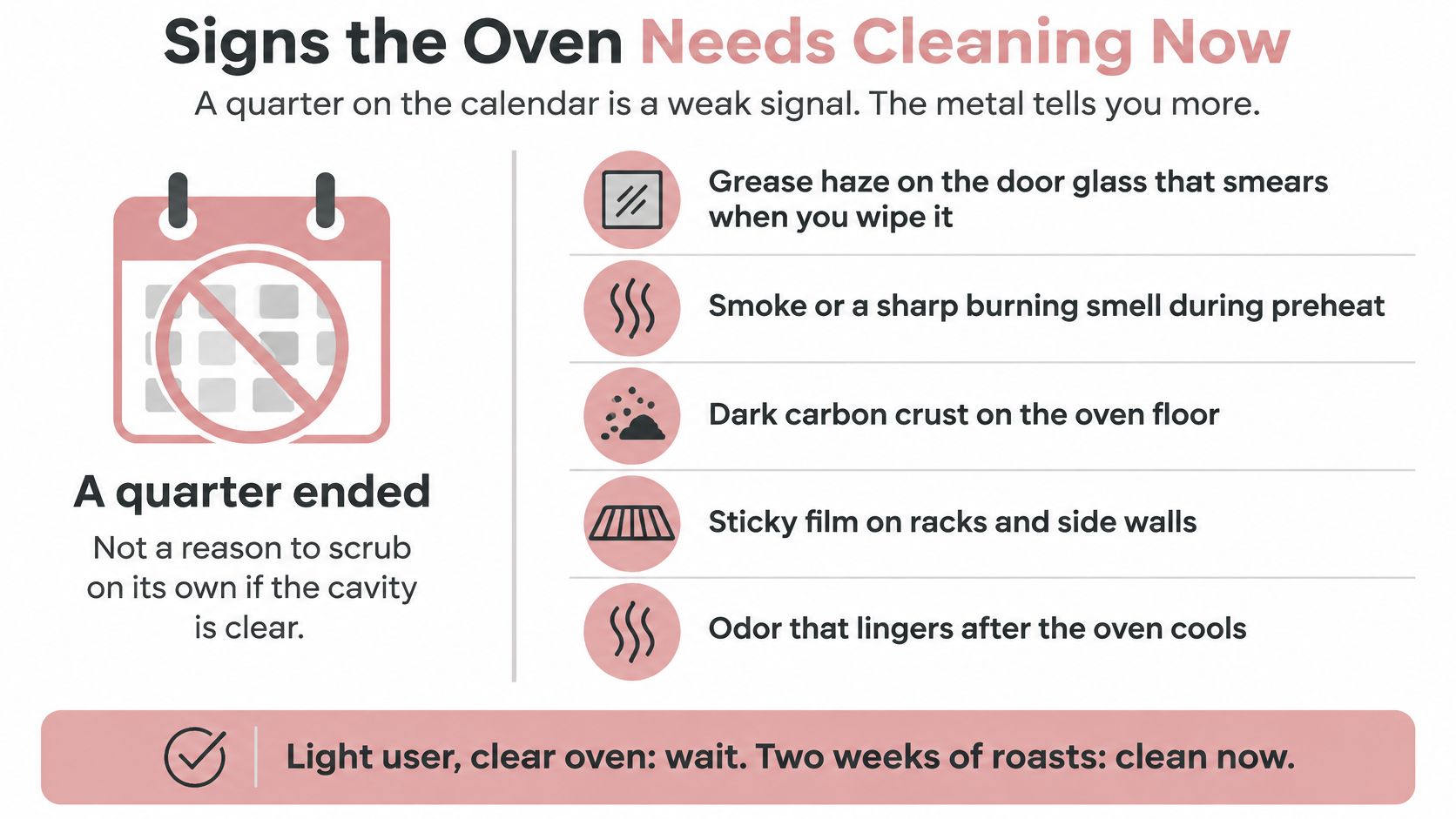
Smoke on preheat is the loudest sign. If the kitchen smells sharp before the food is even in, the cavity already has fuel on it. Months on a calendar are a weak signal next to what is on the metal.
A light user with a clear cavity doesn't need a scrub because a quarter ended. Two weeks of uncovered roasts can justify one. Apple Valley's oven-cleaning safety page frames it as condition, not elapsed time: wipe fresh spills after the oven cools, inspect the door, bottom, racks, and heating area monthly, and schedule a deeper clean when grease, carbonized residue, persistent smoke, or odor shows up. Heavy grease raises smoke and ignition risk during a high-heat self-clean. Light users can wait if the cavity stays clear.
What a monthly look covers
Open the door with the oven off and cool. Check four places and stop at the first real problem.
- Door glass: A brown haze that smears means grease, not steam.
- Oven floor: A sticky film or a dark crust that a damp cloth won't lift is carbon, not a crumb.
- Racks: Tacky bars and food stuck in the corners mean the next sheet pan will drag.
- Around the heating element: Pooled fat here is what flashes into smoke.
Grease on hot metal behaves like dust on a lamp shade left too close to a bulb. Every heat cycle bakes the next layer harder, the way extra coats of paint get tougher to sand.
Three meals, three decisions
Sunday roast juices that are still soft after cooling are a wipe. Lift them while they are soft and leave the deep clean on its date.
Berry-pie syrup on the door that has turned black and shiny is not a wipe anymore. That shine means the sugar has carbonized. Move the job to a deep clean.
Cheese from a frozen pizza on a rack gets the rack washed in the sink. Then look at the floor and the walls. If the cavity is clean, you are finished. If you see more black film, the deep clean moves up.
Fresh soil is a spot job. Carbonized soil is the scheduled deep clean. Busy families and renters can keep one fridge-door line: wipe fresh messes after cooling, inspect once a month, and deep-clean when smoke, odor, or carbon appears.
Wipe Fresh Spills After the Oven Cools
Say a lasagna boils over on a Tuesday. Sauce hits the floor and a ribbon lands on the door. That mess is tonight's job, and only after the heat is gone.
- Turn the oven off and wait until the cavity, the door, and the racks are completely cool. Hot enamel turns the lasagna's sugar and fat into carbon. A wipe on a warm oven smears a film a cool wipe would lift.
- Take the dish out and lift the racks. You want the sauce, not a hot rack against your wrist.
- Pick up loose noodles and sauce with a paper towel or a soft scraper. Don't drag a metal blade across the glass or a coated wall.
- Wipe the floor and the door where the sauce landed, using only a method the manual allows. While the soil is fresh, warm water and mild dish soap are often enough.
- Wash the racks in the sink so grease doesn't stay on the bars and drip back on the next bake.
- Look at the door gasket and the heating element. Leave them alone if the manual says no cleaner belongs there.
- Put the racks back only when they are dry. A wet rack steams and spots the clean floor.
A self-clean cycle right after a small lasagna spill adds heat and smoke the mess doesn't need. Manual cleaning is the better routine for fresh soil and for any surface that shouldn't see pyrolytic temperatures or harsh chemicals. A guide from Spencer's TV & Appliance makes the same split: wait until the oven is completely cool, remove racks, wipe loose residue, use only an approved method, and wash racks and door glass separately. Products can be wrong for heating elements, door gaskets, catalytic liners, and electronic controls.
If the same spot is already black and shiny, stop scrubbing. Move that patch to the deep-clean date instead of spending an hour on carbon a cloth won't lift.
The glass on the oven door is a different job from a smooth cooktop, but the same patience helps. This glass cooktop cleaning walk-through shows why you wait for a cool surface and skip grit that scratches. Tonight you only need the cool wipe. Save the deep clean for soil that has already turned black.
Match the Schedule to Your Oven Type
Your habit row still sets the date. The oven type decides which tool is safe to use on that date. Smoke, odor, carbon, or a fresh spill only ever move the date sooner.
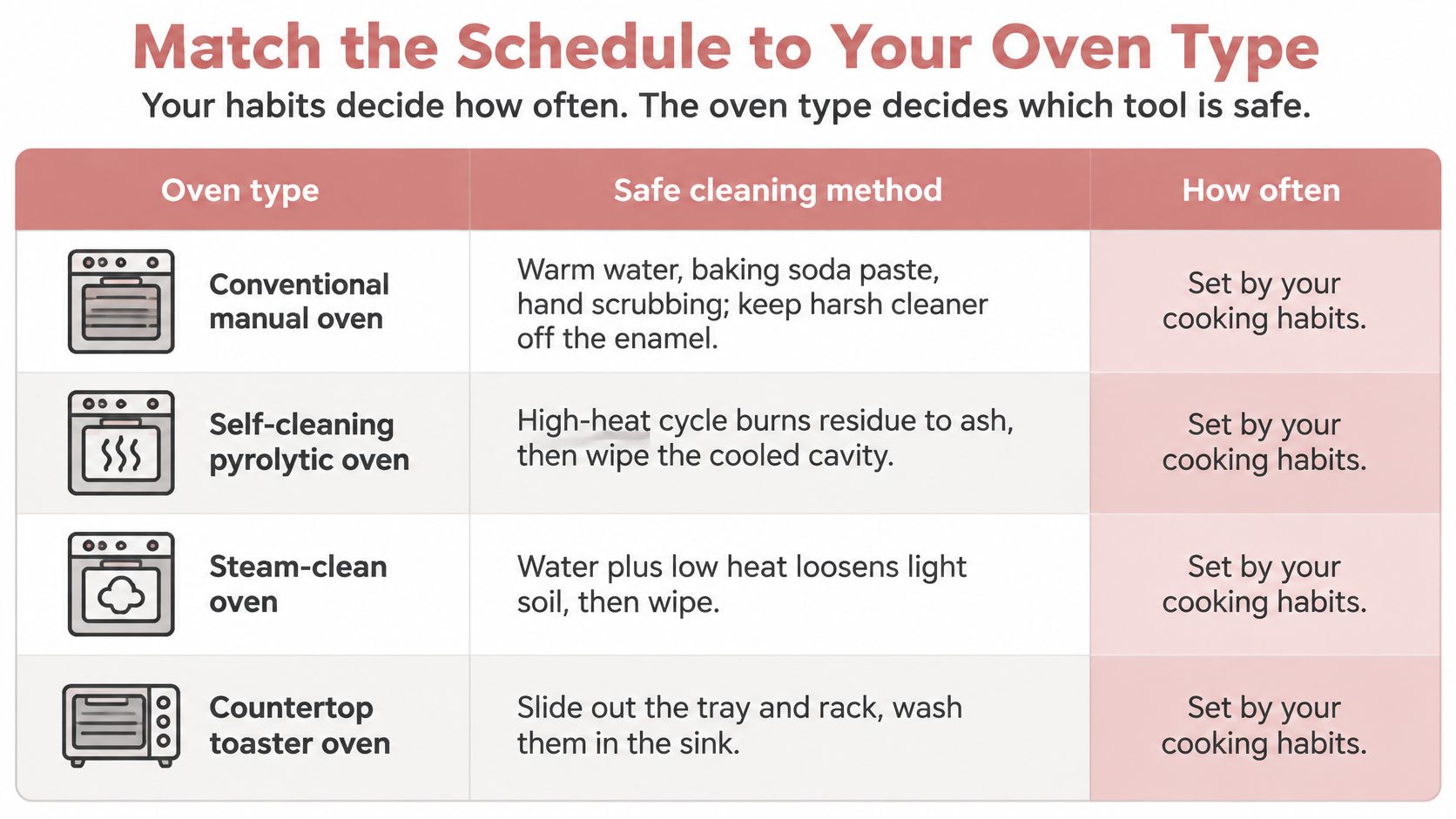
A steam cycle works the way a soak works on a dinner plate: warm moisture loosens light, recent soil so a cloth can finish the job. It stops where a scrub would start, so a black crust from last month's roast sits past what steam can do. KitchenAid treats steam as the between-clean tool for light soil and a pyrolytic self-clean as the tool for heavier buildup, roughly every 3 months, or every 6 to 12 months on some systems when soil level and the model instructions agree. Wipe fresh spills after cooling, inspect monthly, and run a manual or approved automated deep clean on your habit schedule, sooner when heavy soil is visible.
| Oven type | Soil it handles | Typical timing | Avoid |
|---|---|---|---|
| Conventional manual | Fresh spills through baked-on soil if the manual allows | Deep clean on the habit schedule | Cleaner on elements, seals, or glass the manual does not approve |
| Steam clean | Light, recent soil | Between deeper cleans | Expecting steam to lift black carbon |
| Pyrolytic self-clean | Heavier baked-on residue | About every 3 months, or 6 to 12 months if the manual and soil agree | A cycle over a pool of grease, or chemical cleaner in that cavity |
| Catalytic or continuous-clean liner | Light grease during normal cooking | Inspect on the habit schedule and clean when film remains | Abrasive pads and standard oven cleaner on the liner |
A conventional oven follows your habit row with whatever method the manual allows, often warm water, a baking-soda paste, and a non-scratch pad on enamel the maker approves.
A steam cycle sits between deeper cleans. Run it after a light drip, then wipe.
A pyrolytic cycle burns heavier residue to ash you wipe up once the oven cools. You still look inside and wipe tonight's spill by hand. Heavy grease can smoke during the cycle, so lift out large loose debris before you start it.
A catalytic or continuous-clean liner handles light grease during normal cooking. If a film remains, keep checking on your habit schedule and clean when the film stays. Abrasive pads and standard oven cleaner can ruin that liner.
Chemical oven cleaner belongs only where the manual permits it. Heating elements, door seals, racks, electronic controls, catalytic liners, and self-clean coatings can all be damaged by a product made for a different oven. Whichever row your oven matches, the shared ground rules in this oven cleaning frequency guide stay the same: a cool oven, cookware out first, and the appliance maker's instructions.
Match the model name inside the door, or the manual in the drawer, to one row before you buy cleaner or press self-clean. A countertop toaster oven is simpler still: the tray and rack come out and go to the sink, which is the method in this toaster oven cleaning guide.
Why Grease Left in the Oven Matters
Cooking fires are common enough that leftover fat isn't a cosmetic problem. In the United States, fire departments responded to an estimated average of 187,500 residential-building cooking fires in each year from 2017 through 2019, according to figures compiled by the National Fire Protection Association. Newer NFPA estimates for 2020–2024 found kitchen and cooking equipment involved in 48% of home structure fires, 35% of home fire injuries, and 16% of home fire deaths.
Grease is the sharp part of that picture. 66% of reported home cooking fires began with the ignition of cooking materials such as food, fat, or grease. Cooking oil, fat, or grease was the first item ignited in 51% of those material-ignition fires. Those grease fires produced 53% of associated civilian deaths, 75% of injuries, and 78% of direct property damage.
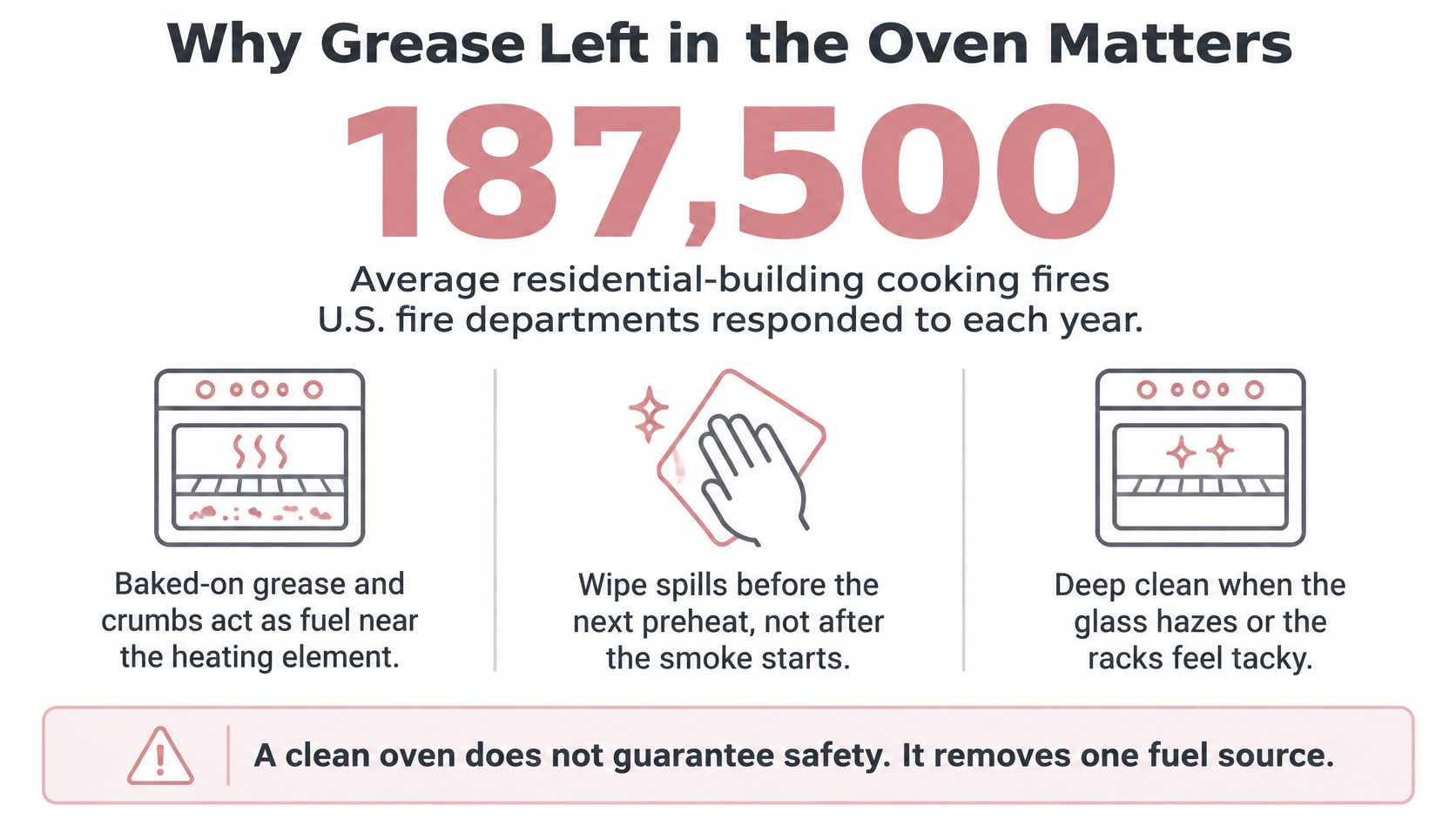
Those figures don't prove that one cleaning interval prevents one fire. Ovens generally show lower casualty and loss rates than many other cooking appliances. They do show why burnt fat and food shouldn't sit through the next high-heat meal.
Three actions follow from that, without promising a fire-proof kitchen.
- After a significant spill: Clean once the oven is cool, before the next preheat bakes the fat in place.
- Before a holiday roast or a self-clean cycle: Look inside. A pool of grease is fuel, not a shortcut.
- On an ordinary year: Keep the deep clean in the 3 to 6 month range for ordinary use, and follow the maker's safety steps.
Stay in the kitchen while food cooks at high heat. Don't use a self-clean cycle to burn off a pool of grease. If the film is already baked on, use a method made for that soil, such as the steps in this guide to removing baked-on oven grease, instead of hoping the next roast will cook it off.
A clean oven doesn't guarantee safety. It removes one fuel source you can actually see.
Set Your Next Oven Cleaning Date
Lock one date from the row you already chose. Don't average the rows.
- Match last month to light use, typical cooking, frequent baking, fatty roasting, nearly daily cooking, or a holiday surge.
- Check the door glass, the oven floor, and the racks for smoke on preheat, a burnt smell, sticky film, or black carbon.
- If the cavity is clear and use is light, set a spring date and an autumn date, and keep same-day cooled wipes.
- If smoke or a black film is already there, clean before the next roast. Don't wait for month three.
- If guests or a move-out has a date, deep-clean before that day. Clean again only if a spill burns on.
Write the date next to the other kitchen reminders, the same way a household keeps a busy-family cleaning schedule. A date you can see beats a plan you have to remember.
If you want the oven done with the rest of the house, add an interior oven clean to a housekeeping visit. Many of our customers book a deep clean before recurring service, during a seasonal clean, or before and after guests. Our additional services include refrigerator and oven interior cleaning, along with garage, basement, window, and move-in or move-out cleaning. We serve Kennesaw and North Atlanta, and you can request a free cleaning estimate.
Tonight, either write the calendar date from your row or ask for that estimate. A clear door and racks that slide are the proof the date was the right one.
Aquastar Cleaning Services, LLC cleans homes across Kennesaw and North Atlanta, and our oven-interior add-on fits the deep-clean date you just picked. Insured, bonded teams handle recurring housekeeping, one-time deep cleans, and move-in or move-out work, with eco-friendly products when you want them. Visit Aquastar Cleaning Services, LLC to request a free estimate and put the oven on the same visit as the rest of the kitchen.