



It's Saturday in a North Atlanta ranch, the rental carpet cleaner is by the door, and the sofa is in the garage. By bedtime, the hallway still feels cool and damp. DIY wins for fresh, small spills. Professional extraction is the better choice for whole rooms, returning odor, pet contamination, or a hard deadline. The right choice starts with what's in the carpet, not which machine costs less.
Why the Cheaper Clean Is Not Always the Right One
Say that ranch has about eighteen hundred square feet, and you've decided to clean every carpeted room before Monday. You collect the rental, shift furniture, and keep going over the hallway because it still looks gray. Now everyone has to step around damp flooring to reach the bedrooms.
A competent professional crew can handle a comparable job in a few hours, according to Easy Clean Carpet Care's cost comparison. With effective recovery and air movement, same-day use may be realistic, but it's not automatic.
Professional cleaning isn't automatically better, and DIY isn't automatically a compromise. A fresh coffee splash on a cushion-sized patch needs blotting, not a whole-house rental. Gray traffic lanes, a smell that returns after drying, or a Monday move-out walkthrough call for a different level of intervention.
Practical rule: Match the cleaning method to the depth and spread of the problem, not your determination to finish it yourself.
Keep five things separate: soil removed, cash paid, homeowner hours, wet-floor hours, and who lives in the house. A lower bill doesn't help much if your only route to the bathroom stays damp overnight.
For ongoing maintenance, use our guide to how often carpets should be cleaned. If you're dealing with substantial wetting rather than ordinary dirt, RestoTek TX's explanation of what drying and rebuild add helps distinguish a cleaning bill from a water-damage project.
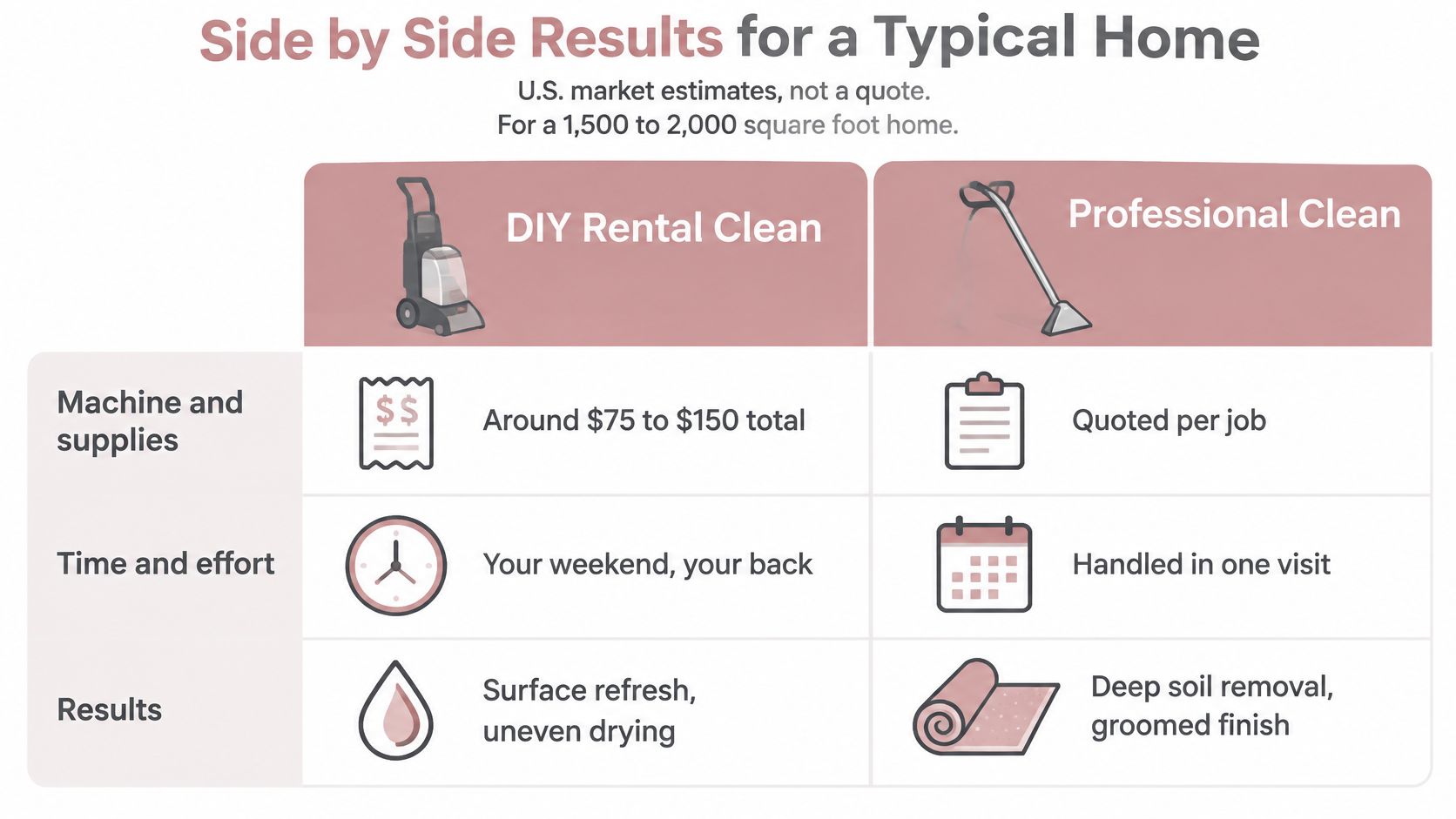
Side by Side Results for a Typical Home
| What you compare | DIY rental | Professional cleaning |
|---|---|---|
| Cash for an average home | About $75–$150 for 1,500–2,000 square feet, machine and solutions included | About $175–$300, before condition and add-ons |
| Published price check | About $40 a day at Home Depot in a 2024 Consumer Reports example | $403 in Kansas City to $701 in New York City in that same example |
| Time you spend | About 8–12 hours or a full weekend, including pickup and setup | A few hours of crew time |
| Soil or allergen removal | Often estimated around 50–70% | Often estimated around 90–95% |
| Drying under favorable conditions | About 12–24 hours | About 4–6 hours |
| Where it fits | Fresh spots and light interim cleaning | Whole-home soil, traffic lanes, pets, move-out |
These are U.S. market estimates, not a quote. The cost and homeowner-time ranges reflect the rental-versus-service estimates from Easy Clean Carpet Care cited above; they compare the entire DIY process with a crew visit, not equal amounts of homeowner labor.
The published price check comes from Consumer Reports' 2024 rent-or-hire comparison, which found a Home Depot rental near $40 per day and example professional prices from $403 in Kansas City to $701 in New York City. That spread is a useful warning against treating any national average as your local invoice.
The extraction and drying rows come from Loos & More's professional-versus-DIY comparison, which estimates 50–70% removal for DIY versus 90–95% for professional equipment, and 12–24 hours of drying versus 4–6 hours. Those are comparative industry estimates, not universal laboratory results or promises for your carpet.
What changes the price and result
The professional carpet cleaning vs DIY calculation changes when a room needs more than a general refresh. Professional pricing can reflect:
- Area and layout: Square footage, room count, and the extent of traffic lanes.
- Contamination: Pet odor treatment and difficult stain work.
- Optional work: Stain protection and agreed furniture handling.
- Location: Local labor rates and travel requirements.
DIY costs also rise when you buy extra spotters, keep the machine longer, or repeat a room. Your labor includes collection and return, vacuuming, pretreatment, furniture handling, cleaning passes, and checking whether the floor is dry.
Compare recovery, not just appearance
Consider a hypothetical sixteen-hundred-square-foot living area with a pair of dark walking paths. A rental might brighten both paths enough for photographs, yet weak recovery can leave soil or detergent behind. The lanes may look dirty again within days.
Equipment must fit both the surface and the workload. Material Handling USA's guide to scrubber sizing for large warehouses illustrates that equipment-selection principle in a different setting, although warehouse scrubbers aren't carpet-cleaning machines.
For residential carpets, understand the method before comparing labels. Our carpet cleaning versus steam cleaning guide helps clarify terminology so you can compare the proposed work rather than the name on the package.
Soil Removal and What the Machine Must Recover
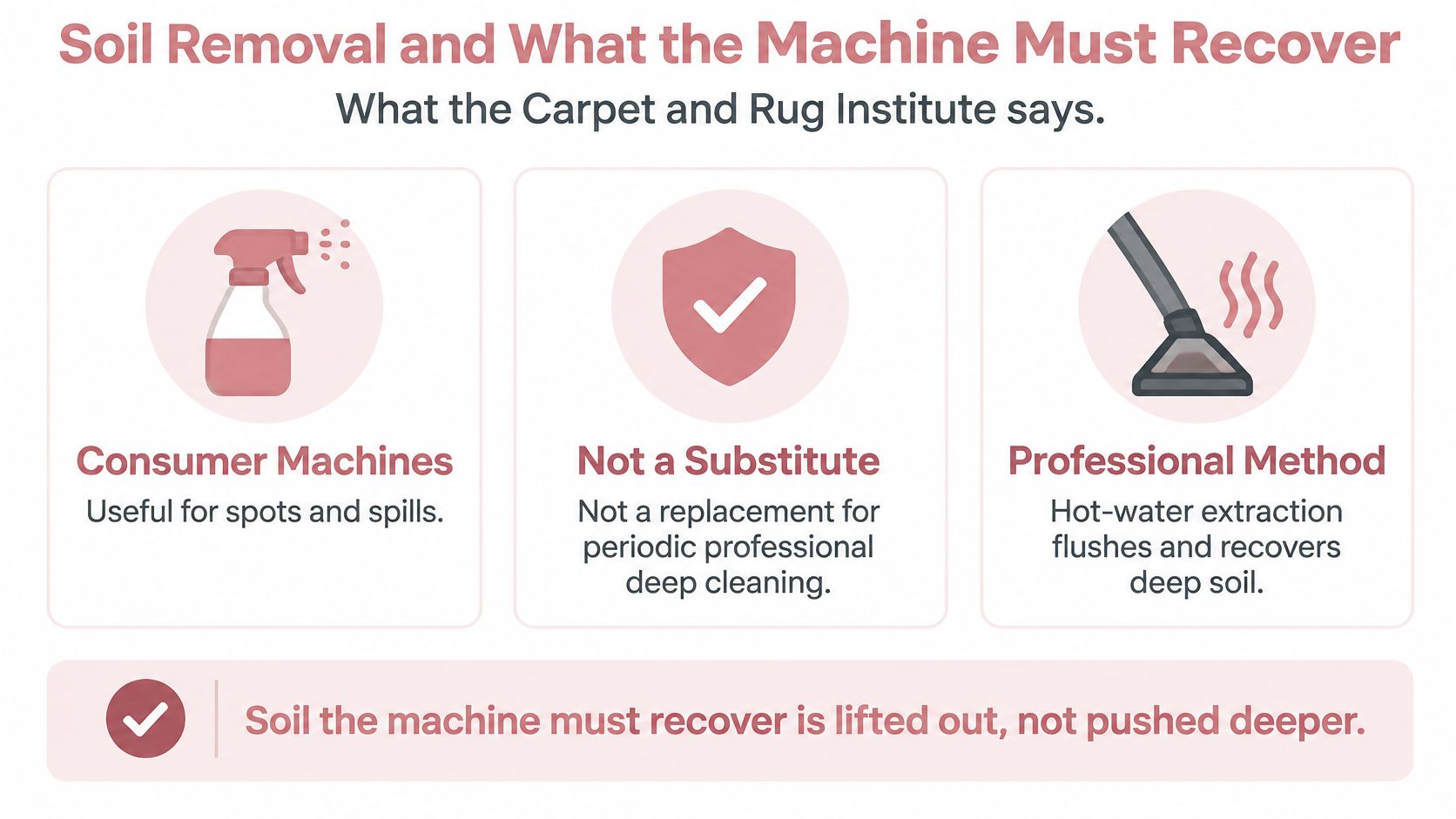
A clean-looking surface isn't proof that the machine recovered the soil. Hot-water extraction applies heated cleaning solution and then removes it through suction. The recovery step has to carry out loosened dirt, cleaning agents, and moisture, not just redistribute them.
The Carpet and Rug Institute's residential cleaning standard treats consumer machines as useful for spots and spills, not replacements for periodic professional cleaning, and describes extractor soil-removal bands of 55–69% Bronze, 70–79% Silver, 80–89% Gold, and 90–100% Platinum, alongside a residual-moisture benchmark of no more than 8 ounces per square yard.
| Rating or check | Result required |
|---|---|
| Bronze extractor | 55–69% soil removal |
| Silver extractor | 70–79% soil removal |
| Gold extractor | 80–89% soil removal |
| Platinum extractor | 90–100% soil removal |
| Residual moisture benchmark | No more than 8 ounces of water per square yard |
Clean the hallway in the right order
Start with thorough dry vacuuming. Otherwise, you're adding water to loose grit before removing the material a vacuum could have collected easily.
Apply a correctly diluted prespray, then agitate with a fiber-appropriate tool. Give the treatment its specified working time without letting it dry on the carpet. Extraction follows, with deliberate recovery rather than repeated soaking.
For wand systems, the CRI cleaning and testing guidance supports one wet pass and two dry passes and warns against excessive detergent concentration. Extra detergent can leave a soil-attracting residue, so a carpet that looks good on Sunday can appear gray again by Friday.
Don't solve weak recovery with more solution
Consider a rental user cleaning dense Berber. The face yarns brighten, but a dark lane remains, so the homeowner adds more solution and skips the recovery passes to finish faster. The surface looks improved while the backing stays wet.
That's a process failure, not a reason to add stronger chemistry. Stop adding liquid when the equipment isn't recovering what you've already applied.
A useful extractor removes the cleaning solution along with the dirt. It doesn't earn credit just for making the carpet wetter.
Follow the carpet manufacturer's approved method, especially with wool, dense pile, or moisture-sensitive backing. If you don't know the fiber, identify it before selecting chemistry or aggressive agitation.
Our guide to deep cleaning carpet provides context for planning more substantial work. Use the CRI ratings to evaluate equipment quality, but remember that they're laboratory classes, not guaranteed removal percentages for every living room.
How Long the Carpet Must Stay Off Limits
Can the children, the dog, and the sofa come back before bedtime? That's often the most important question in a family home. A cleaning plan that ignores room access isn't finished.
Say you shampoo a plush living room on a humid July afternoon in metro Atlanta, then turn off the air conditioner to save money. The room becomes muggy, the pile stays cool, and the family ends up avoiding it overnight.
The EPA's indoor-air-quality guidance advises extracting saturated carpet and drying it within 24 hours, keeping relative humidity below 60%, ideally between 30% and 50%, and avoiding HVAC shutdown during or soon after water-intensive cleaning. Those are moisture-control recommendations, not permission to leave an ordinary cleaning job unnecessarily wet.
Check the room, not just the clock
- Keep cooling or dehumidification operating. Don't close a wet room and assume the water will disappear.
- Direct fans across the pile. Move air along the carpet surface, including corners and the space near furniture.
- Check below the face yarns where safely accessible. At an already accessible edge, feel the backing. Don't pull installed carpet off tack strips or reach toward exposed fasteners.
- Keep pets and bare feet off while it remains damp. Don't replace the sofa just because the carpet's color looks even.
Substantial wetting needs extra attention. The EPA's building-maintenance guidance identifies 48 hours as a key drying limit for heavily wetted porous materials; that isn't a routine carpet-cleaning target or a reason to postpone help.
Know when cleaning has become a drying problem
Professional crews can reduce retained moisture through stronger recovery, controlled room-by-room work, and air movers when appropriate. But fiber, padding, humidity, and technician technique still affect the result. Nobody should promise the same dry time for every house.
If liquid has soaked into padding, AMPM Restoration Services' Florida flood carpet drying guide helps distinguish surface drying from deeper water removal. Floodwater is a different problem from cleaning solution, and contaminated water requires restoration guidance rather than a household shampooer.
Access test: If your household can't spare a full day of closed-off rooms, don't choose a rental solely because its checkout price is lower.
For a home with asthma, plan occupant access as carefully as drying. Avoid placing a sensitive family member in the room during aggressive vacuuming or agitation, and arrange a clean, separate place for them to spend that time.
How to Treat a Fresh Spill Without Soaking the Pad
Use this routine for a fresh, localized spill on a known, water-cleanable synthetic carpet, such as coffee on nylon. If the liquid has already spread widely, reached the padding, or affected an unidentified fiber, stop at blotting and arrange an assessment.
A spot treatment should remove a small problem without creating a larger wet area. Gather clean white towels, a manufacturer-approved carpet spotter, a soft brush, and a fan before you begin.
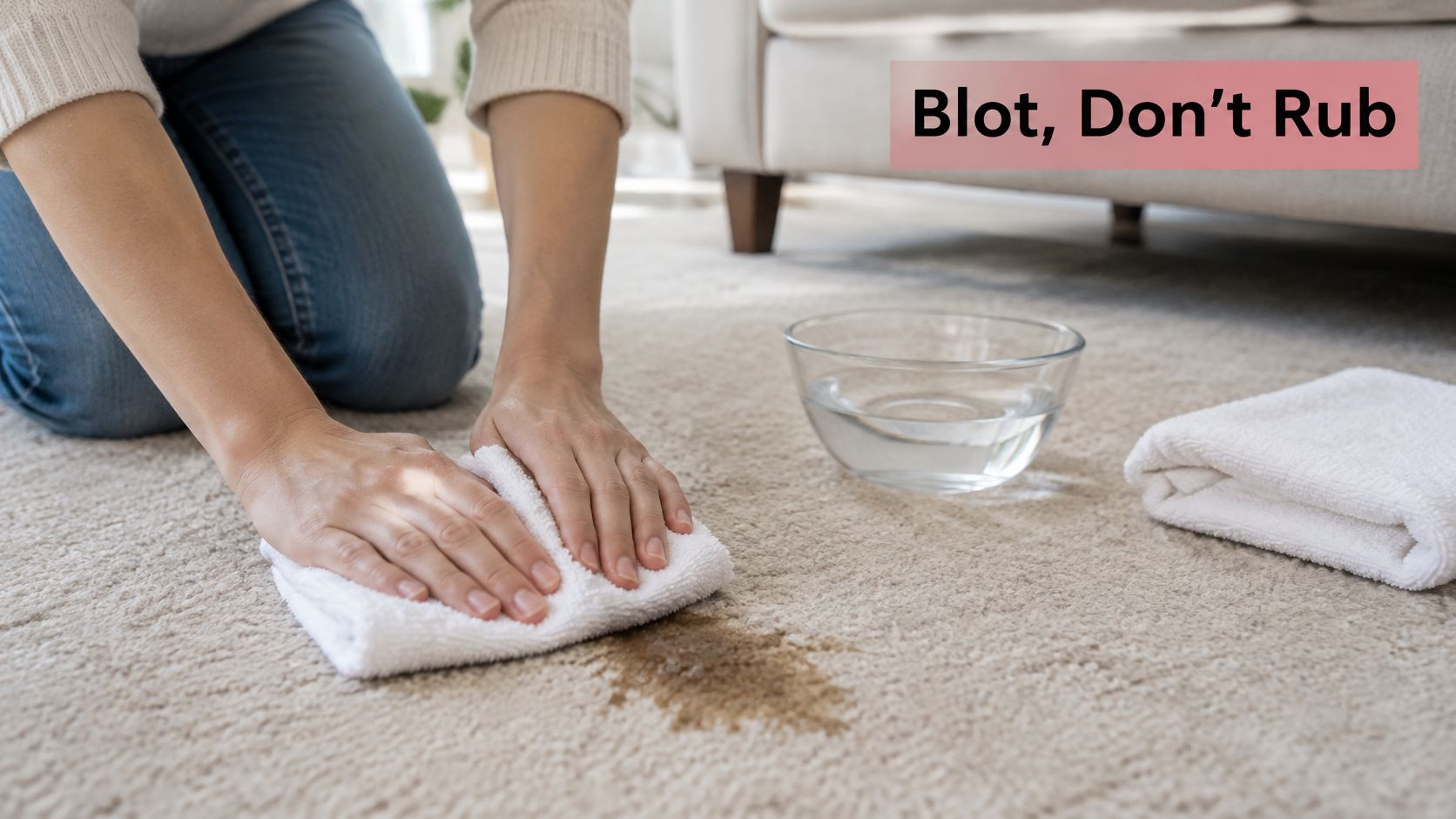
Follow the seven-step spot routine
- Blot with white towels. Press instead of rubbing. Replace the towel as coffee transfers so you aren't putting it back into the yarn.
- Lift solids carefully, then vacuum dry grit around the spot with a well-filtered vacuum. Don't run an ordinary dry vacuum over liquid.
- Prepare the approved spotter at its labeled dilution. Test a concealed edge first. Stop if color transfers from the carpet or the texture changes.
- Apply a little solution to a towel or the affected yarn, not a soaking pour. Gently work with a soft brush or the back of a spoon, then blot.
- Rinse sparingly with clean water. Blot repeatedly until the towel comes away nearly clear. Don't flood the area to chase the last trace.
- Place dry towels over the spot and weight them with a clean, moisture-safe object. Run a fan across the area and keep cooling or dehumidification operating if the room feels muggy.
- Check the backing where it's safely accessible. If it remains wet, stop adding liquid and get help with recovery.
Set a stopping point before you start
Treat a couple of careful attempts as your limit, not an invitation to keep changing chemicals. If color or smell remains, the area spreads beyond a place mat, urine has soaked through, or the pile is wool, stop wet treatment.
Say a renter pours a kettle of water onto red wine. Instead of lifting a small stain, they carry diluted wine into the padding and enlarge the later extraction job. More rinse water isn't always more cleaning.
For vomit-related odor, our guide to eliminating vomit smell from carpet helps identify the next steps, but don't treat contamination as ordinary dust.
Our cleaners don't handle biohazards such as mold, blood, or animal waste, move furniture heavier than 25 lbs, or climb ladders higher than 3 feet. Don't drag a heavy sofa alone to reach a stain. Stop and arrange suitable help rather than adding an injury to the cleaning problem.
Match the Method to the Carpet Problem and Book the Right Path
Use the smallest method that can reach the soil. A child's juice spill caught while it's still in the yarn needs towels and a suitable spotter, not a machine. A stale pet smell that returns in a humid bedroom needs an assessment of what's beneath the surface, not another fragrance.
| What you see | Choose | Why |
|---|---|---|
| Fresh spill still sitting in the yarn | DIY blot and spot treat | Catching it promptly can prevent it reaching the pad |
| Light soil between scheduled deep cleans | Vacuum, or a small DIY spot clean | Consumer machines serve interim spots, not the periodic deep clean |
| Gray traffic lanes across a room | Professional hot-water extraction | Embedded soil needs agitation plus strong recovery |
| Pet odor that returns after the carpet looks dry | Professional assessment | Contamination may be in the padding |
| Whole-room cleaning with asthma, allergies, or an infant at home | Professional, with ventilation planned | Agitation can stir particles even while removing soil |
| Move-out, listing, or inspection on a deadline | Professional | A planned finish and shorter expected dry window |
| Humid day and thick pad | Professional with a drying plan | Retained water is the main risk |
| Unknown debris after renovation | Stop and get specialized guidance | This isn't a routine carpet-soil job |
Apply the rule to the people in the room
A small, fresh pet accident that's promptly absorbed and leaves no continuing odor may be manageable with careful owner-applied treatment appropriate to the carpet. That doesn't mean household cleaners should handle animal waste. Disclose the contamination before arranging service.
If the smell returns later, stop treating the surface as the whole problem. Padding contamination may require work beyond ordinary carpet cleaning, and extraction alone shouldn't be sold as a guaranteed cure.
For sensitive occupants, cleaner-looking carpet isn't the only outcome that matters. The National Center for Healthy Housing's carpets fact sheet explains that cleaning can reduce contaminants while vacuuming and mechanical agitation can temporarily increase airborne coarse particles. Keep an infant or someone with asthma away from active cleaning, and plan ventilation and their return before work begins.
Unknown renovation debris needs a different response. An EPA evaluation of contaminated carpet cleaning demonstrates why suspect hazardous material shouldn't be aggressively vacuumed or casually wet-cleaned. Stop, identify the material, and seek specialized guidance before anyone runs a beater bar through it.
Bring a usable description to the booking call
We can plan more effectively when you describe the carpet rather than requesting a deep clean. Have the following ready:
- Carpet and padding: Fiber type, if known, and whether liquid reached beneath the surface.
- Room scope: Rooms, approximate dimensions, stairs, and visible walking paths.
- Household needs: Children, pets, respiratory sensitivities, and rooms that must remain accessible.
- Previous attempts: Products used, stains that returned, and any sticky or crunchy areas.
- Access deadline: The actual hour someone needs to walk on the floor, not just the date of an inspection.
Ask which method is proposed, what drying range is realistic in humid weather, and how furniture handling affects the scope. Our team is professional, trained, and insured, and we provide free cleaning estimates. Furniture limits still apply, so disclose heavy items before the appointment.
Use our carpet-cleaning preparation guide to organize access and belongings. Don't spend your preparation time soaking a difficult stain immediately before the cleaner arrives.
A 2025 ServiceMonster survey summarized by Sigmadax found that 35% of respondents considered professional-grade results compared with DIY when choosing a carpet-cleaning company. For your home, define those results concretely: the stain addressed, the odor assessed, and a realistic plan for using the room again.
Photograph the spot and note when it happened. Then choose your next action: blot a suitable fresh spill today, or request an estimate before another humid weekend turns into a damp-floor project.
Aquastar Cleaning Services, LLC offers carpet cleaning and driveway pressure washing, with a professional, trained, and insured team. For room-wide soil, returning stains, or a cleaning deadline, visit Aquastar Cleaning Services, LLC to request a free estimate and describe the carpet, the problem, and when you need the floor back.